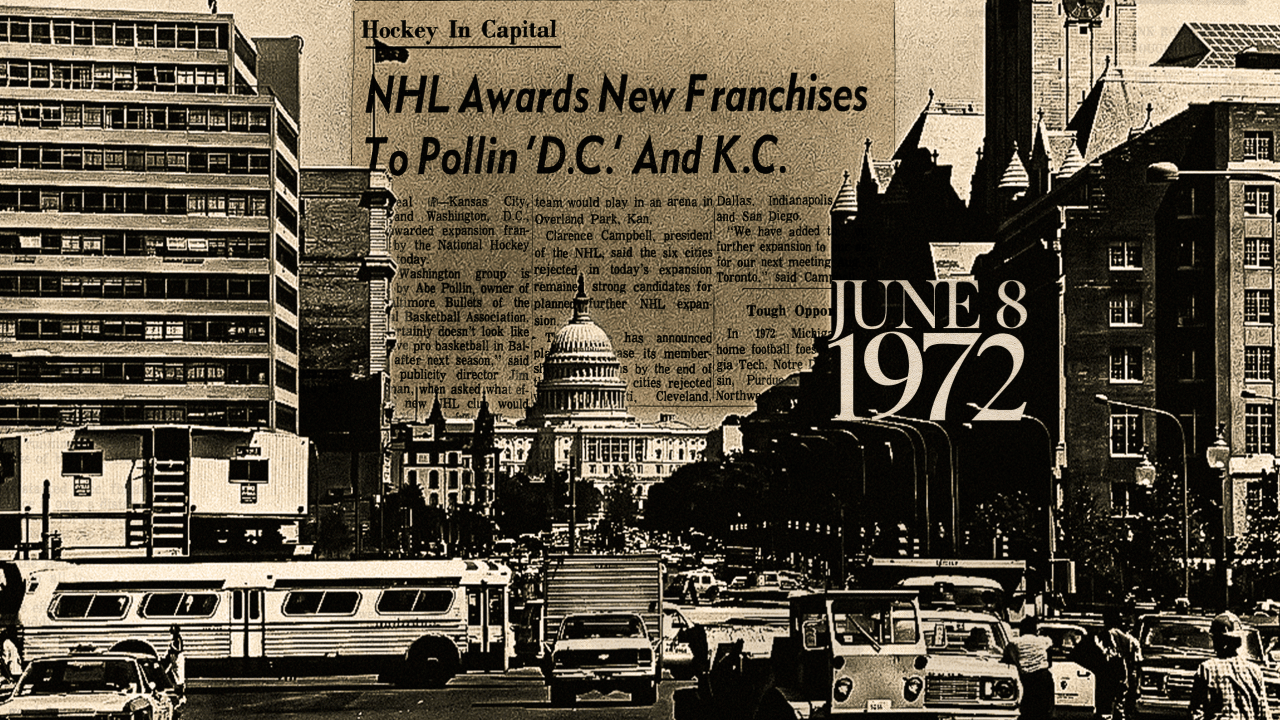
Although the team’s official 50th anniversary is still a couple years ahead on the horizon, today is the day we celebrate the actual 50th birthday of NHL hockey in the District. It was 50 years ago today – on June 8, 1972 – that Washington’s NHL hockey life began in a hotel in Montreal when the city was granted its NHL franchise following weeks of intense lobbying from Abe Pollin, who was the owner of the NBA’s Baltimore Bullets (now the Washington Wizards) in those days.
Although the odds seemed significantly stacked against Pollin in that drastically different pro sports climate of the late spring of ’72, the Caps’ original owner was able to persevere and to persuade, with an emphasis on the latter. Looking back at it now, it’s quite remarkable that Pollin was able to pull off Washington’s admission to the NHL fifty years ago today.
Pull up a chair, and we’ll tell you how it all went down.
Along with partners Earl Foreman and Arnold Heft, Pollin purchased the Bullets (née Chicago Packers) on Oct. 24, 1964. The Bullets had just started their fourth NBA season and their second in Baltimore, where they played their home games at Baltimore Civic Center, which opened in October of 1962. The Civic Center had a seating capacity of 12,289 for basketball.
In missing the playoffs for a seventh straight season at the outset of their NBA existence, the Bullets drew an average of just 4,754 fans for 36 home dates in Charm City in 1967-68. That figure ballooned to 7,635 – just over 62 percent of capacity – for 38 home dates in ’68-69, but that was the attendance peak of the Baltimore years. Patronage then slipped back to roughly half of the arena’s capacity even as the team was averaging 48 wins a season over its next five campaigns in Baltimore.
In July of 1968, Pollin bought out his partners and took ownership of the Bullets outright. After the team drafted dynamic guard Earl “The Pearl” Monroe with the second overall pick in the 1967 NBA Draft and landed star center Wes Unseld in the same slot in the 1968 Draft, a run of a dozen straight playoff appearances followed from ’68-69 through 1979-80, leading to the team’s only NBA championship in 1978.
Born in Philadelphia, Pollin moved to the District as a young boy and was raised and schooled in the city. He had a great deal of pride in the city and the family business was construction, so he hatched a dream of building a new venue for his Bullets closer to his D.C. home.
In order to secure the loans needed for his arena project, Pollin was also in need of a second tenant for the building. The Bullets would only occupy the venue for 41 nights each year, so Pollin – who had never seen a hockey game at that point of his life – set to the task of convincing the NHL’s board of governors that Washington deserved an NHL expansion franchise.
It was a fortuitous time to be undertaking that task.
From 1942-43 through 1966-67, the NHL had been a six-team circuit in which no franchises failed or folded, and none moved to other locations either. This was in sharp contrast to the franchise expansion and nomadism seen in the other major pro sports during that time period. But with other pro sports leagues growing rapidly in size and scope with the advent of commercial air travel, the NHL finally followed suit in 1967-68, doubling instantly in size to a dozen teams. Two years later, Buffalo and Vancouver joined the League, expanding its ranks to 14 teams.
On November 8, 1971, NHL president Clarence Campbell announced the League’s intention to expand its ranks to 24 teams by the end of the 1970s, a goal that would require the League to accelerate its already swift pace of expansion even further. This proclamation came on the same day that Atlanta and Long Island franchises were granted entry as the League’s 15th and 16th teams, scheduled to start play less than a year from that date. Campbell’s announcement came a week after the upstart World Hockey Association announced its 10 inaugural franchises for its first season of play in 1972-73.
When the NHL announced plans to add Atlanta and Long Island in November of 1971, it sparked a lawsuit from Long Island lawyer Neil Shayne, who had been granted a WHA franchise to play at Nassau Coliseum in Uniondale, NY, which was still under construction at the time.
“The purpose of the NHL expansion is to keep us out of the Coliseum,” Shayne was quoted as saying in the Nov. 10, 1971 edition of The Montreal Star. “I intend to pursue vigorously whatever remedies are available to me under United States anti-trust laws.”
The nascent league also announced its intent to put teams in Calgary, Chicago, Dayton, Edmonton, Los Angeles, Miami, St. Paul, San Francisco and Winnipeg.
According to the piece in The Star, Campbell claimed that the NHL had received expansion feelers from groups in Baltimore, Cleveland, Kansas City, Indianapolis, San Diego, Seattle-Portland, Denver and Columbia City, a new community near Washington, D.C., where Pollin initially thought of building the new arena. Given Campbell’s stated intention to make the NHL a 24-team league by decade’s end, even adding two new teams every other season wouldn’t get the League to that objective until 1980-81.
In the tiniest of nutshells, that was the state of the NHL and the WHA in the early 1970s. Locally, the sporting landscape was dire. Aside from Washington’s longstanding NFL franchise, there were no other major pro sports franchises in the District at the time.
Less than a year earlier, Major League Baseball’s Washington Senators had pulled up stakes and moved to Arlington, Tx., where they would continue existence as the Texas Rangers. That incarnation of the Senators was the second to depart the District in less than a decade; the original Washington Senators moved west to become the Minnesota Twins in 1961. Those original Senators were replaced by an expansion team with the same name in ’61, the team that ultimately split for Texas after the 1971 season.
The NBA hadn’t been in D.C. since the 1950s, but the renegade American Basketball Association briefly had a team in the District after Earl Foreman suddenly bought and abruptly moved the Oakland Oaks here, just ahead of the start of the 1969-70 season. Renamed the Washington Caps, the team played just that ’69-70 season in D.C. The Caps played their home games at Washington Coliseum – formerly known as Uline Arena – but attendance was weak. After their lone season in the District, the Caps bounced in a southerly direction once more, becoming the Virginia Squires.
The state of pro hockey in the District was even worse in those days. In 1973-74 – the season prior to the Capitals’ entry into the NHL – there were five different minor professional leagues with NHL affiliations scattered around North America: the American Hockey League, Central Hockey League, International Hockey League, North American Hockey League and the Southern Hockey League. Each of those latter two leagues was conducting its first season in ’73-74; both rose from the ashes of the newly defunct Eastern League, which shuttered after the ’72-73 season, the end of a four-decade run.
In addition to the 16 teams in the NHL and the dozen operating in the WHA, those five minor pro leagues had a total of 40 teams among them, for a total of 68 professional hockey teams in operation, none of which was headquartered in Washington. Not only that, pro hockey hadn’t had a home in the District since the aforementioned Eastern League’s Washington Presidents moved to south Jersey to become the Jersey Larks following the 1959-60 season.
Ray Miron was the general manager of the Presidents in their final season in D.C. The Presidents missed the playoffs and moved on to Jersey, where Miron discussed some of his woes in Washington upon arriving in his team’s new home in Haddonfield, N.J.
“The people in Washington all want to get something for nothing,” beefed Miron to Frank Dolson in the Aug. 17, 1960 edition of The Philadelphia Inquirer. “You only get crowds if you give the tickets away. They used to get big crowds there in the ’40s, but they had to paper the house to get them. And once people are used to going someplace for nothing, well, it’s hard to break them of the habit.”
Miron wasn’t finished.
“We wanted to move the team out of Washington when we got it,” Miron continued, “but the league wouldn’t let us. Philadelphia had a vote then, and they didn’t want us to come here. When they went bankrupt they lost their vote – and here we are.
“We did $69,000 worth of business in Washington last season. Philadelphia did something like $109,000. Yet they threw in the sponge and we kept going. Still, how do you go on competing with a team that takes in $40,000 more than you do?”
After playing the 1960-61 season in Haddonfield as the Jersey Larks, Miron and the team moved once again, this time to Tennessee where they became the Knoxville Knights.
Following the departure of the Presidents from the District in the spring of 1960, D.C. was without pro hockey for more than a decade, and this was at a time when the game was spreading far and wide, with multiple major and minor leagues in operation once the WHA began play in the fall of 1972. Pollin’s task was to convince the NHL and its franchise owners that Washington deserved an NHL franchise more than the other applicants, despite hockey’s long lack of success – albeit at the minor league level – in the city.