
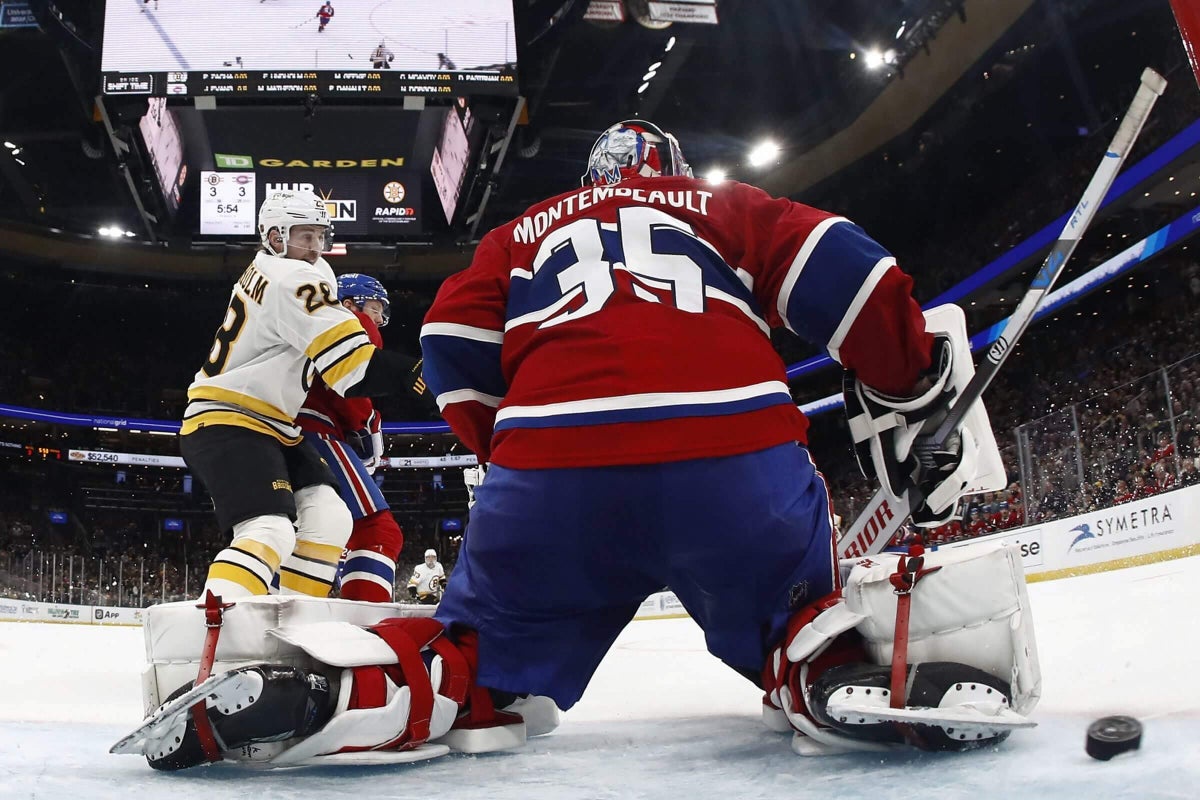
Sam Montembeault definitely needed to stop at least one, if not both, of the goals that sunk the Montreal Canadiens in the third period of their 4-3 loss to the Boston Bruins at TD Garden on Saturday night.
Fraser Minten’s backhand from the slot was a stoppable shot, Morgan Geekie’s one-timer from the top of the circle — despite tipping off Jake Evans far from the net — was a stoppable shot.
Sheeeeeeesh 😮💨 pic.twitter.com/v2Vdvna6aL
— Boston Bruins (@NHLBruins) January 25, 2026
Yet the only reason the Canadiens were ahead 3-2 after two periods was the play of Montembeault. In the second half of the second period alone, Montembeault got across to make a pad save off Pavel Zacha at the back post off a blown coverage, gloved a David Pastrňák shot from the slot and poke-checked away a point-blank chance for Charlie McAvoy right off the ensuing faceoff — which did not even register as a shot attempt on the official play-by-play.
Later in the same shift, there was a loose puck in the Canadiens zone. McAvoy gave chase, as did Noah Dobson and Cole Caufield. Not only did McAvoy get the puck, he was even able to send it out in front to Elias Lindholm, who had beaten Nick Suzuki to that spot in front of the net. Suzuki, in desperation, was able to get his stick on Lindholm’s shot and force it wide. But McAvoy coming out of the corner with the puck making a play was indicative of the Canadiens’ play in that period.
The Canadiens escaped the period despite themselves, allowing odd-man rushes because forwards failed to compensate for their pinching defencemen — also an issue in the first period against the Buffalo Sabres on Thursday — and stretch passes that caught them by surprise, as was also the case on the Minten’s tying goal.
There is no doubt Montembeault has to take his share of blame for the loss, as well as the loss to the Sabres, who got out to a 3-0 lead in the early minutes of the second period. It would have been nice if the Canadiens did not shield Montembeault from reporters in Boston on Saturday to at least give him the opportunity to take that responsibility.
But to ignore what Montembeault did over the first 54 minutes of the game also seems to be ignoring a big part of the story. The equivalent would be to blame the Canadiens’ power play for the loss.
At 8:14 of the third period, with the Canadiens still leading 3-2, Bruins defenceman Andrew Peeke took a retaliation penalty on Brendan Gallagher. The Canadiens had a chance to extend their lead to two goals, but they generated a single shot on goal. They didn’t really threaten at all.
But to blame the power play for the loss would be ridiculous. The Canadiens went two-for-three, with Cole Caufield scoring twice from his office just above the goal line in the second period.
And yet, Montembeault’s inability to make the saves he needed to make in the third period erased everything he had done over the first 54 minutes of the game.
Montembeault deserves his fair share of the blame. He was in goal for every second of the Canadiens’ first consecutive regulation losses since Dec. 7 and 9.
But it needs to be a fair share.
The Demidov and Slafkovský combo
Ivan Demidov has played 52 games in his rookie NHL season and had 43 points, two up on Beckett Sennecke of the Anaheim Ducks for the rookie scoring lead. His 32 assists alone would have Demidov fourth in rookie scoring, and he’s tied for 26th in the NHL in that category.
Among players who have played at least 40 games this season, Demidov’s 2.8 points per 60 minutes of ice time at five-on-five ranks first on the Canadiens by a wide margin and is eighth in the NHL.
A big reason for that is the efficiency and unpredictability of Demidov’s decision-making with the puck, which comes from his ability to take in an abnormal amount of information, process it at an abnormal speed and use his skill to execute.
Martin St. Louis loves to talk about a player’s computer. Demidov has a super computer.
“There’s players that see certain things,” St. Louis said. “Like Demi, he understands the game that’s in front of him, but he also knows the game that’s behind him. … It’s constantly gathering information knowing where everybody is, not just his teammates, but the opponents. Because then he’ll know sometimes that the good ice is behind him. But you have to be aware of that. So how do you get that good ice behind you? Well, you might have to sell something forward to go behind you again.
“So to me, he’s got an elite offensive computer and the skills to do what his brain is actually processing.”
Demidov’s linemate, Juraj Slafkovský, sees the same thing as his coach.
Slafkovský’s emergence in this, his fourth season, has come from the NHL game slowing down for him. He entered this season with 200 games under his belt.
“He’s a different type of player,” Slafkovský said of Demidov. “I feel like for players like him, maybe the game slows down a little earlier. It’s great to see it’s after, what, 50 games played? It’s beautiful and it will only help us.”
But Slafkovský has also learned something about how to be effective in the NHL. He has fully grasped the ability to use his reach to its full potential. His ability to not only put pucks in areas opposing defenders can’t reach it, but make plays with the puck that far away from his own body has been a game changer for him.
Since Nov. 28, Slafkovský has 31 points in 30 games, and he is only now starting to really produce.
When Slafkovský takes the puck wide, he now naturally carries it as far away from his body as he can, shielding it from the defender. We asked Slafkovský last week about a play he made against the Ottawa Senators on Jan. 17, one where he entered the zone on the left side, shielded the puck to his left with Artem Zub closing on him — all 6-foot-3 of him — and whipped a pass to the back post for Demidov, whose tap in was stopped by Senators goalie Leevi Meriläinen.
“For a big guy with a long reach, you just have to get comfortable with it. Just try it a couple of times,” Slafkovský said. “Obviously you’re not going to make the best play every time, but keep doing it.”
Using your reach is not an easy thing to fully grasp. Protecting the puck that way is important, but having the ability to make plays from a wide variety of angles with an opposing defender trying to get at the puck is on another level.
“I feel like it’s a lot of just watching other big guys in the league, how they position themselves, where they put the puck when defencemen are coming at them and just try to bring that to my game,” Slafkovský said. “There’s a lot of people I can learn from, even some smaller guys, like (Nick Suzuki). Suzy does it really well even though he’s not the biggest guy, he always puts the puck in a good spot.”
As the conversation flowed back to Demidov’s vision, Slafkovský’s sense of humour and, more importantly, self-esteem came to the forefront.
“It’s crazy,” he said. “Often he just skates with the puck and he’s looking one way, but he just sees you open somewhere else. I think that’s great, because he’s selling one play and he’s making the other play.
“And that’s something not many people can do, and when you have two guys like that on the same line, that’s great.”
Slafkovský smiled. He was right, Demidov does it with his vision and deception. Slafkovský does it with his reach and his enhanced understanding of how to use his size to his advantage. Both cases are examples of creating plays that otherwise wouldn’t be there, of changing angles to your advantage.
They are both making the most of their natural gifts.
Hot tub lineup machine
Before last Tuesday’s game against the Wild, Jayden Struble revealed how he found out he was in the lineup that night and Arber Xhekaj was not.
“I was actually in the hot tub with Arbs, and Slaf comes in and goes, ‘you’re playing, Arbs you’re out,’” Struble said.
There is a group of Canadiens players who do a hot tub before hitting the ice for the morning skate, and what happened before the Wild game is apparently a regular occurrence. Slafkovský announces the lineup changes to the group, and he does it in the hot tub.
“More or less,” Struble said. “If there’s any changes, it’ll be Slaf coming in the hot tub.”
This was confirmed by Xhekaj.
“We always do a morning hot tub, a bunch of us,” he said. “But Slaf usually on game days, he’ll tell us who’s playing. So today he told me I had the night off.”
As Struble finished telling us this, he was told the information would be shared on the TSN broadcast that night. When we asked Xhekaj if it was wrong that we found this funny, he said no. Neither of them told us not to share it.
Yet as we finished our interview with Slafkovský the next day, he took exception with the broadcasting of his hot tub ritual.
“Don’t expose my hot tub sessions with the boys, OK?” he said as he walked away.
Again, he was smiling. But we stand by our decision to report something that is legitimately funny. Which is why we’re doubling down on it here.