
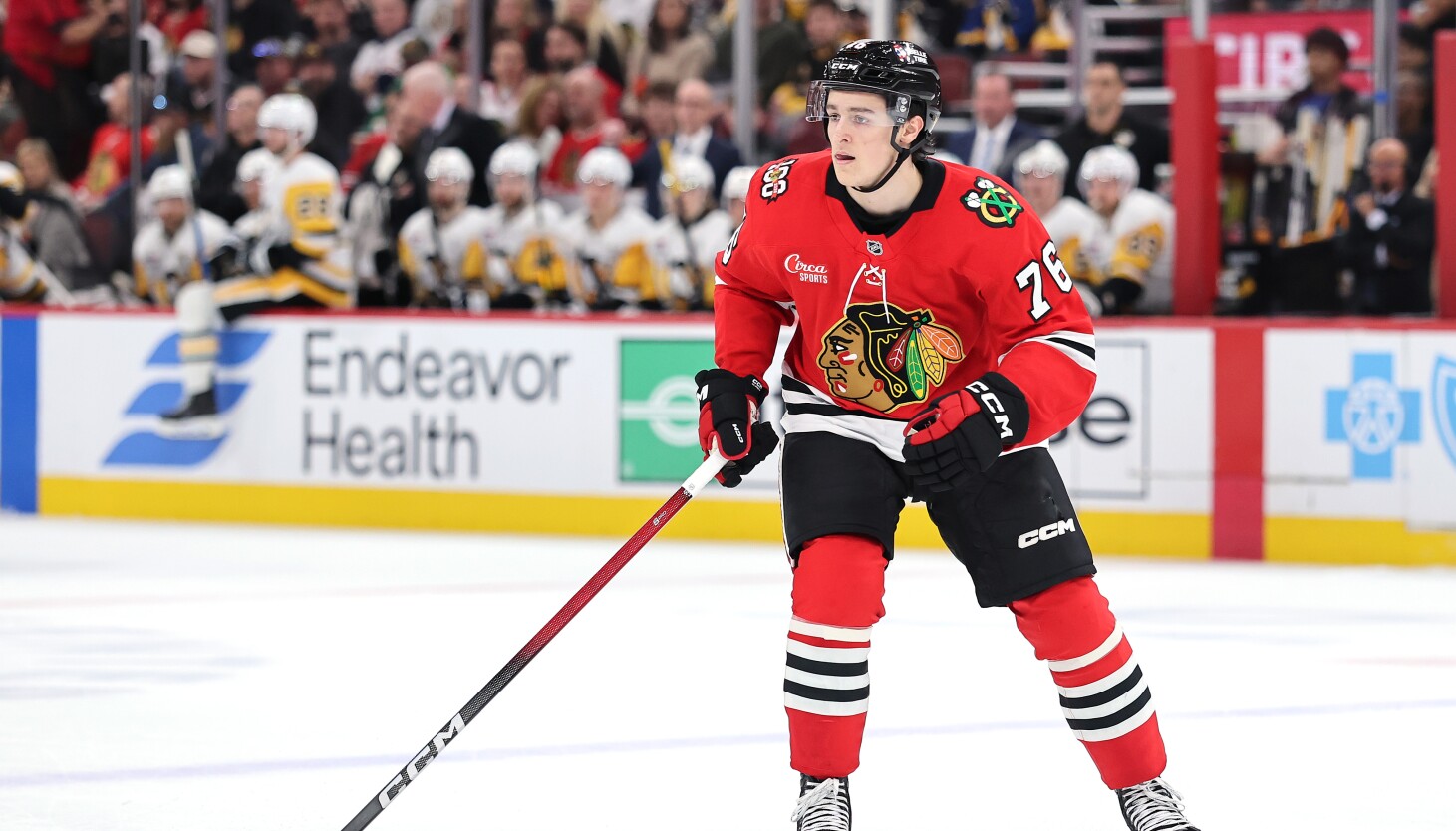
With five games left until the Olympic break, Monday marked a reset day for the Blackhawks, who know they need to produce more offense moving forward.
Teuvo Teravainen returned from injury, Nick Lardis was sent down to Rockford and coach Jeff Blashill deployed new lines that he hopes to stick with longer than his previous sets.
With Teravainen expected to play Tuesday at the Wild after missing six games due to an upper-body injury, the Hawks are totally injury-free for the first time all season, which created a surplus of forwards that necessitated Lardis’ reassignment.
Lardis, 20, tallied five goals and two assists in the first 21 games of his NHL career. He also went 2-for-5 in shootout attempts. He spent enough time on the roster to settle into a rhythm, rekindle his chemistry with Oliver Moore and demonstrate his poise under pressure.
But he averaged only 12:39 of ice time per game in a fluctuating role — especially since the return of Connor Bedard, whose injury initially prompted Lardis to be called up from the AHL earlier than planned.
For Rockford, which has struggled mightily as a team since his departure, Lardis will average close to 20 minutes per game in a starring role and get more time to build up physical strength. He can keep playing through the Olympic break, too.
“Early on, [he was] probably trying to find his way a little bit,” Blashill said Monday. “I thought he got more confident. So he’s done a good job of making a first impression to the coaching staff.”
Hawks general manager Kyle Davidson needs to learn a lesson himself from Lukas Reichel, who was probably moved up and down between Chicago and Rockford too often during his first couple pro years. Reichel’s eventual flameout can be blamed on many factors, but that’s one of them.
That mistake shouldn’t be repeated with Lardis. The next time he comes up, it needs to be permanent. But getting one temporary taste of the NHL seems reasonable enough.
Meanwhile, Bedard and Frank Nazar were put together on the Hawks’ first line Monday next to Teravainen, and struggling Andre Burakovsky slid down to the third line alongside Oliver Moore (who was wisely slotted back at center) and Ryan Greene.
Blackhawks lines in practice with 15 healthy forwards:
Nazar-Bedard-Teravainen
Bertuzzi-Dickinson-Mikheyev
Greene-Moore-Burakovsky
Donato-Foligno-Slaggert
Dach-Lafferty-Lardis
Vlasic-Crevier
Kaiser-Levshunov
Grzelcyk-Murphy
— Ben Pope (@BenPopeCST) January 26, 2026
Blashill maintained remarkable consistency in the Hawks’ forward lines during the season’s first half. Their recent scoring drought — just 13 goals in their last nine games, excluding empty-netters — brought out his line blender. He’s putting that blender back in the cupboard now.
Bedard’s faceoffs ban will continue at least until the Olympic break, so he needs a center on his wing no matter what. But this marks the first time Blashill has seriously explored the “nuclear option” of uniting Bedard and Nazar, the team’s two most dynamic forwards.
They’ve spent just 22 minutes together during five-on-five play this season, during which the Hawks have been alarmingly outscored 3-0 and outshot 18-8. But they’ll easily double that sample size this week alone against the Wild, Penguins and Blue Jackets.
“What you hope, when you put lines together, is the sum is greater than the parts,” Blashill said. “So can they be exponentially better? We hope so. The one thing I’ve got to do is give it some runway…[and] just stay with it through the next three games.”
Burakovsky has drawn fans’ ire with a bunch of turnovers and miscues lately, and those have finally resulted in a demotion for the puck-carrying veteran.
Blashill described Burakovsky as someone who tries too hard when things start going poorly, which only makes them worse. They’ve had conversations about two points of emphasis: finding the right balance of “when to make a play and when to live another day,” and slowing down enough to avoid “skating himself out of the pocket of when to get a puck.”
Mental processing
Consistency and chemistry in forward lines is important because it helps the Hawks develop predictability, which they felt like they had established during Bedard’s absence and which — for whatever reason — has eluded them since his return.
“We’re fast not only because we can skate fast,” Jason Dickinson said Sunday, “but [also] because we can play fast together when we’re connected and we understand our routes and we’re predictable to one another.”
Dickinson first brought up a “disconnect” in the Hawks’ passing and overall on-ice play on Jan. 17. And despite some improvement in that regard in wins over the Jets and Hurricanes, it re-emerged in losses to the Lightning and Panthers.
The Hawks’ team speed is unquestionably a strength, but it’s only useful if they can read plays and anticipate teammates’ movements at the same speed. Their mental processing has to keep up with their legs.
That’s something that should improve as the Hawks’ young generation spends more time in the NHL together.
Dickinson and frequent linemate Ilya Mikheyev, for example, have achieved that after hundreds of minutes together over the last two seasons. Now, “99 times out of 100, he’s going to do exactly what I’ve already expected him to do,” Dickinson said.
“That’s part of the mental processing,” he added. “[I] can make those decisions so quickly because I know I can count on him to do what we’ve talked about doing.”