

With 29 games remaining in the 2025-26 season, the Montreal Canadiens are sitting in the first Wild Card spot in the Eastern Conference with 65 points, a +5 goal differential, and 49.6% control of expected goals at five-on-five, adjusted for score and venue. Compared to the same point in 2024-25, they are 12 standings points better, six places higher in the standings, +28 better in goal differential, and +3.17 percentage points better at controlling play. Yet, the vibes at the moment are not great.
There are legitimate reasons for the mood to be a bit sour. The Canadiens were atop the Atlantic Division not so long ago, and while the team is playing well, they have consistently been brought low by poor goaltending, poor penalty-killing, and an extremely weird situation regarding penalty calls (to put it diplomatically).
The goaltending situation appeared to be improving, but a string of poor showings has the fanbase worried once more. The goaltending is not comforting, we’ll take a look at that, but let’s go beyond it as well to improve the mood a little.
The situation at hand
As a team, the Canadiens have received the fourth-worst goaltending in the NHL this year by save percentage at .878, and for those of us who grew up in the era of peak goaltending, that’s an alarmingly awful-looking number. However, let’s remember that the league-average save percentage this season is the lowest we’ve seen since 1993-94 at just .897. That doesn’t excuse the poor goaltending, but it does put it in context a bit and that should take a little of the sticker shock off.
Over the course of the season, Samuel Montembeault holds the worst save percentage among the Habs’ goaltending trifecta at .869, followed by Jakub Dobeš at .888, while Jacob Fowler leads the group at .902, the only one who has been above league average.
Ironically, it’s Fowler who has the worst win/loss record at 4-4-2, while Montembeault boasts a pedestrian 9-8-2 record, and Dobeš leads the group at 15-5-3. Naturally, Dobeš’s record gives a lot of people the impression that he’s the most reliable goaltender of the three, but wins and losses are not a good indicator of goaltending performance, just like plus/minus is not a good indicator of defensive play. In 2026, in a fanbase as enlightened as Montreal’s, the discourse should not be about a goaltender’s win/loss record when we have known for literal decades that this is a useless metric for evaluation or projection.
Even if we want to take win/loss records into account, recent history should matter a lot more than season-long numbers, especially since the goaltending has been so inconsistent. If we shift the data we’re looking at to exclude October, Dobeš and Montembeault had each played in 17 games as of January 26, Dobeš continues to hold the best record at 9-5-3, while Montembeault is 7-5-2 , and Fowler is still 4-4-2.
That smooths the records out significantly, and the save percentages also get closer. Since the beginning of November, Dobeš has stopped 87.0% of the shots he’s faced, Montembeault has stopped 87.6%, and Fowler remains the same. In goals saved above expectations according to Evolving-Hockey, Montembeault is actually above expectations at +4.49, Fowler leads all three despite playing seven fewer games with +5.59, while Dobeš brings up the rear with -3.72 goals saved above expectations.
If we cut it even further to December 15 and onward, Montembeault now leads the pack at +4.96 goals saved above expectations (seriously), Fowler is second with +3.36, and Dobeš is a distant third at +0.53. That all three are positive during this stretch raised both my eyebrows.
Not good enough to win?
Whether you believe the expected goals calculations or not, I don’t think anyone would fault you for not being confident in the goaltending the Habs have received this season as a whole or lately. What is sort of funny though, is that while Fowler is in Laval and the fanbase argues about Dobeš and Montembeault not giving the Habs goaltending that’s good enough to win games, the two of them are a combined 9-2-2 over their last 13 starts.
That record should tell you everything you need to know about using wins and losses to judge goaltending, because those who think the Habs haven’t been getting strong enough goaltending to win are correct. They absolutely need better, however I think we’re overreacting a little bit. Even while the goaltenders are struggling mightily once again, the Canadiens have still managed to win games, and their losses remain close too.
The fact is, neither goaltender has done enough to secure the starting job, both have things to work on, and both need to play.
Penalties are killing them
Interestingly, if you restrict the dataset to five-on-five since December 15th, the difference in save percentage between the goaltenders almost disappears. Fowler is at .909, Montembeault is at .905, and Dobeš is at .900.
The biggest issue for the Canadiens, goaltending and otherwise, is their penalty kill. The Canadiens don’t have the worst penalty kill in the NHL, even though it feels like that of late, but it is pretty rough.
While short-handed the Habs’ allow 9.58 expected goals per 60 minutes, which is only the 12th-worst mark in the league, and their 8.74 goals allowed per 60 is the seventh-worst mark in the NHL. The goaltenders have stopped just 83.5% of the shots they’ve faced on on the penalty kill, the fifth-worst save percentage in that situation in the league.
It’s slightly confusing that the Canadiens give up fewer goals than expected while short-handed, but the issue appears to be more goaltending than defending considering save percentage ranks lower than what they’re giving up compared to the rest of the league. It appears that, in general, power plays under-score their expected goals this year.
Adding to the Canadiens’ middling to bad penalty-killing is the fact that the Canadiens don’t threaten much offence while short-handed. While Montreal has scored four short-handed goals this season, their 0.73 expected goals per 60 ranks 25th in the league, giving them an expected-goal ratio of 7.06%, 26th in the NHL.
When you combine the poor play on the penalty kill with the Habs taking the fourth-most penalties in the NHL, the penalty kill is a problem. More specifically, it’s a -36 goal differential hole that outpaces the +33 differential their power play creates.
Big changes in the middle of a season with a compressed Olympic schedule and almost no practice time are going to be difficult for any coaching staff to implement, but I do think it’s worth it for the Canadiens to try something other than the diamond formation while short-handed.
The Canadiens don’t lack in good penalty-killing individuals, but the unit isn’t functioning well. An aggressive box formation is one essentially every penalty-killer in the league will know how to slot into without much practice, and putting more pressure on opponents near the blue line has the potential to bring the Canadiens’ generally quick forwards more opportunities to score. Even the threat of short-handed chances can back off a penalty kill quite a bit; we all remember Paul Byron, right?
More than problems
I don’t fault anyone who doesn’t feel confidence in the Canadiens’ goaltending at the moment, but let me give you some reasons for optimism.
At 181, the Canadiens rank third in the NHL in man-games lost to injury this season.
With a team-wide save percentage of .878, the Canadiens’ goaltenders collectively have the fifth-worst save percentage in the league.
Montreal has the third-worst power-play differential in the NHL this season
Worse than that, the Canadiens have been leaned on in high leverage situations like when they’re trailing and in third periods in a way that doesn’t make practical sense.
Despite those issues, compared to the same point last season, the Canadiens have improved from a .510 points percentage to .606, an 18.9% improvement. They’re scoring 15.9% more goals, and allowing 1.8% fewer goals against despite the rough goaltending. The team’s ability to control play at even strength has improved by 6.8% as well, and this is all while playing in by far the toughest division in the NHL.
There are certainly issues the Canadiens will need to address over the final 29 games as they keep fighting to secure a playoff spot, but even with how severely they’ve been impacted by those issues all season long, they’re in strong position overall and continue to improve.
Just this season’s improvements don’t fully illustrate how much better the team has been. Since December 11, the Canadiens have controlled 52.4% of the expected goals at five-on-five when adjusted for score and venue, scoring 60.4% of the goals. Those are creeping ever closer to contender numbers, which the Canadiens should not be at this stage of their rebuild. Let’s remember where this team was recently.
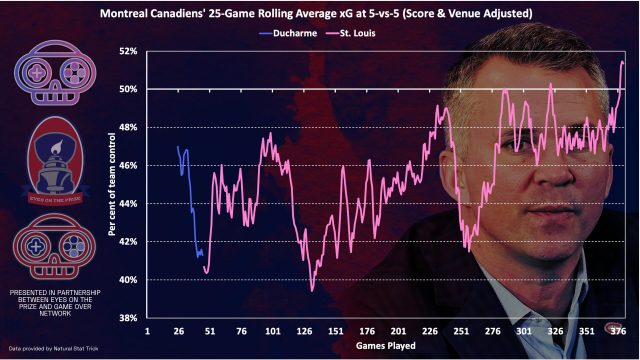
That spike at the end is where the Canadiens are right now. It’s always important to see the forest for the trees.
Andrew Berkshire is the former managing editor of Eyes on the Prize, and the founder of Game Over Network Inc. A Canadian, employee-owned sports media startup focused on platforming young creators across the country. Find Andrew live on YouTube after Habs games with Game Over Montreal, where you can also find Marc Dumont, Kay Imam, and Conor Tomalty to bring you interactive postgame analysis. You can join the Game Over Network’s Discord, and support us on Patreon as we employ over 30 young sports journalists and analysts across Canada’s seven NHL markets.
Social Media links: [Bluesky] [TikTok] [Instagram] [Threads] [Facebook] [LinkedIn]