
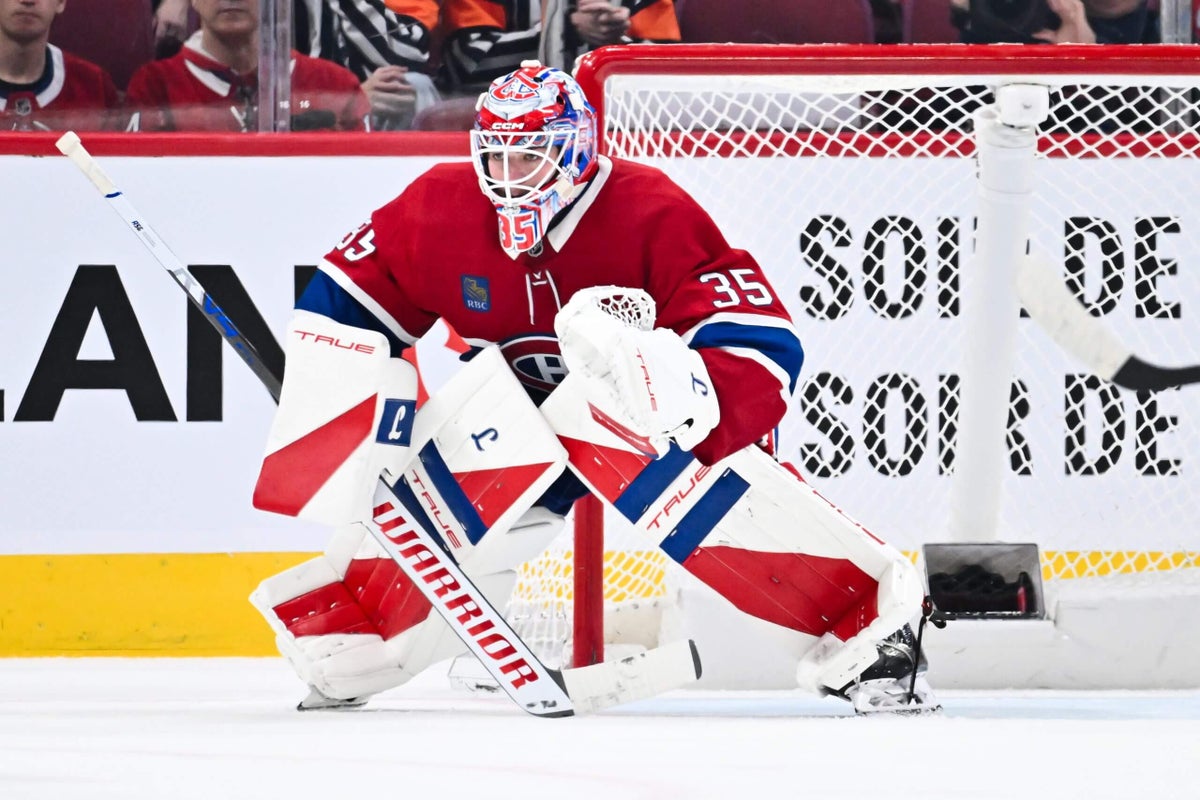
BROSSARD, Que. — In understanding the reasons why the Montreal Canadiens fired goaltending coach Éric Raymond and replaced him on an interim basis with Laval Rocket goaltending coach Marco Marciano, it’s important to look at a sequence of events.
First off, as Canadiens president of hockey operations Jeff Gorton reluctantly demonstrated Wednesday, there’s not a whole lot the organization can say about a decision like this, just as there was not a whole lot they could say publicly when they called up Jacob Fowler from the AHL on the evening of Dec. 9 after both Jakub Dobeš and Sam Montembeault were lit up for three goals apiece in a 6-1 loss to the Tampa Bay Lightning.
Both actions — calling up Fowler and firing Raymond — speak louder than anything Gorton or general manager Kent Hughes can say publicly. Still, it is important to say something, to provide some explanation to fans as to why this unusual move of firing a goaltending coach in the middle of a season was necessary.
And so Gorton did that, providing some necessary context along the way.
He expressed support and belief in Dobeš and Montembeault. He noted how Raymond was in the final year of his contract and that the organization had concluded that his contract would not be renewed. He revealed Marciano had been getting some interest from other teams around the league and the Canadiens had “sort of held him back.” He equated this decision to the one four years ago to fire Dominique Ducharme and bring in Martin St. Louis as head coach at a very similar time of year after they had reached the same conclusion on Ducharme as they had now reached on Raymond. And he revealed that there had been ongoing discussions “over the last few weeks” between him, Hughes and St. Louis on the possibility of making this move.
All of it is important context that provides clarity to this decision.
But when asked if his goaltenders need to own the circumstances that necessitated this move — if they should be accountable for it — Gorton stood behind his goalies.
“Listen, I think the easiest thing to do is blame the goalies,” he said. “It’s not just the goalies. Anytime something like this happens, it’s on all of us. So we’ll all take that, we’ll all take the responsibility, and we’ll move forward.”
Fair enough. This is where the sequence of events comes in.
Knowing these discussions were already underway at the time, Montembeault gave up two goals in 12 seconds in the third period in Boston in a 4-3 loss to the Bruins on Saturday after playing 54 excellent minutes. An important divisional win became an important divisional loss in 12 seconds on two shots Montembeault should have had. Reporters on site in Boston asked to speak to Montembeault, but he was not made available.
Meanwhile, the day before that game in Boston, Hughes was on the “Basu and Godin Notebook” podcast — an interview that was recorded three days before the game and one day before Montembeault and the Canadiens lost 4-3 to the Buffalo Sabres on home ice — and among other things, said, “I think one of the things we would like to see more of and coax out of our team, and the current players as well, is, ‘Can we ratchet up that competitiveness one or two levels?’”
Competitiveness was an overwhelming theme of that conversation.
On Monday, after Canadiens practice, roughly 36 hours after the game in Boston and after having obviously gone over the game with Raymond, Montembeault talked about his performance against the Bruins. Except it wasn’t just Montembeault talking. It was also Raymond, because Montembeault’s view of that game would have been shaped — at least in some small way, but more likely in a major way — by how he had discussed that game with Raymond.
And for a general manager who wants to see his players ratchet up their competitiveness, this could not have sounded great.
“I think even in the last game, for 55 minutes, it was going really well,” Montembeault said Monday. “I didn’t get a lot of shots. The third goal is a save I can make, but aside from that, the game against Buffalo and the other goals against Boston, they’re goals where there’s not a whole lot I can do. The last one hit Jake (Evans’) hand and deflected. You can’t look at the numbers too much, just keep on working, and today I had a good practice.”
Two goals in 12 seconds for the Bruins, and they take the lead 🤯 pic.twitter.com/APxYIhKvum
— Sportsnet (@Sportsnet) January 25, 2026
It is worth noting that Montembeault has had a very negative season. So, Raymond trying to be positive with his goaltender should not be all that surprising, and Montembeault said that was exactly what he was trying to do: be positive.
But for a competitor playing the most important position on a competitive team in an important game, being positive in that situation would be difficult.
Dobeš played the following day, Tuesday, against the Vegas Golden Knights, and he competed. He stopped 32 shots, several of the highlight-reel variety. St. Louis admired after the game how much Dobeš battled.
But there was also one save that was not of the highlight-reel variety and was arguably his most important save of the game.
With a little more than two minutes left in regulation, and a little less than a minute after Pavel Dorofeyev tied the game, Vegas took a shot from the left side of the ice that went wide, banked off the end boards and bounced right to Rasmus Andersson on the right side of the ice. Andersson did not hesitate, firing a one-timer. It landed harmlessly in Dobeš’ stomach, and he smothered the puck.
“It wasn’t really anything crazy,” Dobeš said. “I feel I had harder saves than that.”
He’s right, but the timing was the biggest part. It was a moment that could have broken the Canadiens’ back, much like what happened the prior game in Boston, but it didn’t.
The fact that it appeared to be an easy save because Dobeš was there and square and just let the puck hit him is a credit to him first, but also to Raymond and the work he’s done with Dobeš on that specific aspect of his game.
That’s the fine line the Canadiens had to straddle here, and the reality is this team’s playoff hopes are more reliant on Montembeault reclaiming his old form — an old form that was, again, largely shaped by Raymond — than they are on a rookie like Dobeš or even a rookie like Jacob Fowler to carry them.
In that sense, the Canadiens had an example to lean on.
On Oct. 22, New York Islanders general manager Mathieu Darche fired his goaltending coach, Piero Greco, and replaced him with his AHL goalie coach, Sergei Naumovs, who had a long history working with star goaltender Ilya Sorokin.
“Piero’s done a great job for the organization for the last seven years,” Darche said at the time. “We just felt at this time it was the right timing to have a reset with our goalies. There’s obviously a history with Sergei and Ilya, and we just made that decision going forward, just to have a reset with our goalies.”
At the time, in just five starts, Sorokin had a 2-3-0 record with an .873 save percentage and a 3.90 goals against average over an incredibly small sample. Since the goalie coach change, Sorokin has emerged as a Hart Trophy candidate, leading the league by a large margin in goals saved above expected and putting up a 15-9-2 record with a .924 save percentage and a 2.15 goals against average.
But another thing Darche mentioned that day, when asked a question about head coach and Hall of Fame goaltender Patrick Roy getting out on the ice with Sorokin, might apply to the situation in Montreal.
“Patrick is humble enough to understand the technical part of it is not what it (was),” Darche said, “but a goalie mindset is a goalie mindset, and Patrick had a pretty good one.”
Technical adjustments are necessary for Montembeault and Dobeš. But what appears to be more pressing is the goalie mindset.
And in that mindset, the competitiveness needs to be ratcheted up one or two levels.