
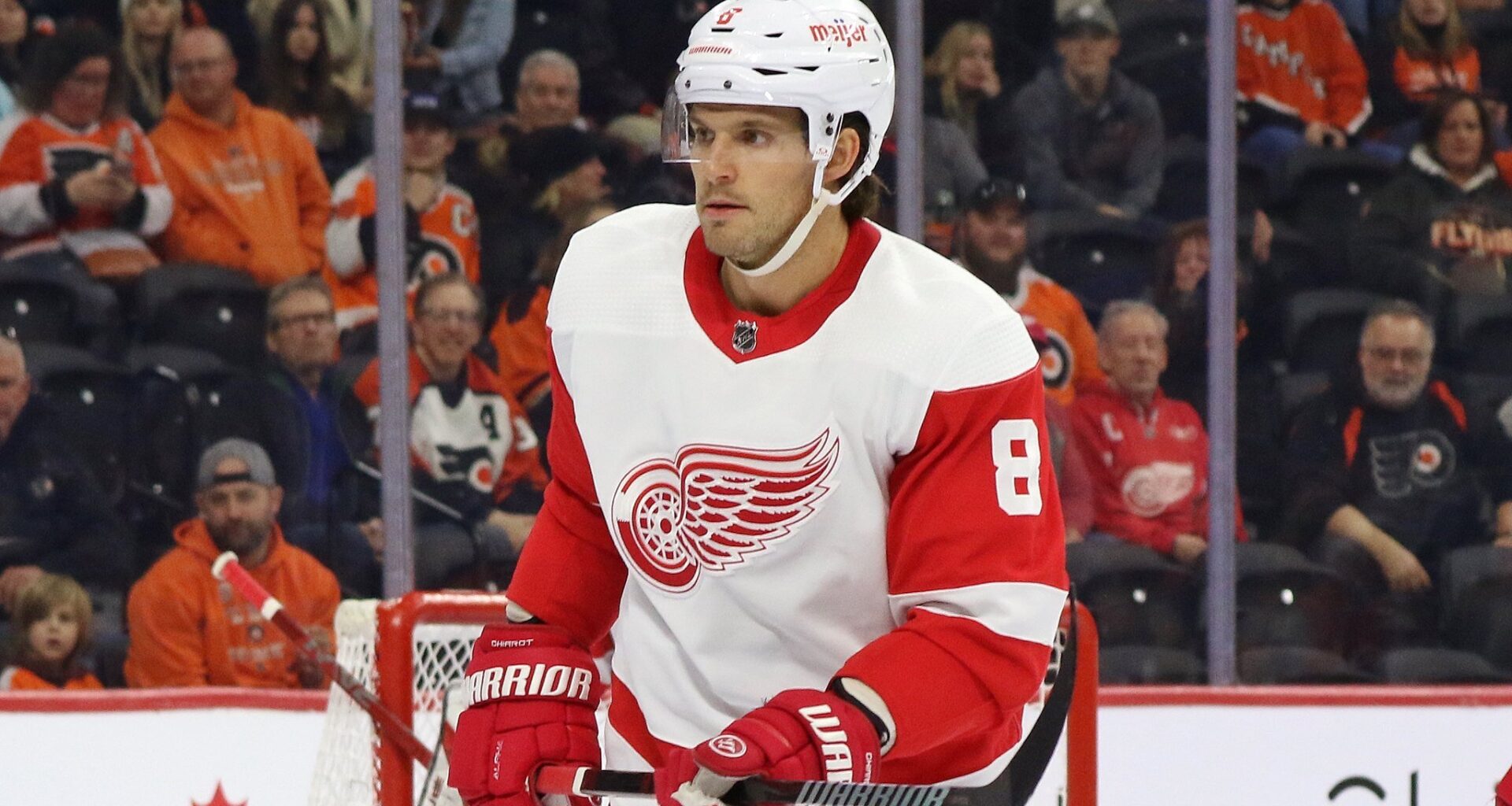
On Wednesday, the Detroit Red Wings signed defenseman Ben Chiarot to a three-year contract extension that comes with a $3.85 million AAV.
The veteran blueliner has been durable during his tenure in Detroit and is expected to hold down a top-four role through next season. Beyond that, he’ll likely slot in on the third pair in a depth role.
Public opinion on the signing has been polarizing. Some view it as a great deal. Others see it as downright awful. The reality, as usual, likely falls somewhere in between. Here, we’ll dig into the nuance of why re-signing Chiarot makes sense for the Red Wings.
Proper Evaluation for Red Wings-Chiarot Deal
It’s become clear that Chiarot is a valued presence within the Red Wings organization. He’s well-liked by teammates, the coaching staff, and the general manager. That counts for something.
He has been asked to play a difficult role and shepherd along an ascending Moritz Seider. He puts in the effort night in and night out, playing 20-plus minutes a game for a top-10 NHL team. That counts for something, too.
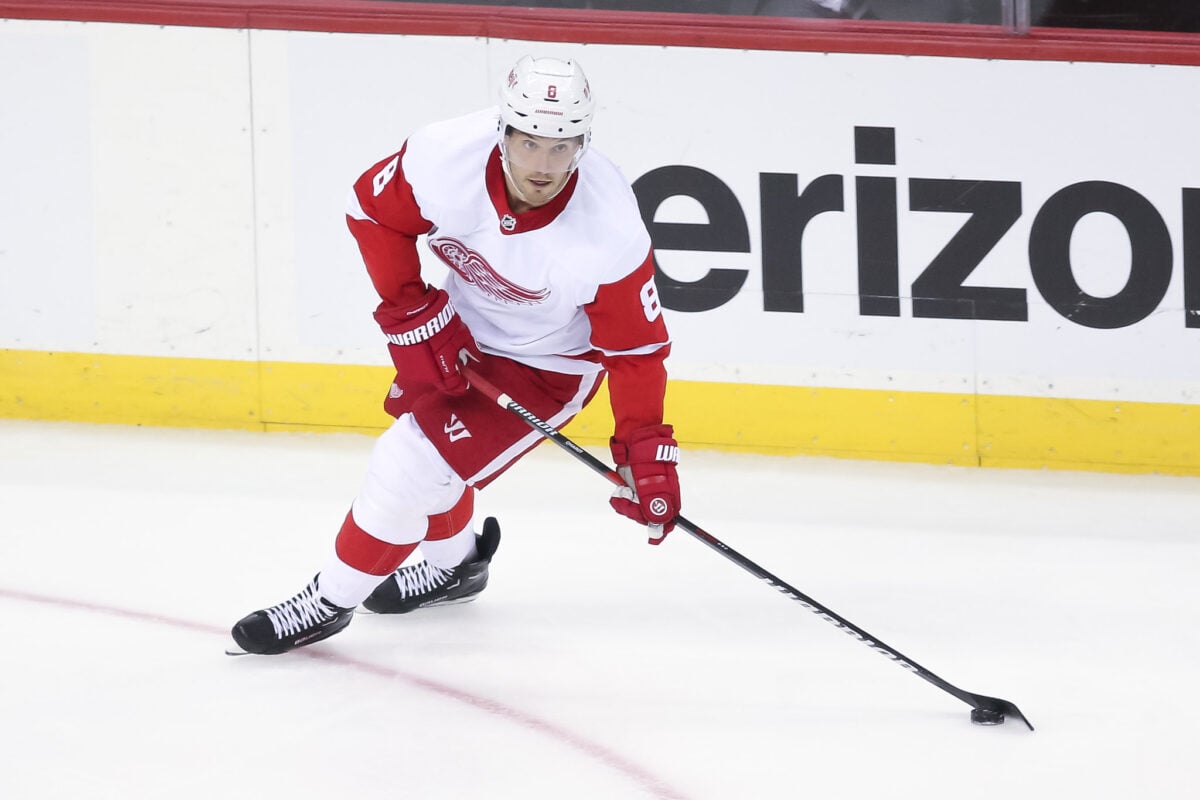 Ben Chiarot transitioning the puck up ice for the Detroit Red Wings.(Jess Starr/The Hockey Writers)
It’s easy to evaluate a player solely through point totals or expected goal differentials, but that doesn’t tell the whole story. The qualitative traits—commitment to building a culture, professionalism, leadership—are part of the equation as well.
Because of that, contracts and trades shouldn’t be judged on on-ice performance alone. Those metrics are an important part of the calculus, but they aren’t the only variable. In Chiarot’s case, the cap hit may look high when viewed strictly through certain analytics, but the cap-hit percentage over the life of the deal is quite palatable, especially in a rising salary cap environment.
Take, for example, the final year of Chiarot’s new deal. By the 2028-29 season, he’ll be 37 and a bottom-pairing or depth defenseman, and, by then, the NHL salary cap upper limit could exceed $120 million. Using that $120 million figure as a placeholder, Chiarot’s $3.85 million cap hit will account for 3.21 percent of the total cap – essentially $3 million for today’s dollars with a $95.5 million upper limit. That’s what Tyler Myers and Trevor van Riemsdyk make this year. Ian Cole, Olli Maatta, and Nate Schmidt are in the neighborhood as well. These are all reasonable deals for depth players, so long as you have cap space, which the Red Wings certainly do (and will continue to have).
Market conditions need to be taken into account, too. Suppose Detroit moved on from Chiarot. Then what? This summer’s UFA crop is pretty thin. The only free agents who would be upgrades over Chiarot are Mario Ferraro and Rasmus Andersson, and I highly doubt the Vegas Golden Knights let Andersson get to market. (I’m excluding John Carlson here because he will more than likely re-sign in Washington.)
How about a trade? Well, first, Detroit would need to find a partner willing to move a bonafide top-four blueliner. Easier said than done. Then there’s the cost. With quality defensemen in short supply, the Red Wings would need to pay a premium. Threading that needle would be difficult.
Related: Red Wings Need to Pursue Elias Pettersson In a Potentially Franchise-Altering Trade
Instead, the Red Wings are getting a known quantity in Chiarot – someone they can depend on to be a veteran leader on a team filled with talented young players.
Final Word
Overall, Chiarot’s new deal makes sense for both the team and the player. The AAV is reasonable and should age well as the salary cap continues to rise. If there’s any concern, it’s that the term may be a year too long, but the contract can be waived or bought out, if necessary.
More importantly, there’s continuity with the culture being built in Detroit. Plus, it’s important to have teammates that you like – and the Red Wings like Chiarot quite a bit.
I’ll end with a real-world example. When hiring someone, candidates are not judged solely on their experience/recent performance. Soft skills are taken into account, too. Are they good leaders? Easy to get along with? Strong communicators? Culture builders? These qualitative factors have a positive downstream impact on organizations. That is why the Red Wings value Ben Chiarot.
