
WASHINGTON (7News) — When you sit down with Craig Fitzpatrick, it’s clear hockey found him.
“It was exactly the right time for me,” he said.
Though he grew up a fan of the game, the longtime DMV resident didn’t spend his childhood lacing up skates or circling ice rinks. Instead, his connection to hockey was sparked in 1995 when he attended his first college hockey game as a cadet at the Air Force Academy.
“[I] kept that passion as a fan for a little over a decade, and then I started ice skating [and] figured out that hockey might be a possibility for me,” Fitzpatrick told 7News Sports Anchor Natalie Spala.
But hockey didn’t just find him. Fitzpatrick admits, in a way, it saved him.
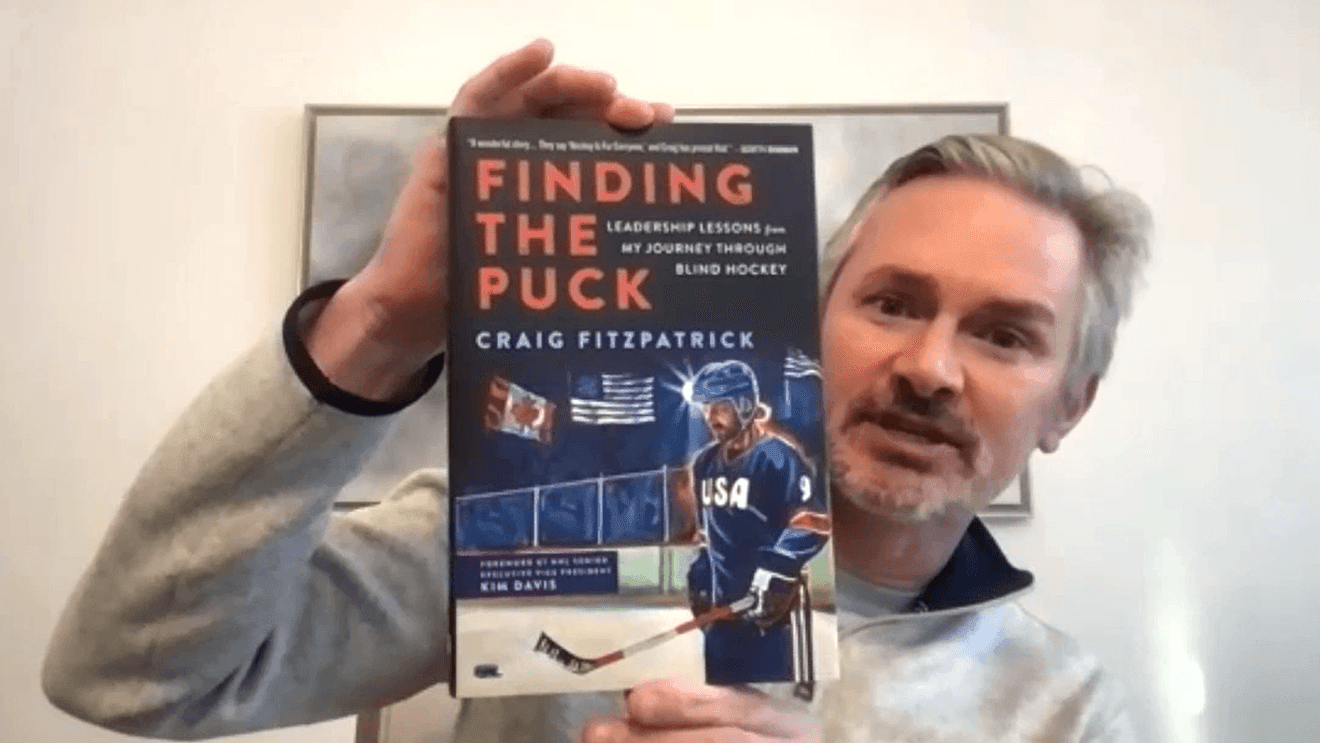
Craig Fitzpatrick sits down with 7News Sports Anchor Natalie Spala to explain Finding the Puck (7News)
Fitzpatrick recently authored a memoir titled Finding the Puck: Leadership Lessons from My Journey Through Blind Hockey. The title is deeply personal — Fitzpatrick is blind. Diagnosed with a rare form of macular degeneration at just 25 years old while on active duty in the Air Force, his life — which in many ways was just beginning — took a complete 180.
Fitzpatrick had grown up with an affinity for planes, which ultimately led him to a career in the Air Force. Now, he had to start over. Fitzpatrick received an honorable discharge and proceeded into a new career in technology.
But something was missing. Enter, blind hockey.
“The first big difference between regulation hockey and blind hockey is that we have this blind hockey puck,” Fitzpatrick explained. “This is made of metal and it makes noise and we can track it on the ice. It’s about, by volume, three times larger than a regulation puck.”
While differences in pucks change game tactics, Fitzpatrick said the speed of blind hockey resembles that of traditional hockey. All players must be legally blind, including the goalie, who is tasked with defending a slightly smaller goal.
Not only did Fitzpatrick enjoy the sport, he thrived while fostering its growth. In 2016, he co-founded what is now known as the Washington Blind Hockey Club. The club, which encourages blind athletes to fall in love with the sport, received immediate support from the Washington Capitals when Fitzpatrick approached the team with the idea.
“We’re celebrating our 10 year anniversary this month, actually,” Fitzpatrick said. “Over the last 10 years, locally here in DC, we’ve put seven players onto the US national playing team which is the most of any program in the country.”
Proof that the organization is changing lives led Fitzpatrick to continue to grow the game to new heights. He wants to see blind hockey added to the 2034 Paralympic Winter Games in Salt Lake City which will be the next time the games will be played in the states.
“There are 45 million blind people in the world today, and there is not one single team sport in the Winter Paralympics for blind people right now,” he said. “We’re going to try to fix that, and I hope this book can be an important first step towards it.”
Fitzpatrick’s Finding the Puck is available anywhere books are sold. The audio book is available on Amazon.