
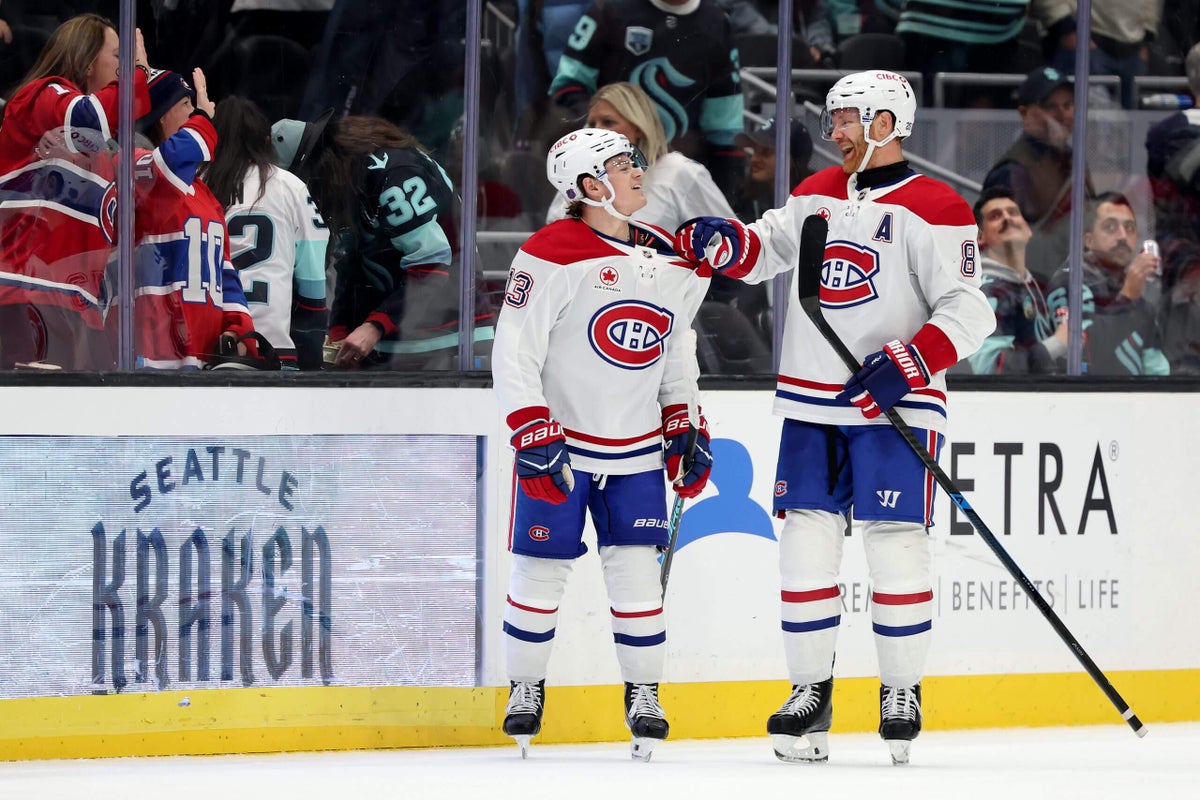
ST. PAUL, Minn. – It might be difficult to see Cole Caufield and Mike Matheson as having similar NHL journeys. But it’s right there if you’re willing to look for it.
The difference between the two is one began his journey far from Montreal, and the other began it under the hottest of spotlights.
Let’s start with Caufield, left off the U.S. Olympic team seemingly because of a perception he can’t kill penalties or play a two-way game.
One of those perceptions is true: Caufield has never killed penalties. The other is abjectly false.
Caulfield faces opposing top lines every night. Last week alone, his top opponents at five-on-five were Jack Eichel, Nathan MacKinnon and Ryan McLeod — and the latter was only because Sabres coach Lindy Ruff was at home Saturday and seemed intent on getting Tage Thompson, Alex Tuch and Zach Benson away from Caufield, Nick Suzuki and Kirby Dach.
The result of that matchup decision by Ruff? Caufield scored the tying goal in the third period against Peyton Krebs’ line and the winning goal against Noah Ostlund’s line, with both coming against the Sabres’ third defence pairing of Bowen Byram and Michael Kesselring.
If you want to get your top guys away from the Suzuki line, they will burn you offensively. If you accept the matchup, they can burn you defensively. Suzuki deserves the lion’s share of credit for the defensive presence of his line, but Caufield seems to get absolutely no credit for that. And that’s unfair.
Just as it is unfair to describe Caufield as a perimeter player. It is not only unfair, it is untrue.
“Cole has evolved,” Canadiens coach Martin St. Louis said after the game. “He’s not just a perimeter player anymore, he’s not just a power play guy on the outside. If you see where we play Cole on the power play, he’s goal-line, he’s around the net always, he finds himself sometimes screening the goalie. Cole has evolved. We know he’s good on the outside in space, but sometimes the game is asking you to get inside, and he’s able to do that.”
Matheson agreed that what Caufield has done with the role he’s been given this season is worthy of credit.
“To start your shifts in the defensive zone and have to carry the puck down the ice to get your chances in the offensive zone is something that is tough to do,” Matheson said. “The fact he can do it is impressive.”
Caufield’s evolution has followed a similar path to Matheson’s. It just took longer for Matheson.
During Matheson’s first season in Montreal, the second trade of his career, he played consecutive games in Pittsburgh and Sunrise, Fla., his two previous NHL homes. In an interview prior to facing the Florida Panthers, Matheson spoke frankly about how difficult his time was there.
“I was a risky player that wasn’t defending very well,” Matheson said in March 2023. “As a coach, that’s not a good person to have on the ice.”
Fast forward to Saturday night, where Lindy Ruff was trying to get the Thompson line away from Suzuki with some degree of success. But he did not succeed in getting Thompson away from Matheson, and that’s all St. Louis really cared about.
“Their top line is a heavy task,” St. Louis said after the game. “The one constant thing that we have against the top line is it’s usually Matty. I know we’ve used (Kaiden Guhle) there a little bit, we have other guys, (Noah Dobson) can do that too. But Matty gets those for sure. If the cadence allows it, I’d like to have Suzy against them as well.
“You don’t always get that luxury, but knowing that Matty’s out there, I feel pretty comfortable.”
That is quite the leap from his time in Florida, where Matheson was practically unplayable in defensive situations. But in between, there was the winning pedigree and Hall of Fame talent in Pittsburgh, and more specifically Todd Reirden, the Penguins’ assistant coach at the time and currently behind the Philadelphia Flyers bench.
“He had a huge impact on me,” Matheson said after practice Sunday in Buffalo. “That was the shortened season that started in January, and I got traded in September. He called me in September and we met every single week on Facetime and watched video together all the way up until January. That’s just a snapshot of the work we continued to do over the next two seasons, but that’s how committed he was to me. So I owe a lot of that transition through Pittsburgh to him.”

Mike Matheson’s defensive play is now a crucial part of his game. (Minas Panagiotakis / Getty Images)
Matheson plays among the most difficult minutes in the league among defencemen, according to hockeystats.com, just as Caufield and Suzuki do among forwards.
And if Matheson is impressed by the difficulty of Caufield starting his shifts in the defensive zone and finishing them by creating chances in the offensive zone, Caufield has a very simple explanation as to why he’s able to do that.
“He’s a guy we lean on back there to shut down their top guys and he does that every single night,” Caufield said Sunday.” I know in the locker room we appreciate it every night. We know what kind of talent he goes up against every night. His ability to skate with those guys, shut them down and be hard, in their face, it’s very good to have back there. It’s calming to know he’s back there. The offensive side of his game hasn’t dipped, it’s just he makes the simple plays that go less noticed. Without those things, we don’t get in the offensive zone as easily.”
Matheson will be 32 at the end of the month; Caufield just turned 25 last month. They are at different stages of their careers, but in some ways, they are at the same stage. They are dispelling previous notions of their games and rounding into truly two-way NHL players with exceptional offensive ability.
Caufield is on pace for a career high in goals and points. Matheson already has more five-on-five points than he had in the past two seasons and is six points shy of his career high of 28, set in his last season in Pittsburgh.
But while Caufield’s defensive game is a complement to his offensive game, Matheson’s defensive game has become the defining feature of his NHL identity.
And that would have been unthinkable when he was a young Kent Hughes client playing for the Florida Panthers.
Suzuki’s role for Team Canada
After the game Saturday, Suzuki was asked how important it was for him to be playing this well a week shy of his departure for the Milan-Cortina Olympics.
“I definitely want to feel good about my game going over there,” Suzuki said after a two-assist performance in a 4-2 win against the Sabres. “Obviously not sure what kind of role I’m going to have, it doesn’t really matter. I just want to feel good and show that I can be a player that can help Team Canada.”
A few days earlier, when the Vegas Golden Knights were in town Tuesday, we had a chance to ask head coach Bruce Cassidy what exactly Suzuki’s role might be with no expectations of a detailed response. Cassidy runs the power play for Team Canada and will assist Rick Tocchet in working with the forwards more generally. Suzuki is unlikely to get a spot on the power play, but Cassidy still shared far more insight on Suzuki’s role in Milan than we expected.
“We discussed lines recently, and I don’t want to get into that, that’s (Jon Cooper), he’d be the guy to ask,” Cassidy said. “We all had opinions. Listen, everybody likes every player on the team, so that’s an easy one to say.
“But there could be a couple of different spots for him. I know that he’s got the ability to play the wing, so when you look at (Connor) McDavid and (Nathan) MacKinnon and (Sidney) Crosby and some of the centres on the team, is he a guy that can move up in the lineup and give you more on the wing as opposed to down the lineup in the middle? So those are things that we’ve discussed and I think they’ll get sorted out. … He plays both special teams, so I think he’ll be a good player for Team Canada. Where he fits — a lot of players we’re not sure with. Last year going to 4 Nations, you certainly know there was a little bit of chemistry between certain guys, and Nick would be on those guys we’re not quite sure of yet.”
So while Cassidy did not provide all that much clarity as to what role Suzuki will fill, he did seem to strongly suggest he will have a role. Suzuki has said he would be happy to do anything for Team Canada, even if that means sitting in the stands and watching. That answer from Cassidy did not sound like that’s something Suzuki will need to worry about. But we’ll see soon enough.
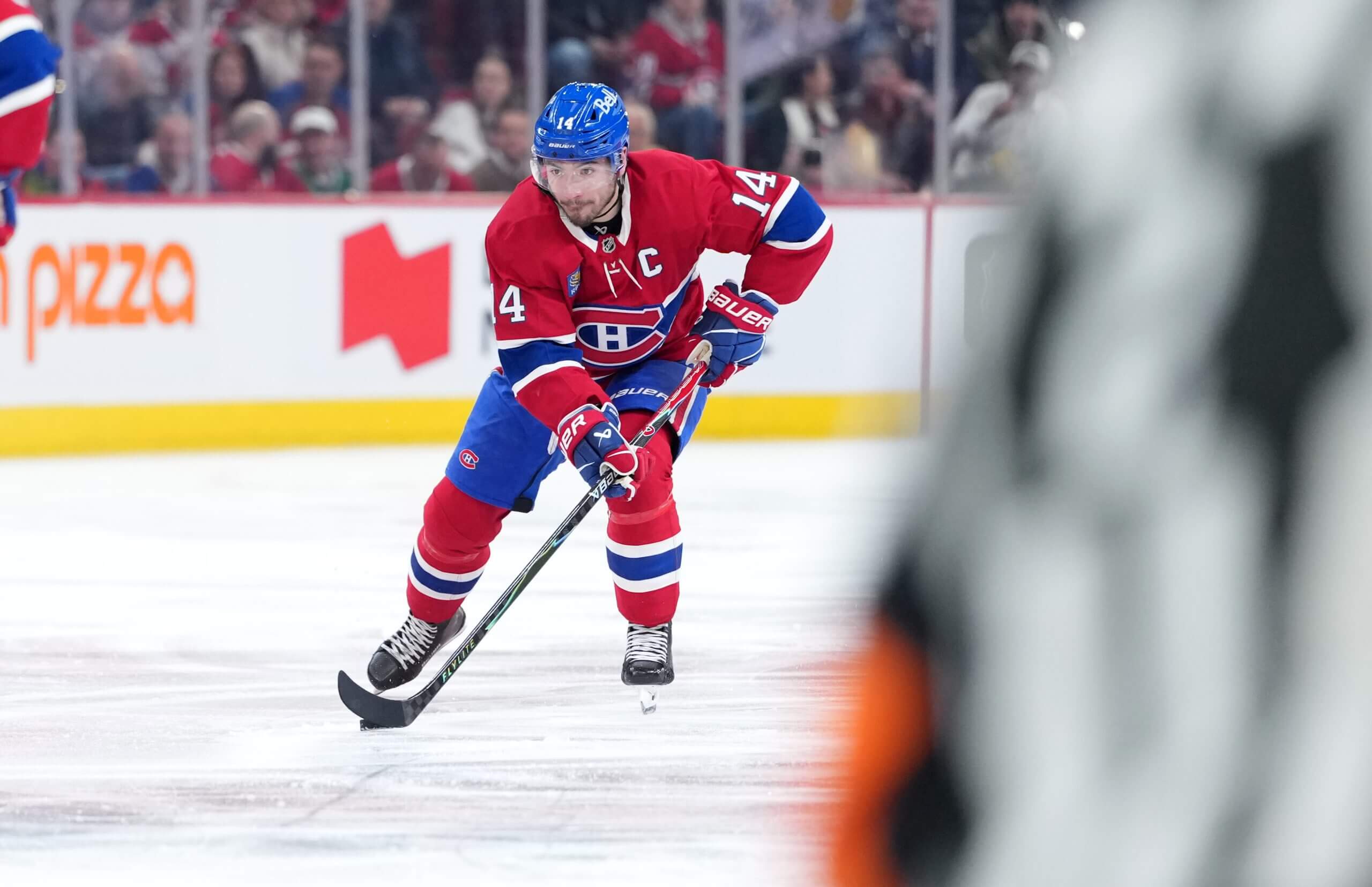
Nick Suzuki’s Team Canada coach and teammate both sounded high on his chances of playing a meaningful role in Milan. (Eric Bolte / Imagn Images)
Vegas captain Mark Stone also chimed in on the Canadiens captain, and had more to offer than we expected as well.
“Honestly I didn’t know the guy at all, and then we roomed together at the orientation camp in Calgary, so I got to know him pretty well,” Stone said. “I hadn’t had a roommate in a while, so that was different, but I got to know him pretty well. Obviously he’s just gotten better every year. He’s still a young guy, a young player, he’s still 26, just coming into the prime of his career.
“He plays a 200-foot game, he’s the type of guy that goes over the boards first in every situation, and those are the types of players you want to have. That’s what we have in (Jack) Eichel, who goes over in every situation. That’s what you want in your first-line centre.”
Suzuki won’t be a first-line centre in Milan. He might not even be a centre. But he should be preparing himself to at least play a role.
Another thing the Sabres and Canadiens have in common
The Sabres and Canadiens are the two youngest teams in the league. They are fighting for playoff placement. They are emerging from a rebuild, one much shorter than the other, and they will likely be competing for placement against each other for years.
But there is one more quirky commonality.
Both the Sabres and Canadiens have one player with a Stanley Cup ring in their respective dressing rooms, they were teammates when they got that ring, and they were both very young when it happened.
Sabres defenceman Bowen Byram and injured Canadiens forward Alex Newhook were teammates on the 2022 Colorado Avalanche. Byram turned 21 two days before the series began and Newhook turned 21 a little more than four months earlier. They were Colorado’s two first-round picks in the 2019 draft. There’s a kinship there.
But how much experience do you actually gain going through a Stanley Cup run at such a young age?
“That’s a good question, I’ve thought about it too,” Byran said Saturday morning. “In the moment, you’re just kind of rolling with the punches, trying to survive. But I do think playing in the playoffs, playing deep into the playoffs is valuable to your development as a young player, but also to your confidence. It’s about understanding how the playoffs are. It’s a completely different brand of hockey.
“I don’t know, experience probably comes with age and disappointment, a lot of different things. I think as a player throughout your career, you’re just gathering information and trying to overcome challenges. That was one me and Newy were lucky to be a part of and it was a lot of fun.”
Newhook is looking like he might be back in the Canadiens’ lineup when the Olympic break ends as he ramps up his recovery from a fractured ankle. There is a possibility the Sabres and Canadiens will face each other in the first round of the playoffs. And there is therefore a possibility Newhook and Byram will be the only players in the series with a Stanley Cup ring.
They are entering the prime of their careers. And they may have the opportunity to test just how much experience they gained together in that Cup run against each other this spring.