
There’s a famous proverb about how an empire wasn’t built in a day, and it’s pretty safe to assume the Colorado Avalanche aren’t going to “fix” the power play with only one game left before the 2026 Winter Olympic break.
Regardless of what happens Wednesday night at Ball Arena, figuring out some level of consistent success with the man advantage has to be at the top of the to-do list for the Avs once everyone returns later this month.
This team, despite a recent 5-7-2 funk, is still in control of the race for the Central Division, Western Conference and President’s Trophy. It is still the favorite to win the Stanley Cup.
And for nearly two-thirds of this season, the power play has been the one leak in an otherwise formidable operation. The Avs are 16-0-4 when they score at least one goal with the man advantage. They are 5-0 when scoring more than one, and have racked up 31 goals (6.2 per game) in those contests.
Injured Avalanche stars should be ready for 2026 Winter Olympics
But the game Wednesday against the San Jose Sharks is No. 55 on the season. That is far too many games for any team not to have a power-play goal in, let alone one with this collection of talent.
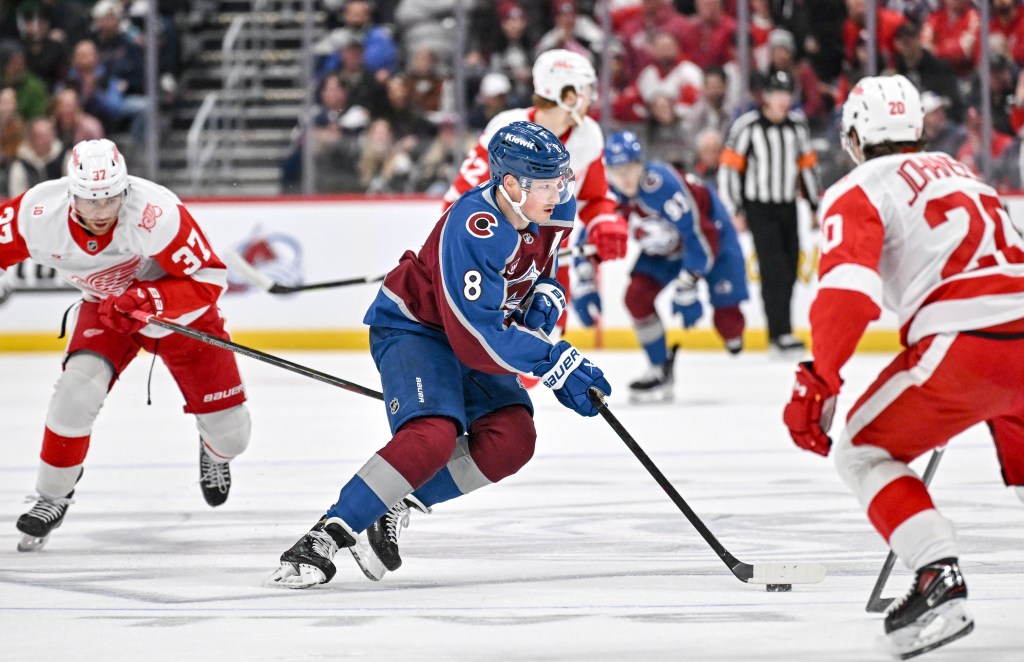
It wasn’t the sole reason the Avs lost Monday to Detroit, but two chances with the power play in a 1-0 game certainly loom large. As the club has tried to grind through this adverse period, the power play hasn’t been able to help when other parts of the Avs’ game have finally slipped a little after a historic start.
“There’s some inconsistency there, for sure,” Avs coach Jared Bednar said. “I can’t carry the baggage of 45-50 games into every game. I think you have to reset and take what you can learn from the night that you have and what you liked about it, and try to implement that more often and get more consistent with it.
“Right now, it’s kind of a snowball the other way. We need to have a big night one night and get it turned around, and then try to repeat that performance.”
Colorado did not have the worst power play in the NHL, at least by proficiency, after a 2-0 loss Monday night to the Detroit Red Wings. The Avs were officially 31st, but only by using a second decimal point. They are at 15.34%, which is just ahead of the Utah Mammoth, who are at 15.29%.
The power play has produced 27 goals in 176 chances. The 27 goals are actually tied for 23rd in the league, which is slightly better but still miles off the pace a team with this talent level and accomplishment in every other aspect of the sport this season should have.
The Avs do have the worst power play in the NHL if we measure it by goal differential during the man advantage. Colorado has allowed a league-leading nine shorthanded goals, so the Avalanche is plus-18 after those 176 opportunities.
That means the net power play (18 for 176) is actually 10.4%, which would also rank last in two of the previous four NHL seasons since the Covid-19 global pandemic.
Avalanche will enter Olympic Games break as NHL’s top team. Here’s how others finished. | Journal
From the first day of Cale Makar‘s first full NHL season (2019-20) until the end of last year, the Avs had the fifth-best power play by proficiency and the third most goals scored, behind only Edmonton and Tampa Bay. Those are supposed to be Colorado’s peers with the man advantage.
This collapse is inextricably linked to the stunning seven-game loss to the Dallas Stars in the 2025 playoffs, when the Avs went 3-for-22 and lost back-to-back games in overtime when they had chances to win late with a power play. It cost longtime Bednar lieutenant Ray Bennett his job. The lack of success this year has made his replacement, Dave Hakstol, the target of significant online criticism from the fan base.
Dallas, Edmonton and Minnesota are three of Colorado’s top competitors for the Western Conference. Those teams are first, second and third in power-play goals scored at 49, 48 and 47, respectively.
Colorado’s elite penalty kill will do its best to try and neutralize those high-powered power plays if and when it faces them in the postseason. A team can win the Stanley Cup with a mediocre or worse power play — six of the past 15 champions have finished the postseason at worse than 20%, most recently, Florida two years ago was at 18.5.
But given what happened at the end of last year and the narrative that has grown since then, the Avs need to show some improvement in the final third of the season — both for the players who have clearly struggled with confidence and execution and for a fan base still carrying the baggage from last season that Bednar tries to avoid.
A positive update for ‘The Mayor’
Logan O’Connor has missed the entire season to date, first because of offseason hip surgery and then issues that have arisen during his recovery. Bednar said Tuesday he is back on the ice, and expressed optimism about a pending return for the first time in a while.
“He’s back on the ice now, making progress,” Bednar said. He will be a guy that uses this break to his advantage. He’s planning on getting on the ice, staying on the ice and working his way back to hopefully join the team at some point in the near future, if everything goes well.”
O’Connor, an undrafted free agent after four years at the University of Denver, has been a key glue guy for the Avs in recent years. He signed a six-year, $15 million contract in September 2024 that began this season.
“We feel confident in the plan,” Bednar said. “He feels good about it, and he’s starting to ramp up here again.”
Want more Avalanche news? Sign up for the Avalanche Insider to get all our NHL analysis.