
The Ottawa Senators’ president of hockey operations and general manager (GM) Steve Staios and his team are no doubt busily preparing for the annual crap shoot otherwise known as the NHL Entry Draft. This year’s edition is a virtual draft scheduled for June 27 and 28, and you can be sure that Staios and company are getting tons of advice from Ottawa’s many armchair GMs about what their selection strategy should be.
Not to be outdone, the Bytown hockey punditry is also piling on with unsought counsel. No dignified pundit ever shied away from giving their two cents, so here’s mine – keep it simple, Steve! In the first round of the draft, select the best player available. After that, it probably doesn’t matter that much – so don’t sweat your choices. It’s no more complicated than that.
Senators’ Draft Strategy: Pick the Best Available or Fill Roster Holes?
There are two camps among NHL GMs when it comes to the entry draft. Some say select the best player available – period. (the “BPA” strategy). That doesn’t sit well with the other camp who argue young talent should be chosen more methodically to fill holes in a club’s roster or prospect pipeline. It’s even better if the prospect fits with the club’s character and style of play.
This year, the Senators have the 21st overall pick in the first round. So Staios can take some pressure off himself, knowing that it’s unlikely a player selected 21st overall has the kind of talent that could change the future course of his team. After all, statistics show that just over 1/3rd of players selected in the first round ever play more than 100 games in the league.
To wit, former Senator Colin White was selected 21st overall by the Senators in the first round of the 2015 Draft and lasted an injury-plagued 234 games in a Senators sweater over six seasons. He cleared waivers in the summer of 2022 and was bought out. He’ll be collecting $875,000 per year from the Senators until the end of the 2027-28 season.
To further illustrate the point, over the last 10 years in the league as a whole, the best talent selected 21st overall in the first round has been the likes of the Winnipeg Jets’ Logan Stanley. He has skated on the Jets’ fourth defence pairing in just over 200 games. Vancouver Canucks centreman Filip Chytil was drafted 21st overall in the first round of the 2017 Entry Draft and has played 393 NHL games, skating in the bottom-six.
Still, good things can come from late picks in the first round. The Senators picked their alternate captain Thomas Chabot 18th overall in the 2015 Entry Draft. Even so, as one academic study put it, “picking future NHL players among teenagers has been compared to identifying Nobel prize winners among junior high school chemistry students” (from Peter Tingling, “Educated Guesswork: Drafting in the National Hockey League – Handbook of Statistical Methods and Analyses in Sports – 2016”).
Senators Should Fill Holes With Later Round Draft Picks
The NHL Entry Draft consists of seven rounds in which the league’s 32 teams select 224 teenagers they’re betting could play in the NHL. Yet the cold, hard truth is that players selected after the first round are long shots to play in the league. It’s hard to say who among them is more talented than the next, making the so-called “BPA” approach to draft picking pretty much meaningless.
Yet later-round draft picks can’t be dismissed entirely. Some of the NHL’s best were drafted in the late rounds. Senators’ great and Hockey Hall of Famer Daniel Alfredsson was selected 133rd overall in the sixth round of the 1994 Entry Draft. Boston Bruins’ great Patrice Bergeron was selected in the third round, and the Tampa Bay Lightning’s Brayden Point was a third-round pick. Not only that, but some of the league’s best players were never drafted at all. On that list is Martin St. Louis, current head coach of the Montreal Canadiens and recipient of too many NHL awards to mention.
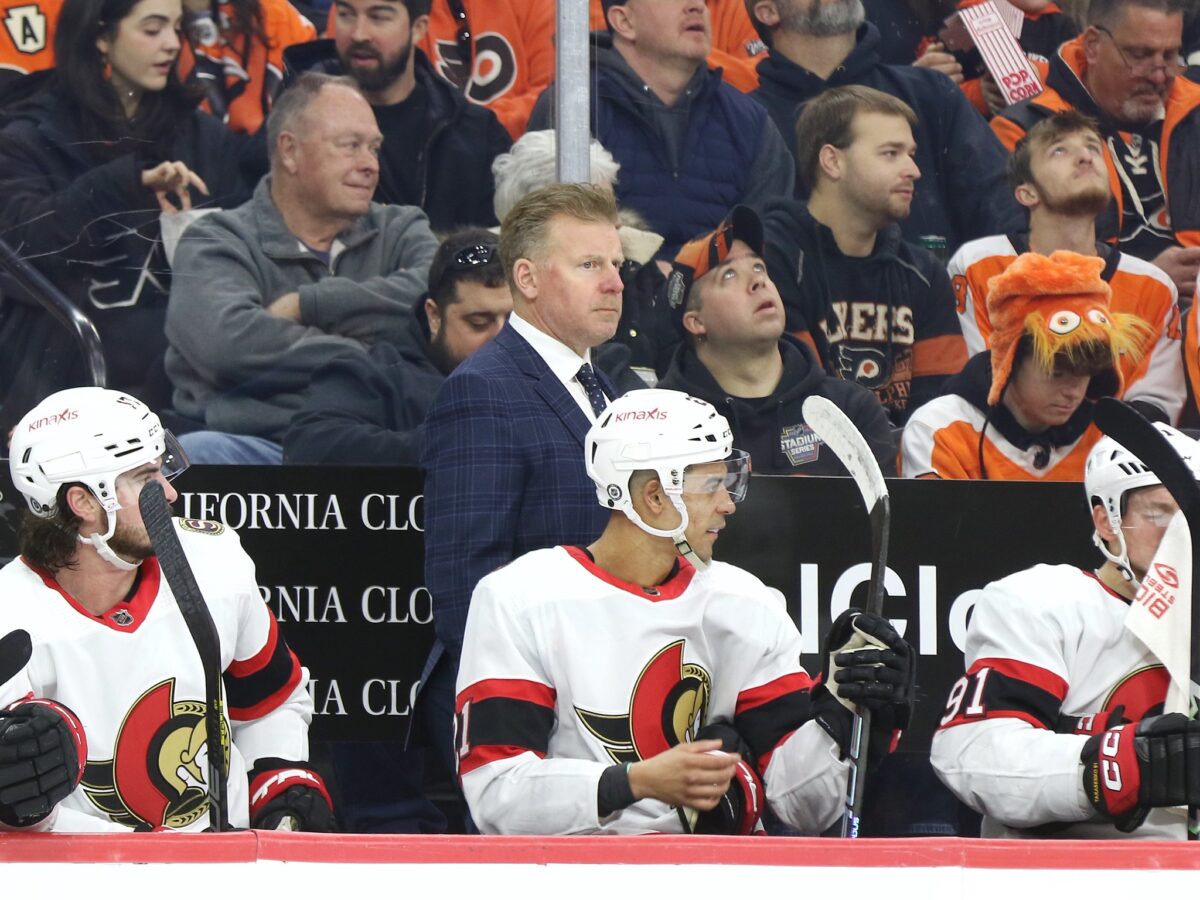 Daniel Alfredsson Behind the Ottawa Senators’ Bench (Amy Irvin / The Hockey Writers)
It’s with players like Alfredsson and St. Louis that NHL clubs can experiment at low risk with players they think could improve their pipeline and eventually their roster, or perhaps sharpen their identity. Alfredsson was picked because then-Senators’ director of player personnel John Ferguson Sr. liked his competitiveness and two-way play – part of the identity the Senators were trying to build at the time.
After the first round, Staios couldn’t be faulted if he took a more methodical approach to the draft that addresses the Senators’ organizational needs. Still, those can and do change quickly, so drafting to solve today’s problems can backfire.
Roster and Pipeline Holes Senators Should Fill
So, after the first round, what should Staios and company focus on, assuming they switch from the BPA approach to filling holes in their roster and farm system?
Arguably, the Senators’ D-corps is now adequate, ranking as it does at 11th in the league. As for goaltending, the puck-stopping duo of Linus Ullmark and Anton Forsberg haven’t delivered stellar goaltending, but what they have mustered is good enough to make the Senators competitive on most nights. The Senators’ save percentage (SV%) last season was .920 compared to the league average of .918. As for their goals-against average, at 2.85 per game, the team is a hair above the league average of 2.85.
The holes in the Senators’ roster and prospect pipeline that need to be addressed are on offence. Last season, the team averaged 2.96 goals per game. While that’s just below the league average of 2.98, it’s well below the number notched by elite teams in the NHL, such as the Washington Capitals (3.63), the Lightning (3.51) and Winnipeg Jets (3.45). All of this speaks to why the Senators’ offence is ranked by many observers in the lower half of the league.
Ideally, after the first round, the Senators should try to select a forward with the potential to crack their lineup in the next three seasons. That’s when they’ll be needed, since the Senators are built to win over the next three campaigns.
Senators Should Not Trade Their 2025 First-Round Pick
My colleague at The Hockey Writers, Jacob Billington, made the case earlier last season that Staios should trade his 2025 first-round pick. That’s a bad idea, since they must then give up their 2026 first-round pick in satisfaction of the penalty the league imposed on them because of the bungled Evgenii Dadonov trade.
Related: Senators Should Trade 2025 1st Round Draft Pick
Trading this year’s first-round pick means the Senators will have had just one in the last five years. That goes a long way to explaining why this venerable publication ranks the Senators’ farm system at 24th in the league. Aside from Carter Yakemchuk, there’s nobody in the prospect pool with the potential to be much more than mediocre in any NHL lineup.
What’s more, The Hockey Writers’ Senators writer and resident prospect guru, Dayton Reimer, argues in a recent piece that it makes sense for Staios to slow walk the forfeit of a first-round draft pick to satisfy the Dadonov penalty. As Reimer explains it, “the Senators aren’t the first team to be hit with a punishment involving a draft pick, but if the NHL goes through with their initial statement, it will be one of the first times the league doesn’t soften its ruling.”
Senators Fans Keep 2025 Entry Draft Expectations Low
The NHL Entry Draft is a roll of the dice – even more so when your first-round pick is 21st overall. That’s why Senators fans should keep their expectations low and pray Staios and company can pick out a diamond in the rough.
