
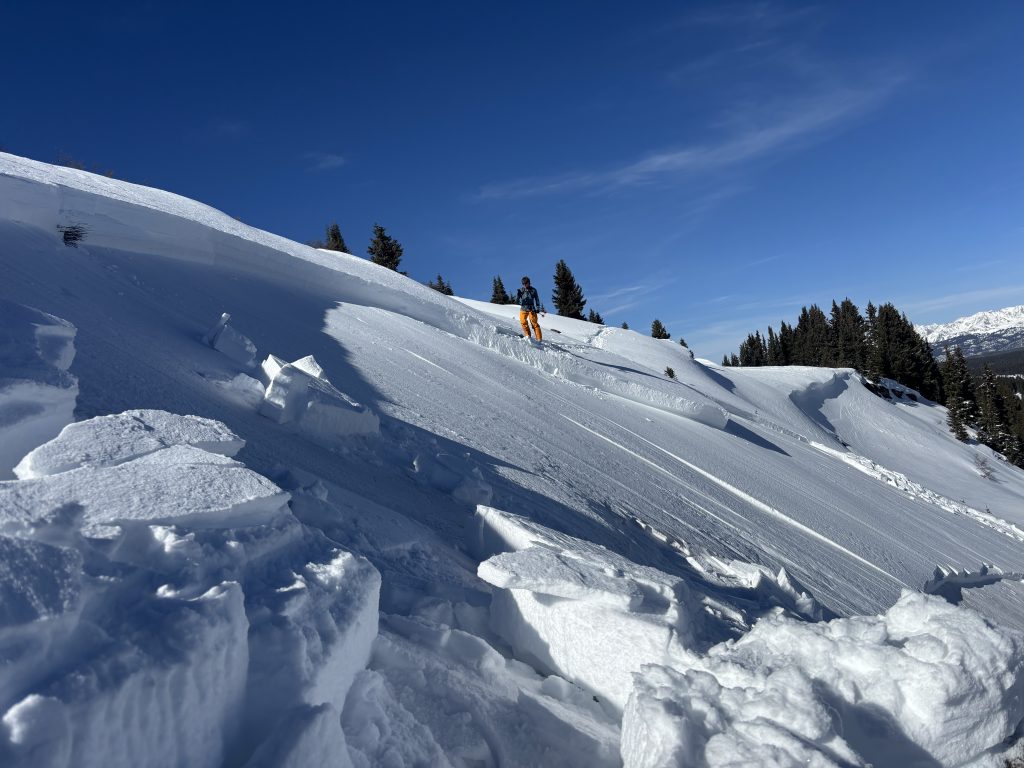
 A backcountry skier stands near the crown of an avalanche that occurred near Vail Pass on Sunday, Feb. 1, 2025. One skier was caught and carried about 30 feet in the avalanche but sustained no injuries and was able to self-extricate themselves from the snow.
Colorado Avalanche Information Center/Courtesy photo
Avalanche danger is declining across Colorado amid a dry spell and a season with a record-low snowpack, but recent avalanche accidents highlight the need for continued caution in the backcountry.
Colorado Avalanche Information Center Director Ethan Greene said that with low to moderate avalanche danger across the state, backcountry skiers and snowboarders are still getting out despite the lack of snow.
“It does seem like some people are getting out there to make the most of what’s available, which is great to see,” Greene said. “From an avalanche perspective, it’s not that common for us to see large swathes of the mountain at low danger in February. A lot of that is just driven by the lack of snow.”
While there have been no avalanche deaths recorded in Colorado so far this season, there have been serious accidents and several close calls. On Thursday, Jan. 29, a backcountry skier sustained a “pretty serious injury” after being caught in an avalanche in the Montezuma area near Keystone, Greene said. Another skier was able to extricate themselves from the snow, uninjured, after triggering an avalanche big enough to bury, injure or kill someone near Vail Pass on Sunday, Feb. 1, according to a field report filed with the CAIC.
Across much of Colorado’s northern and central mountains, there is a persistent slab avalanche problem, especially on steep, wind-drifted slopes, Greene said. Persistent slab problems, which occur when a weak layer is buried in the snowpack beneath a cohesive slab of snow, are difficult to predict, making them especially dangerous, according to the CAIC.
“People are not observing as many obvious signs of instability — that would be recent avalanche activity, cracking or collapsing of the snow — but are still able to trigger them,” Greene said. “We’re still getting a few remote triggers, where people are triggering avalanches on a nearby, steeper slope. These are still fairly concerning avalanches and things people need to be very cognizant of when they’re planning their recreational trips.”
The slide that injured a skier at Montezuma last week was a persistent slab avalanche that occurred on a northeast-facing slope in an area known as Deer Creek, according to a field report. The skier reportedly fractured their leg in the accident and was taken to the hospital after their backcountry partner carried them out on a snowmobile.
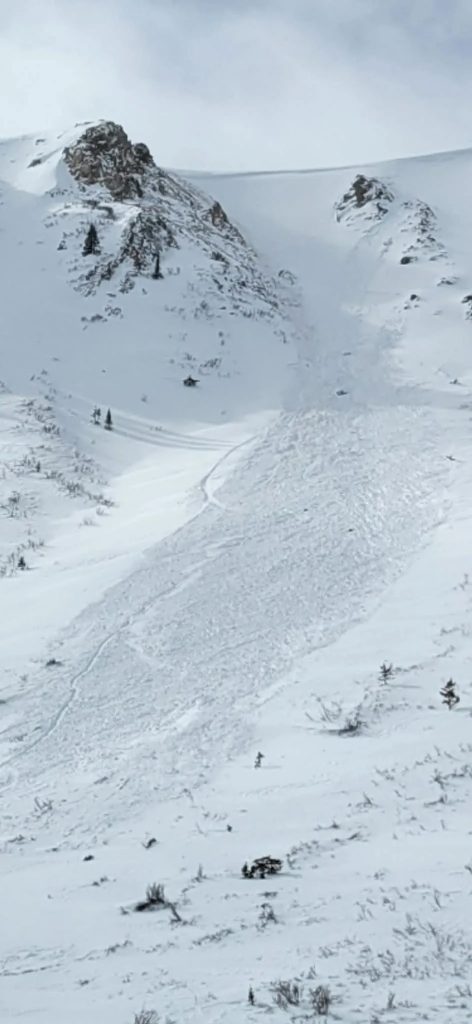 A skier suffered a leg injury triggering this avalanche in the Montezuma area of Summit County on Thursday, Jan. 29, 2026, according to the Colorado Avalanche Information Center. Though the avalanche danger is declining in places across the state, there is still a risk of avalanches that could be big enough to bury, injure or kill a person. Colorado Avalanche Information Center/Courtesy photo
The avalanche on Wingle Ridge near Vail Pass that caught a skier, carrying them about 30 feet, was also a persistent slab avalanche and was triggered remotely, or from a distance, according to the field report. That avalanche reportedly broke above one of the skiers as they were traversing through avalanche terrain just below the ridgeline.
To avoid persistent slab avalanches, Greene recommended backcountry travelers look out for wind-drifted snow that forms stiff, cohesive slabs below ridgelines. The alternative is to remain out of avalanche terrain, which is generally steeper than about 30 degrees, altogether.
In the central mountains, including the area near Aspen and south of Breckenridge, backcountry travelers could also encounter loose avalanche problems, where unconsolidated snow releases near the surface of the snowpack.
The current loose dry problem could develop into a loose wet problem in areas as temperatures warm heading into the weekend, Greene said. Loose avalanches have the potential to knock skiers or snowboarders off their feet and take them for a dangerous ride through rocks and trees, especially due to the low snowpack, he said.
While Greene said that the low snowpack so far this season has made for less than ideal conditions for winter sports enthusiasts, there is still plenty of winter ahead for additional snow to fall.
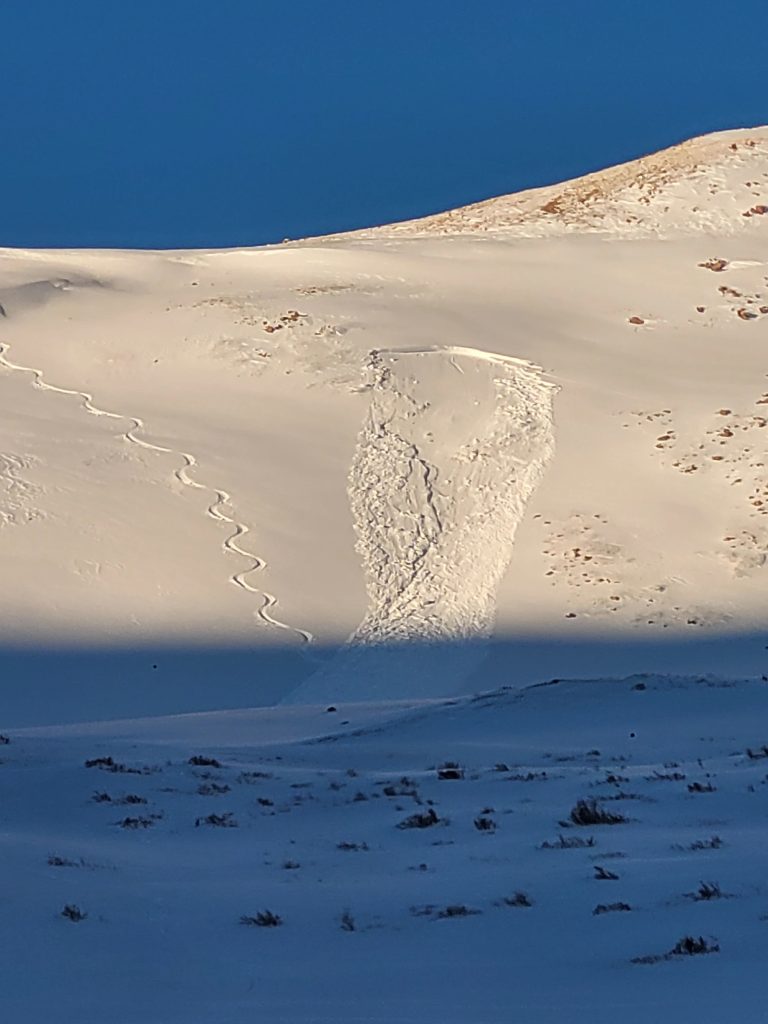 A skier remotely triggered this avalanche in the Summit County and Vail area from below on Jan. 31, 2025. The Colorado Avalanche Information Center forecasts warns that this tricky avalanche problem exists throughout the northern and central mountains. Colorado Avalanche Information Center/Courtesy photo
“February, March are often pretty snowy months. People often talk about the spring really being when Colorado gets the heaviest precipitation,” Greene said. “I don’t think we should give up on winter just yet, but given the snowfall right now, the winter we are going to see the rest of the year is going to be different than what we would see in a typical year.”
To check the latest avalanche forecast visit Colorado.gov/avalanche.