
Emily RussellHerb Brooks statue in Lake Placid honors 1980 Miracle on Ice hockey coach
Ten seconds of television have come to define the village of Lake Placid. Those last few moments of the 1980 Olympic hockey game between the American underdogs and the Soviet powerhouse were replayed at an event in the village last Saturday.
As the clock ticked down, the crowd of more than 150 people listened as ABC broadcaster Al Michaels asked, “Do you believe in Miracles? Yes!”
“Do we ever get sick of seeing that footage? It’s unbelievable,” said John Morgan, who mced the event to unveil a statue of the coach of the 1980 Olympic hockey team, Herb Brooks.

More than 150 people gathered to honor Herb Brooks, the coach of the 1980 Miracle on Ice Olympic hockey team. Photo: Emily Russell
Before he was known for his long coaching career, Brooks was known as a great hockey player who worked past a painful setback. He was cut from the 1960 Olympic team just a week before the games began. That team then went on to win gold. Brooks made the ‘64 and ‘68 Olympic teams, though never medaled.
At the event in Lake Placid, Jack O’Callahan shared insight into Brooks as a man and as a coach. O’Callahan was a top defenseman on the 1980 Olympic team. He said Brooks was bound and determined to get the very best from his players, pushing them to their limits.
“We practiced hard all the time and the bar was always raised,” explained O’Callahan. “He never had a bar, like do this and you’re good. No, you get close to it and he’d raise the damn bar.”

The 1980 “Miracle on Ice” hockey game between the United State and the Soviet Union at the Lake Placid Olympics. Photo courtesy of the Lake Placid Olympic Museum
Brooks was tough, said O’Callahan, and that toughness paid off. The team came from behind in the semifinals to beat the Soviets 4-3. Their work wasn’t over, though.
As O’Callahan reminded the crowd, the team was behind again going into the final period of the gold medal game against Finland.
“And you know what? We sat in that locker room and in the last 20 minutes, we didn’t need him. His job was done. He had spent nine months prepping us for this 20 minutes. And you know what he did, honestly? He didn’t even come into the locker room. He cut the cord and was like, they got this.”
And they did. The team came from behind again, scoring three goals in those last 20 minutes. The arena where those historic games were won was renamed after Herb Brooks in 2005. Brooks had died a year and a half earlier in a car crash. He was 66 years old.

The U.S. hockey team celebrating their gold medal at the Winter Olympics, Lake Placid, N.Y., on February 22, 1980. (AP Photo)
The team’s captain, Mike Eruzione, and sports broadcaster Al Michaels recorded tributes to Brooks, which were played on the TVs at the event in Lake Placid. After a few more speeches, Morgan gathered Brooks’s kids and grandkids up front to unveil the statue.
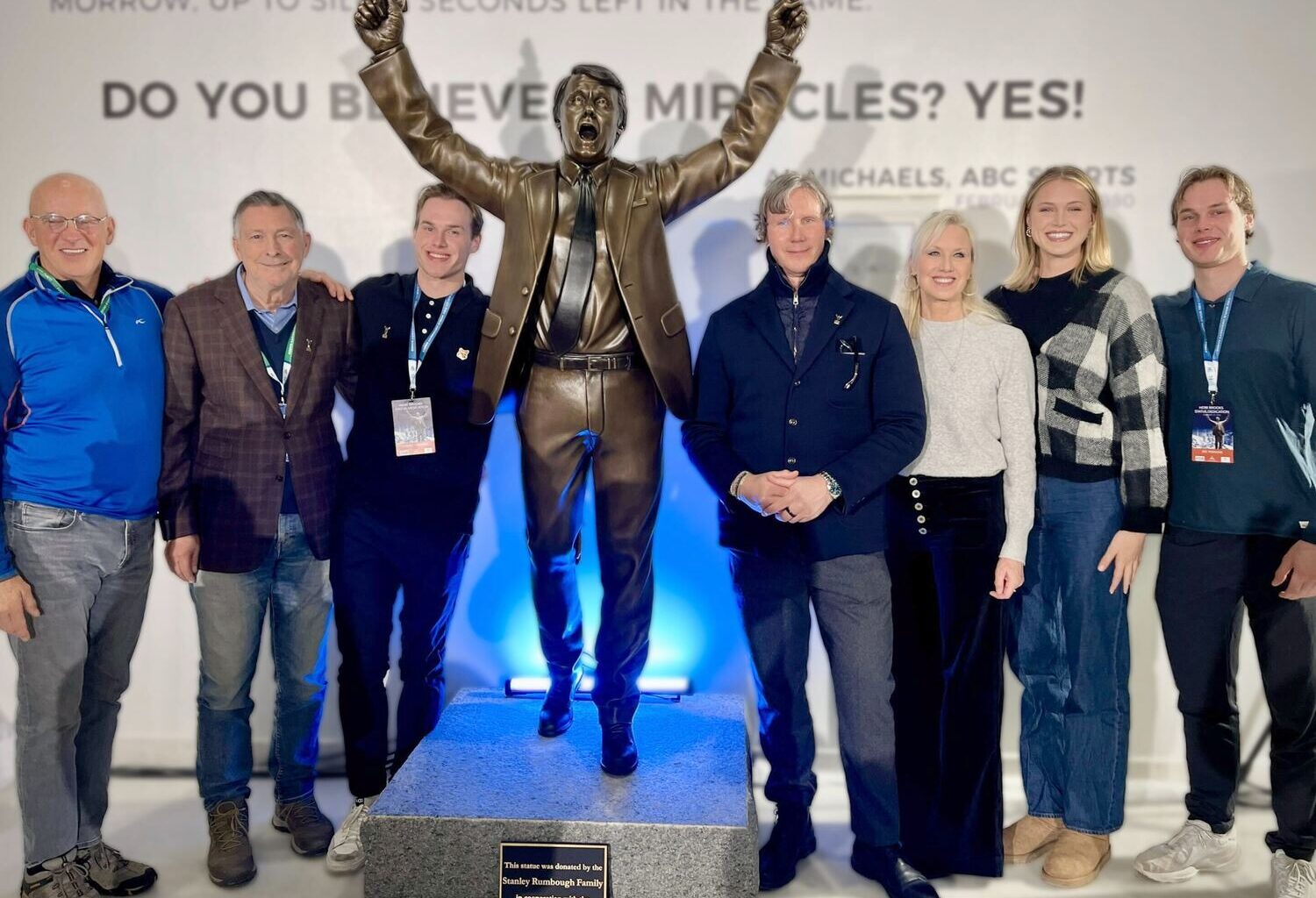
As the white cloth was removed, it revealed a six-foot bronze statue of Brooks with his hands in the air, his mouth open, celebrating the moment his team won gold.

Jack O’Callahan and Stanley Rumbough (left) with Herb’s childen, Dan Brooks and Kelly Brooks Paradise, and three grandchildren, Olivia, Joe and Tommy. Photo: Emily Russell
Stanley Rumbough donated the $90,000 needed for the statue. He has a home in the area and attends the annual Miracle on Ice hockey camp in Lake Placid. Rumbough said the tribute to Brooks was a no-brainer.
“You know, I could afford to do it as a tax write-off, so that helps, right? And why not? When you think about it, this statue should have been erected decades ago,” said Rumbough.
Two other versions of the same statue stand outside hockey rinks in Minnesota, where Brooks lived and coached for much of his career.
His son, Dan Brooks, said while the statue was an honor for the entire Brooks family, his father wouldn’t have needed it.
“It wasn’t about statues, it wasn’t about medals, it wasn’t about money, it wasn’t about trophies, it was peace of mind, knowing you did your absolute best and to be able to be comfortable with that.”

Herb Brooks, coach of the U.S. Olympic Hockey team of 1980, stands in front of a hockey photo at the Hall of Fame Club at Madison Square Garden in New York on Feb. 6, 1980. (AP Photo/Ron Frehm)
Shortly after his father’s death, Dan and his sister, Kelly Brooks Paradise helped start the Herb Brooks Foundation. It donates to local hockey leagues to expand access for younger players.
The statue unveiling in Lake Placid happened the same weekend as one of the CAN/AM youth hockey tournaments in the village, which Paradise said was fitting for her father’s legacy.
“He always wanted to give the game back to the kids,” said Paradise, “so for his statue there and these kids coming by and seeing him and knowing what he did, that hard work paid off, I think it’s a good lesson for these kids and I think that’s meaningful.”

Jack O’Callahan, a member of the 1980 Miracle on Ice Olympic hockey team, signing jerseys for young hockey players. Photo: Emily Russell
As the event wrapped up, young players in their hockey jerseys with their hockey parents started filing in. Once those parents realized a member of the 1980 team was in the crowd, they lined their kids up for autographs and photos.
Some of the kids didn’t know at first who Jack O’Callahan was, but they quickly got out their pucks and other things for him to sign, which O’Callahan did happily.
Now that the Brooks statue is in place, fans and financial supporters are shifting their attention to a bigger, more expensive statue. The Monument to the Miracle would depict all twenty players as they celebrated their gold medal in 1980.
That statue is expected to cost more than $5 million. The goal is to unveil it in Lake Placid at the 50th anniversary of the Miracle on Ice, which will take place four years from now.
