
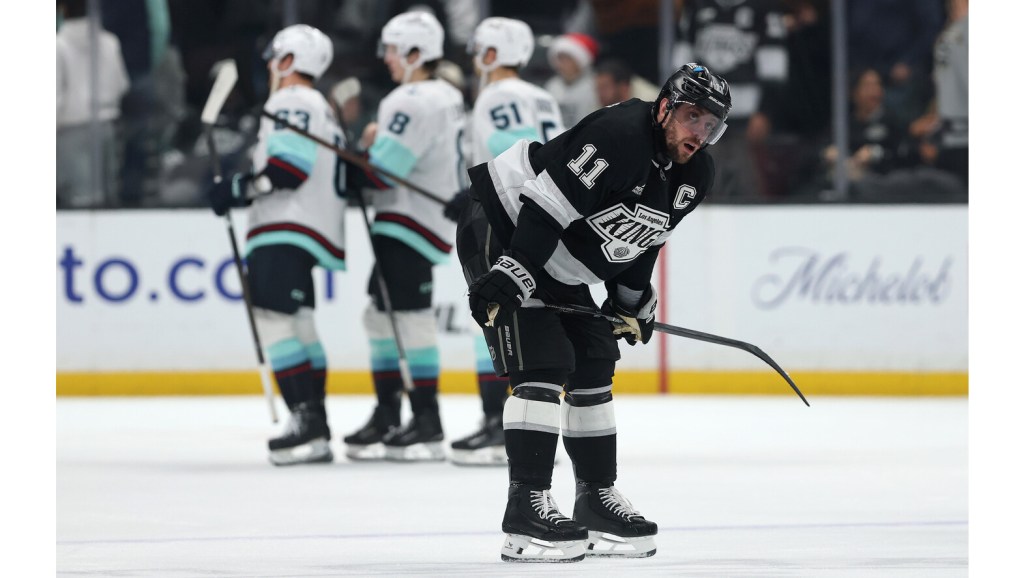
Although reinforcements were on the way, the Kings limped into the Olympic break and were on the wrong side of the playoff bubble as the pause commenced.
They landed Artemi Panarin via trade on Wednesday, but their subsequent back-to-back set saw them bow out of both games by the first intermission. They surrendered four goals in 5:27 against the division-leading Vegas Golden Knights to fall three points shy of the final postseason berth.
With five Kings headed to Milan, here are the grades at the break for each player with a minimum of 30 games played.
Anže Kopitar, center, B-
His final season hasn’t been a storybook one with two lower-body injuries costing him 15 games. He scored his milestone 1,300th point in Vegas but is on pace for just 36, a career low even taking three truncated campaigns into account. His strength and smarts remain elite, but his decline at 38 is increasingly evident.
Drew Doughty, defenseman, C
Doughty is also on track for a personal-worst output for a single season with 50 or more games played. Once masterful on breakouts and ironclad in individual battles, Doughty has dipped in both areas. He has a solitary power-play point and has been on the ice for more short-handed goals against (four) than power-play goals for (two).
Adrian Kempe, winger, B+
Kempe has been the team’s top producer, leading in goals, assists and points after signing a contract extension that will pay him more than any forward in Kings history. He’s been involved in eight of the Kings’ 19 game-winning goals. Yet he’s also endured stretches of invisibility, in part due to the stagnation of the Kings’ rush game and power play, where he’s on course for just 15 points after compiling 65 in the past three seasons.
Kevin Fiala, winger, B
Andrei Kuzmenko, winger, B
Fiala’s underlying numbers have dropped across the board, both five-on-five and overall. He’s still been the most effective Kings forward with the extra man and, of late, he and Kuzmenko have been a dangerous duo at even strength, too. Kuzmenko was a healthy scratch in five games but has been one of the Kings’ most impactful attackers since the calendar turned.
Quinton Byfield, center, C+
Byfield’s totals extrapolate to 16 goals and 44 points, with noticeable suppression of his underlying numbers. At a time when he was supposed to be blossoming into a centerpiece, his value has mostly been measured in minutes played and the matchup game. Perhaps Panarin can rekindle Byfield’s offensive prowess, which has been limited by an apparent decrease in confidence and another increase in defensive responsibility.
Brandt Clarke, defenseman, A-
Clarke has been the brightest spot on the roster, with the Kings scoring six more goals five-on-five with Clarke on the ice than any other skater. He’s been their strongest option on the point during man-advantage situations while posting fantastic two-way and comprehensive metrics. He’s also relished big moments in games and earned increased ice time, upping his value in a contract year.
Alex Laferriere, forward, B-
Laferriere has logged valuable minutes at center in light of not only Kopitar’s injuries but the departure of Phillip Danault via trade in December. Yet one should not mistake activity for achievement, as his production has slacked at a time when the Kings were counting on growth from a young player who they signed to a three-year extension over the summer.
Darcy Kuemper, goalie, B+
Anton Forsberg, goalie, B+
Both members of the Kings’ goalie tandem have stolen points at times and wobbled a bit at others. Kuemper excelled early on but injuries and mixed form followed, while Forsberg might have moved from No. 2 status to more of a 1B designation.
Mikey Anderson, defenseman, B-
Joel Edmundson, defenseman, B-
Anderson and Edmundson are among the banged-up blue-liners for the Kings heading into the break. Anderson has had multiple partners while Edmundson has been deployed consistently with Clarke. Offensive expectations were low, but both players have seen their defensive bellwethers head in the wrong direction.
Cody Ceci, defenseman, C-
Brian Dumoulin, defenseman, C-
These two veterans were signed on July 1 to replace the departed Vladislav Gavrikov and Jordan Spence. Predictably, the dropoffs in speed and skill have impacted the Kings’ two-way game negatively, contributing to the deepening defense-forward disconnect that has often rendered their offense unwatchable.
Corey Perry, winger, A-
Joel Armia, forward, B
Perry has delivered the doggedness the Kings came to expect from him as a longtime rival, along with his best per-game scoring rate since 2018. They’ve won just one of the 11 games in which the 40-year-old did not play. Armia, also signed over the summer, has been as advertised, bringing aggression, energy and a serious threat to score shorthanded.
Trevor Moore, winger, C
Warren Foegele, winger, D-
Moore scored 31 goals two years ago but is barely on target to break double digits, with injuries again being an issue while his defensive impact has receded. Foegele’s plummet has been even more precipitous, causing the $3.5 million man to be scratched in favor of fringe NHL’ers of late. Hindered by an early-season upper-body injury, he’s on a trajectory for just 13 points after notching 46 last season, when Moore said Foegele was “built in a lab” to be a King.
Alex Turcotte, center, B
Jeff Malott, winger, B-
Both Turcotte, a former No. 5 overall pick rebuilding his pro career after injuries, and Malott, who was essentially a career minor-leaguer before joining the Kings, have strong underlying numbers in limited roles. Turcotte has improved immensely on the faceoff dot, which has been key in the face of Kopitar’s injuries, Danault’s departure and Byfield’s continued struggles in the circle.
Jim Hiller, head coach, F
The Kings’ points percentage is equivalent to an 88-point effort after tying a franchise record with 105 in Hiller’s first full campaign at the helm. Nearly every player on the roster has been less effective this season and almost all of them have struggled with consistency. Hiller has tried practically every line combination and defensive pairing, seldom coming up with a sustainable boost. The vibes and junior hockey tactics that functioned early in his tenure seem to have lost all efficacy. Meanwhile, his predecessor (Todd McLellan) and the most obvious candidate he beat out for this gig (Marco Sturm) have thrived elsewhere.
Ken Holland, general manager, B
Holland arrived on the scene of a muddling franchise that had lost four straight first-round series to the same opponent. The Kings had squandered talent, particularly in the 2023 offseason, before losing players in free agency and due to trade requests. Holland’s predecessor Rob Blake passed on an extension. Yet Holland has begun to put his own stamp on the organization, doing right by Danault at the holiday trade freeze while maximizing return for him and now acquiring Panarin, the splashiest in-season addition the Kings have made in at least a dozen years.