
With Artemi Panarin off the trade board as the newest member of the Los Angeles Kings, contenders around the league are reassessing their deadline plans. If you want a big upgrade at the forward position, where do you look?
For my money, the answer to that question starts with Jordan Kyrou and the St. Louis Blues.
The rumour mill has been churning for several months now over St. Louis’ intentions to sell at this year’s trade deadline, and Kyrou is just one of several names – you can add forwards Robert Thomas, Brayden Schenn, Mathieu Joseph and Oskar Sundqvist to that list – that is likely available from the Blues for the right price.
What makes Kyrou such an alluring trade target for a contender is that this “down year” he’s having, which included a healthy scratch back in November, looks much more reflective of the playing environment around Kyrou than his individual calibre of play.
The speedy winger has averaged 34 goals per 82 games played over the past four seasons; that production alone justifies a contract that carries a cap hit just over $8 million per year, especially for a 27-year-old forward in his playing prime. (Note: Kyrou’s contract does have a no-trade clause, so he can dictate potential landing spots if moved.)
His scoring pace has dropped this year (23 goals per 82 games), but that coincides with St. Louis’ broader collapse in the Western Conference. What’s intriguing to me about Kyrou is he looks every bit the part of a dynamic top-six attacker – just one with miserable goaltending behind him.
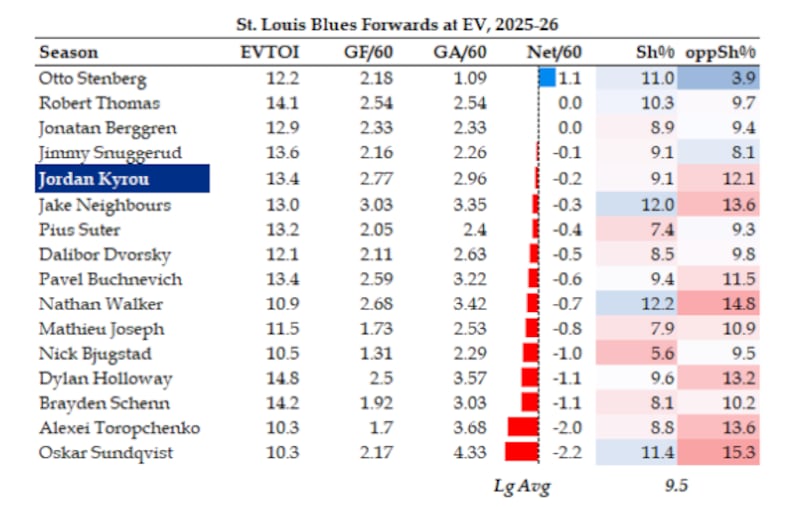
Kyrou has the fifth best on-ice goal differential for St. Louis this season, with the Blues outscored 31 to 29 (-2) with him deployed. That’s nothing to write home about, but noteworthy when your goaltenders aren’t even stopping 88 per cent of shots faced:
 Yost1
Yost1
Save percentages are a function of both goaltending and defensive play in front, which is why analyzing expected goal rates are important here. Poor defensive skaters can be responsible for high goals-against numbers; other times, it’s shoddy goaltending that makes the defensive play look worse than it actually is. In the case of Kyrou, I suspect the latter is what’s happening.
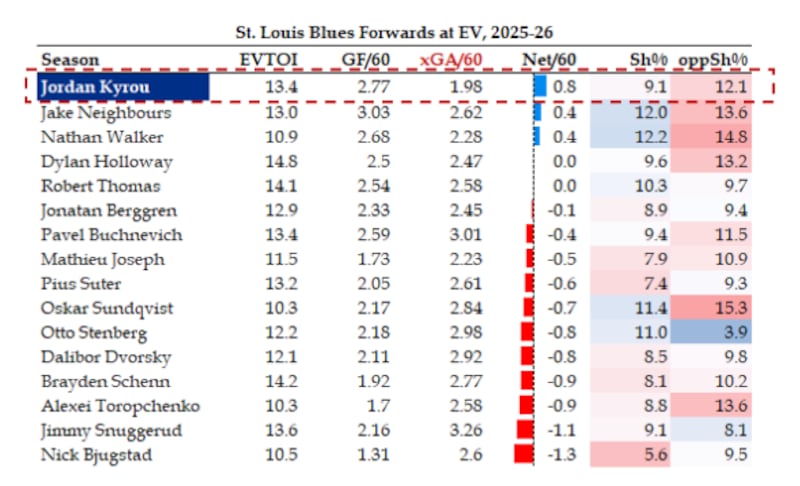
Let’s look at this same table but swap out real goals against for expected goals against, which measures the probability of each shot against finding the back of the net. If Kyrou and every other Blues player had neutral goaltending play behind them, how would their on-ice numbers look?
In Kyrou’s case, incredible:
 Yost2
Yost2
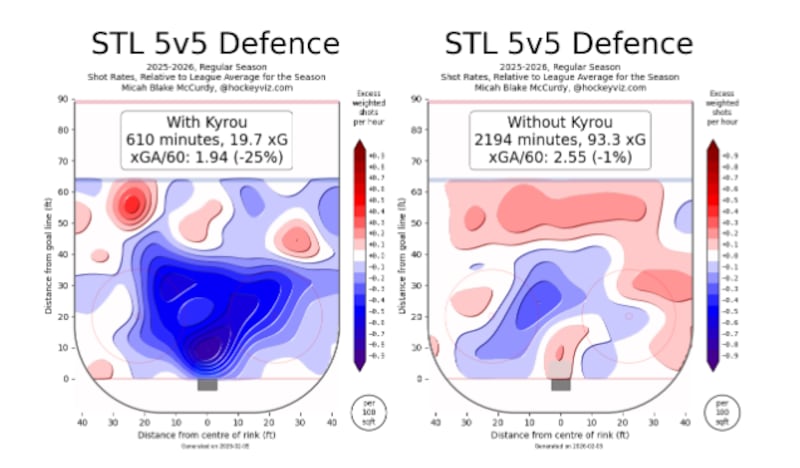
If you need any more evidence that Blues goaltenders are hurting Kyrou much more than his play is hurting them, consider the shot profiles faced at 5-on-5 with and without him deployed.
St. Louis looks fantastic defensively with Kyrou on, with very few shots coming from those dangerous areas near the net mouth and between the circles. It makes it rather stunning Blues goalies are stopping under 88 per cent of shots faced in these scenarios, especially when they’re playing much better in the non-Kyrou minutes where more dangerous shots are likely (via HockeyViz):
 Yost3
Yost3
Considering the above (and the fact that goaltenders have reliably stopped 91 per cent of shots with Kyrou on the ice over his career), it’s reasonable to argue that defensively Kyrou has been burned by some rather unfavourable puck luck.
If we take purported defensive concerns off the table and chalk them up to goaltending woes, the other question of concern inquiring teams may ask: Should we be concerned about his individual production this season?
My short answer again is no. While scoring is marginally down, expected goal rates and corresponding individual shot volumes are at or above his career baseline. When reliable goal scorers see a meaningful and sustained drop in production, it usually coincides with less shooting volume and/or shots from less dangerous areas of the ice. Kyrou is getting to his spots the same way he has in years past, an encouraging sign that a rebound is ahead:
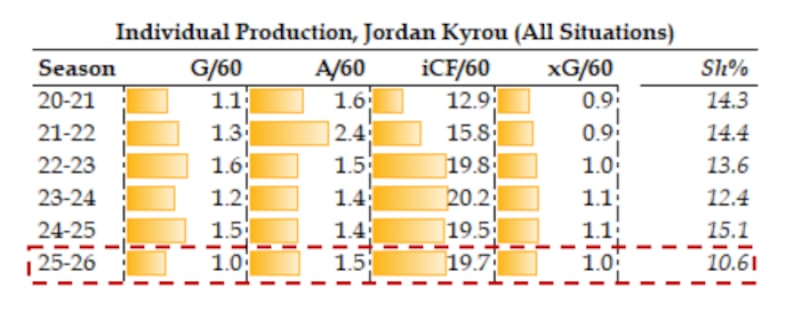 Yost4
Yost4
The Blues organization knows how talented Kyrou is – they drafted and developed the player, and I suspect their asking price at the trade deadline will be commensurate with his production in prior seasons. But the Blues as an organization know they are headed toward a rebuild of sorts, and a player like Kyrou could generate a substantial return.
It’s a price I’d be willing to pay if I’m a contender in need of a speed and scoring upgrade on the wings. Kyrou looks primed for a rebound, and if you can get him for 90 cents on the dollar at the trade deadline, it’s a price you pay every time.
Data via Natural Stat Trick, NHL.com, Evolving Hockey