
For most prospects, the road from being drafted to becoming a successful professional is long, steep, and full of learning. Several Wild prospects are taking that to heart, literally choosing to get an education by leaving the Canadian Hockey League (CHL) and continuing their careers in the NCAA.
While having prospects playing college hockey is normal for any NHL organization, last year’s NCAA ruling that junior hockey players from the CHL are now eligible to play in the NCAA opened the floodgates for players seeking new avenues for development.
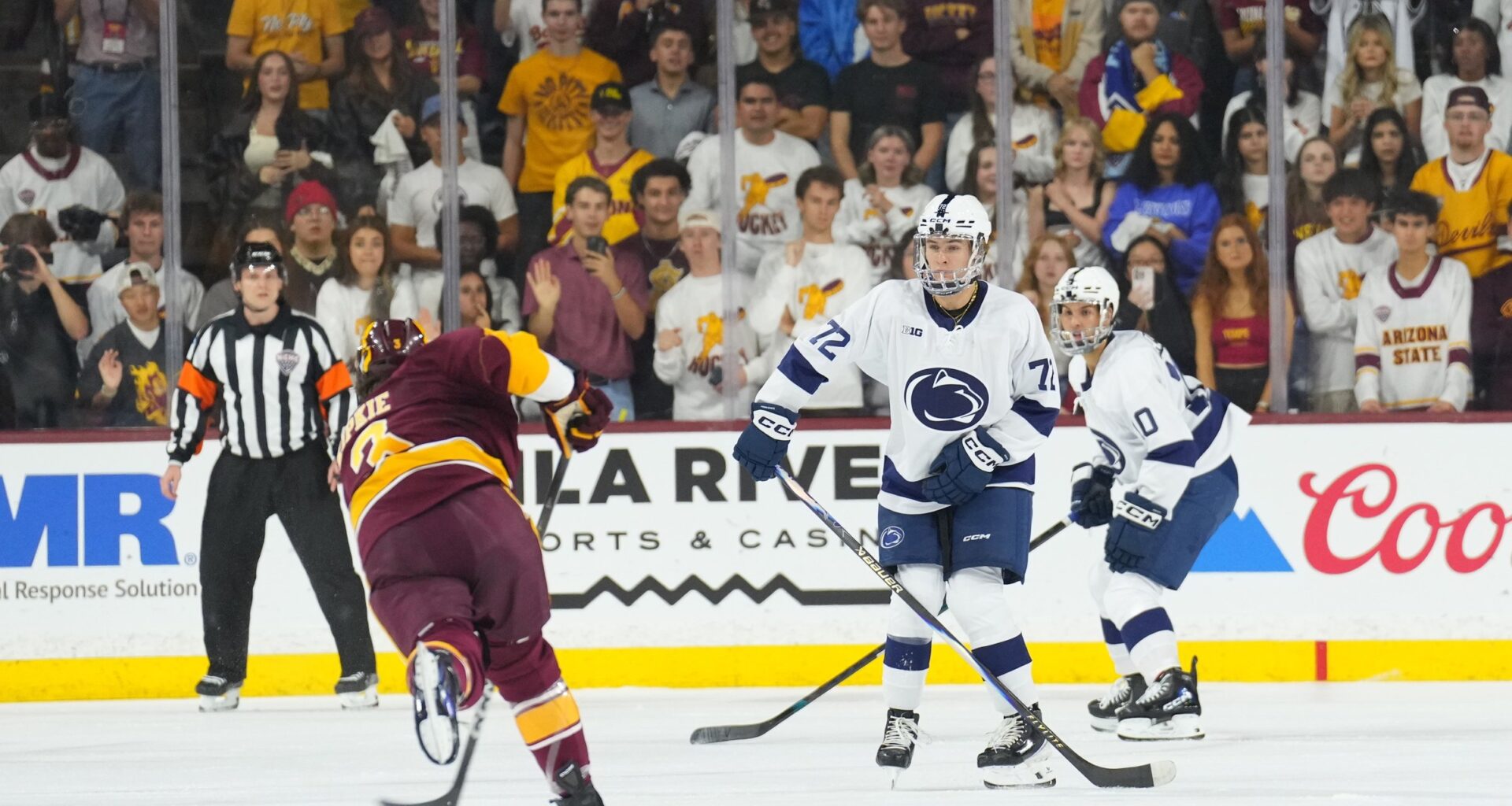
Two of the Wild’s prospects immediately elected to make the leap. Forward Ryder Ritchie, a 2024 2nd round pick, left Medicine Hat of the WHL and enrolled in Boston University for this season. Meanwhile, defenseman Justin Kipkie, a 5th-round draft pick in 2025, moved on from Victoria of the WHL to join Arizona State for this season.
Additionally, forward Lirim Amidovski, another 2025 draft pick (4th round), will be making the jump next season after committing to the University of Connecticut, having spent the past three seasons playing for North Bay in the OHL.
Will more follow suit? It’s possible. 2025 draft picks Adam Benak (3rd round) and Carter Klippenstein (4th round) are players who have the option, should they choose to pursue it. They might be well advised to do so, because the move has benefited Ritchie and Kipkie in their freshman seasons and is also absolutely the right decision for Amidovski.
Ritchie is a key player at BU
Boston University is having an uncharacteristically poor season despite having its usual stockpile of talent. It’s been a struggle all season for the Terriers, who look like a team that lacks continuity or any discernible identity, and they are likely going to miss out on an NCAA tournament bid as a result.
Ryder Ritchie, a right wing, has also had his share of struggles, producing five goals and nine assists in 28 games. While the numbers aren’t impressive for the 19-year-old freshman who was coming off a stellar year in the WHL last season, a deeper look at the numbers reveals that Ritchie has actually been pretty solid relative to his teammates.
He has spent the season moving up and down the lineup as BU’s coaching staff has been regularly adjusting lines to find chemistry. Most recently, he’s spent time on the third line. However, throughout the season, he’s become a trusted player and is third among BU forwards in time on ice, averaging 18:20 per game.
Ritchie is also third among forwards in shot attempts at even strength and on the power play, and has produced 7.4 expected goals, which is second-highest among forwards and above his actual goals scored total of five. When it comes to development, however, the numbers only matter so much.
Ritchie is an intelligent player who makes quick reads and understands how to exploit space and openings, but he’s never been a big point producer at any level, and likely never will be. Instead, his ideal role is that of a facilitator and puck mover on a line with skilled teammates. That’s how he’ll likely make his mark in professional hockey when he eventually makes the jump.
Boston’s struggles with pace and inability to settle on consistent line combinations have made for a challenging environment for Ritchie in his first college season. Pace will always be a question mark for him, and playing on a team that lacks it has led to periods of stagnation. That said, he’s held up well overall. Boston also has several high-end prospects on the way next season, meaning Ritchie should be in a good position to have a quality sophomore season.
He would be best served by spending another season or two in college hockey, and he likely will. The Wild don’t have to sign him until the summer of 2028, and will likely let Ritchie bake in the NCAA for as long as they can before bringing him into the fold. If he has a big year next year, perhaps he could turn pro for the 2027-28 season.
Slow and Steady for Kipkie at Arizona State
Justin Kipkie, a 6-foot-4, 216-pound left-shot defenseman, is a bit of a project, but he has a lot of tools that will translate well to professional hockey. The issue for him is his footspeed. He’s definitely not quick, and it can be a hindrance in certain situations, both when defending and as a puck carrier under pressure. That said, he has learned to compensate for that and understands his strengths, which has led to a solid freshman season as a 20-year-old at Arizona State.
One of those strengths is his shot, and Kipkie has been a shot-generating machine in college hockey. He leads all ASU defensemen in shots and shot attempts, which is more impressive considering that those shots have come almost exclusively at even strength. Still, while 51 of his 101 shots have been on net, over a third of them have been blocked. That means that while he’s generating a lot of shot volume, he’s still adjusting to the tighter defensive structures that accompany college hockey.
Still, the fact that Kipkie can produce such high shot volume despite being fourth among defensemen in time on ice (16:44 per game) demonstrates that some of the offensive tools he showcased in juniors have carried over to the next level. He remains a strong puck mover who can hit seams on outlet passes and in transition. He’s played a bit of a sheltered role as a third-pairing defenseman, so it will be interesting to see how his usage changes next season.
Age is one factor that will impact how the Wild handle Kipkie. The Arizona Coyotes first drafted him in 2023 didn’t sign him, which led the Wild to take a flyer on him in last summer’s draft. Therefore, with Kipkie turning 21 next summer, the Wild will have to sign him by the summer of 2027. However, that could change because the rules remain unclear regarding the retention of rights for CHL players who move to the NCAA.
With the offensive tools and size that Kipkie has, I have to think the Wild will bring him into the fold when they have a chance, even if that means starting in the ECHL. Connecting him with hands-on skating coaches and strength trainers will hopefully help Kipkie squeeze every bit of quickness and speed he can muster and give him a shot at playing in the NHL.
Amidovski was made for college hockey
I’m a huge believer of Lirim Amidovski’s game, and after an excellent showing at last summer’s Tom Kurvers Prospect Showcase, the 6-foot-1, 175 pound right wing is in the midst of another strong season for North Bay in the OHL, where’s he’s serving as an alternate captain and playing on the second line, while also getting plenty of power play and penalty kill minutes.
His scoring numbers are up from last year, as are his shot volume and power play production. Amidovski has produced 18 goals and 15 assists in 49 games. Five of his tallies have come on the power play, and he’s averaging 3.4 shots on goal per game overall.
Amidovski’s game isn’t about scoring, though. It’s about speed, straight-line attacking, and relentless puck pursuit. He moved the puck efficiently out of the zone and in the neutral zone, making strong area passes and drawing in defenders to freeze up teammates. When Amidovski sees a chance to attack a defender, he does. He can also stickhandle well enough to beat guys one-on-one at the junior level.
He will have an opportunity to play against better competition next year. Amidovski is committed to the University of Connecticut along with his brother, Nathan, who has a chance to be a mid-to-late round draft pick in the upcoming draft.
Amidovski’s style of play is reminiscent of Brandon Duhaime. He isn’t as stocky as Duhaime, who was listed at 6-foot-1, 207 pounds in his junior year at Providence. Still, there’s time for him to add to his frame, and also to continue to develop his up-tempo, straight-line, hard-nosed game that he’s increasingly leaning into as a player.
Duhaime left college to begin his professional career after three post-draft seasons. It would not surprise me to see Amidovski do the same, meaning he would spend the next two seasons at UConn before making the leap to the AHL.
Once he does, I expect his transition to pro hockey to be relatively seamless, because his style of play will be conducive to success. If his development stays on track, I’m betting on Amidovski becoming an NHL regular by the 2030-31 season, when he’d be a seasoned 23-year-old with a lot of runway behind him. It will not surprise me if he gets some NHL games before that, either.
Are Benak and Klippenstein next?
Klippenstein is an ideal candidate for a move to the NCAA. He projects as a bottom-six player in professional hockey, and his best chance of making the NHL is to lean into his physical attributes. Klippenstein is 6-foot-3, 185 pounds, and understands that his size can be an asset. Moving to college hockey would allow him to develop his game against stronger, older players.
He’s probably outgrown junior hockey from a physical standpoint. Klippenstein is having an excellent season for Brandon in the WHL (28 points in 38 games). That said, a player at his size isn’t going to be challenged physically often in juniors, meaning he can easily rely on the ability to outmuscle players. Keep an eye out for news on his plans for next season.
Benak’s rise as a prospect has been well-documented on Hockey Wilderness, but he’s mastered the junior level. His 1.63 points per game (23 goals and 34 assists in 35 games) leads a Brantford team that is dominating the OHL this season.
His biggest area for development is learning to get to the interior at the right times and handle physical play in an environment where he can’t rely solely on his skating and quick hands to overwhelm opponents. College hockey would be an ideal environment in which to do that.
The 5-foot-8 Benak has some professional hockey experience in Czechia, but the new NCAA rules mean that that experience doesn’t make him ineligible. Should Benak opt to make the move, he’ll probably have his choice of suitors eager to bring him into the fold. A season or two of college hockey would be ideal for the diminutive and supremely skilled center.