
As Montreal Canadiens players step back from their NHL duties over the Olympic break (one way or another) and reset, hopefully the front office takes some time to assess. Especially with the trade deadline coming up on March 6, there is close to none to waste.
While the Canadiens are in an undeniably good position, there is clear room for improvement. The following 10 stats paint a clearer picture of just how successful they’ve been in 2025-26, while clearly facing their share of conflict. How much of that conflict has consisted of friendly fire, though?
10. Sets of Back-to-Back Games: 16
At the onset of the 2025-26 season, while expectations had been heightened following an unexpected playoff berth the previous spring, it was still going to be tough to so much as replicate that level of success in the face of a condensed schedule as a result of the current Olympic break. While that’s something every team has had to deal with, it’s to varying degrees.
For example, the Canadiens boast a co-league-leading 16 sets of back-to-back games (tied with the San Jose Sharks, Los Angeles Kings, New York Islanders and Pittsburgh Penguins). So far, in back-to-back situations (second game), they’re 5-3-2, which isn’t horrible. Still, six sets remain down the stretch.
Based on how tight things are in the Atlantic, it would really suck (for lack of a better term) were the Canadiens to lose ground in the race to a playoff spot, when they were at a disadvantage from the jump relative to their division rivals, who each will have ended up playing fewer sets when all is said and done.
9. Points Percentage: .632
While the aforementioned 5-3-2 record isn’t bad per se, it amounts to a .600 points percentage. As an illustration of how fatigue can adversely impact a team (in full acknowledgement that fatigue impacts different teams in different ways), the Canadiens are currently earning 63.2% of points up for grabs. Over a full 82-game schedule, that prorates to almost 104 points… and over five more points than the 98 they would earning playing .600 hockey over a full season. Currently in second place in the Atlantic with 72 points, five less points would drop the Habs below the fourth-place Boston Bruins, who are currently holding down the second wild-card spot.
The precariousness of the Canadiens’ current position in the standings notwithstanding, they must be applauded for improving year over year. Between Dec. 3, 2024, when they started the day in last place in the Eastern Conference, and the end of the regular season, when they finished in the aforementioned second Eastern Conference wild-card spot, they played .621 hockey. What’s most impressive is that is a points percentage on par with last season’s Colorado Avalanche and Tampa Bay Lightning, who are the class of the league so far in 2025-26. The Habs are at least playing better than each of those teams did in 2024-25, which is an accomplishment in its own right.
8. Save Percentage: .883
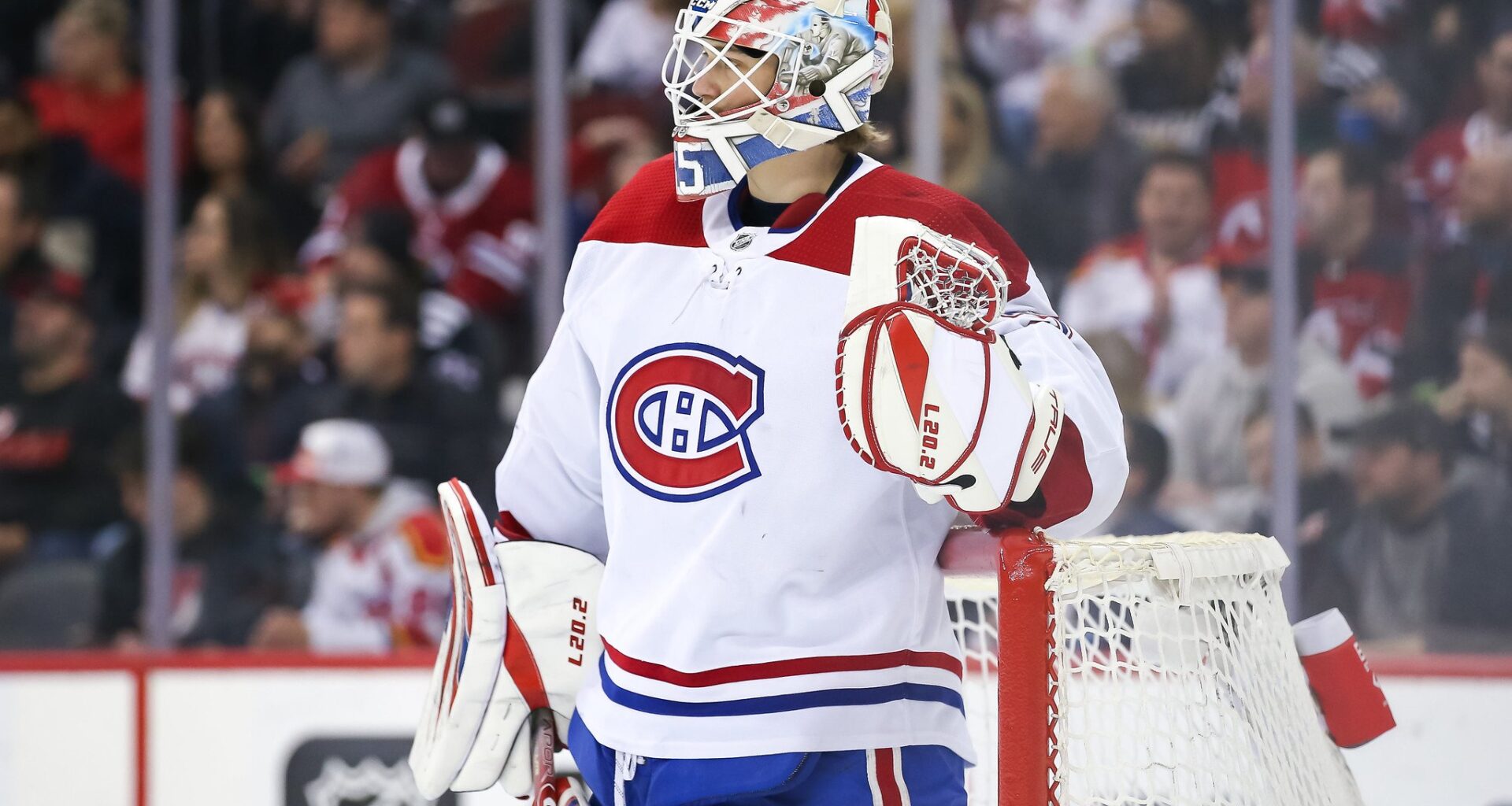
What is both impressive and a black stain on the Canadiens’ performance so far is they’ve accomplished all they have with sub-par goaltending. They currently own a team save percentage (SV%) of .883. The league average is currently .896, which puts the Habs in 24th place.
It’s no secret that last year’s starter, Sam Montembeault, has struggled significantly, after he made Canada’s 4 Nations Face-Off team on the strength of his stellar play that saw him finish the season among the league leaders in terms of goals saved above expected. He finished 2024-25 with a 31-24-7 record, 2.80 goals-against average (GAA) and .902 SV%.
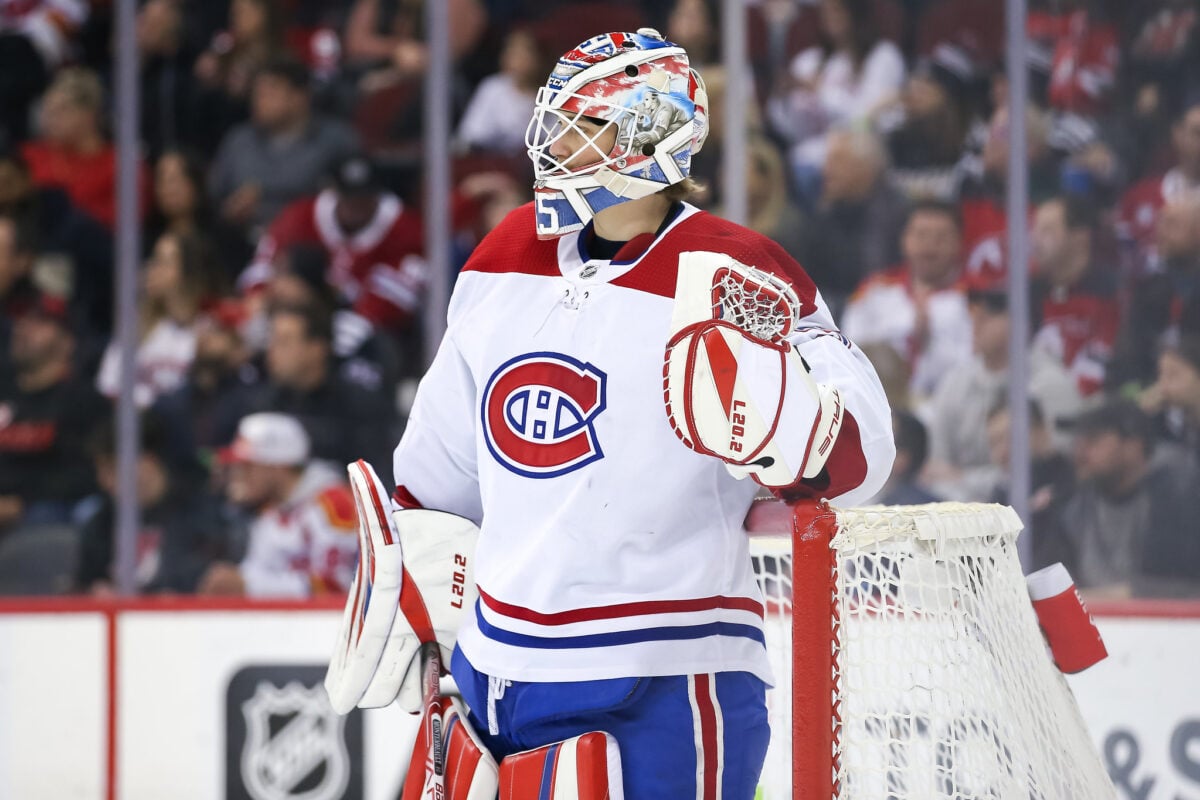 Montreal Canadiens goalie Sam Montembeault – (Jess Starr/The Hockey Writers)
This season, Montembeault is 10-8-2, with a 3.34 GAA and .875 SV%, having been sent down to the American Hockey League at one point and eventually having lost his starting job to Jakub Dobes by most accounts, after an especially disheartening loss to the division-rival Boston Bruins in late January, when he gave up the game-tying and game-winning goals late in the third period, within 12 seconds of one another.
Related: Canadiens Hoping History Repeats Itself After Goalie Coach Change
While Dobes has been better, especially in terms of his winning percentage at 18-5-4, his .892 SV% also leaves something to be desired, prompting many Canadiens fans to ponder how much higher in the standings they’d be with even average goaltending. It’s a fair question, especially when you consider the Habs give up a respectable 27.3 shots per game (ranked 13th).
7. Penalty Differential: -24
Now, it’s not all on the goaltending. In the game in question for example, defenseman Alexandre Carrier took a penalty right after the Bruins had tied it, leading to the game-winning goal being scored on the ensuing play. Granted, it was a shot Montembeault should have had, but he shouldn’t have been put in that position and it’s a recurring position in which both he and Dobes have been put, with the Habs having taken 24 more penalties than they’ve drawn, third-worst in the league.
Ironically, the Bruins are worst in the league at -45. However, based on stats compiled by Andrew Berkshire of Habs Eyes on the Prize, the Canadiens still get the shortest end of the stick of all Atlantic teams when it comes to “game management” on the part of referees. The Habs are the only team in the division to receive less than half of the power plays relative to opponents when they’re trailing.
Whether that’s an odd quirk, a reflection of the team’s poor discipline or subconscious bias on the part of officials after they were called out by everyone with eyes following an especially egregious showing in a game between the Canadiens and Oilers in October, who’s to say? Based on how the Canadiens have seemingly attracted the ire of referees since speaking the truth, it probably shouldn’t be them.
6. Second-Period Goal Differential: -8
While the situation has gotten slightly better since the start of December, the second period remains the worst by the Canadiens. It’s also one of the worst second periods in the entire league. While seven teams have worse second-period differentials, all those teams currently find themselves out of the playoff picture (San Jose Sharks, Toronto Maple Leafs, Philadelphia Flyers, Chicago Blackhawks, New York Rangers, Vancouver Canucks, St. Louis Blues).
You’d think, based on their record, that the Canadiens are better than that. They shouldn’t be setting themselves up for failure in the third period like that, even if that period is one of their best.
5. Number of Comeback Wins: 19
In actuality, the Canadiens’ first period is their best (+10 goal differential). However, their third (+7) isn’t far behind. The fact that the Habs co-lead the NHL in third-period comebacks with eight (Maple Leafs, Vegas Golden Knights) is more reflective of their horrible second… and their general penchant for turning deficits into eventual victories. They lead the entire league with 19 wins when trailing at any point.
The fact that they’ve needed extra time to secure eight of those victories after having fallen behind may make for exciting hockey. It may end up hurting them in the standings in the end, though.
4. Number of Regulation Wins: 21
The first tiebreaker is points percentage. It’s the reason why the Canadiens currently lead the Detroit Red Wings in the standings and are holding down second place in the Atlantic despite both teams having earned 72 points so far. It just so happens the Wings have played one more game. So, the Habs are considered the superior team for all intents and purposes.
Come the end of the season though, that first tiebreaker means nothing, because everyone will have played 82 games. The focus shifts to the second tiebreaker, then: regulation wins. Because the Canadiens owe overtime (and the shootout) to so many of their victories, they’ve only been able to secure wins in regulation 21 times, which is the lowest amount of any Eastern Conference playoff team. And, while there is something to be said for an ability to score in overtime come the playoffs, the fact they’re so adept at playing three-on-three hockey also means little once things switch to a five-on-five format in the postseason.
3. Points by Defensemen: 156
Thankfully, there’s more to be said for an ability to score overall. And the Canadiens boast one of the most dynamic offenses in the league with a third-ranked 197 goals scored (3.46 per game). It should be no shock their elite transitional game originates from an incredibly mobile back-end with 156 points scored by defenseman, which ranks second (Avalanche).
Obviously, Lane Hutson leads the way with 58 points (10 goals) in 57 games to rank third in the NHL among defensemen. However, last offseason’s prized acquisition, Noah Dobson (38), is no slouch and has come largely as advertised as a top-pairing right-handed defenseman, who has complemented Mike Matheson (28) very well on what has been head coach Martin St. Louis’ most-used pairing this season. Just like how most plays typically originate from a puck-moving defenseman though, that is just the beginning.
2. Number of 40-Point Scorers: 5
In some ways, these Canadiens fall short of matching the offense of the 2007-08 edition, which ended that season with seven 50-point scorers. It looks like these Habs may end up with “just” six, but they ended January leading the league with five 40-point scorers: Nick Suzuki (65), Hutson, Cole Caufield (57), Ivan Demidov (46) and Juraj Slafkovsky (45).
 Montreal Canadiens forwards Juraj Slafkovsky and Ivan Demidov and defenseman Lane Hutson – (Bob Frid-Imagn Images)
While Suzuki, Hutson and Caufield are already at 50, Demidov and Slafkovsky look like shoo-ins to join them. Dobson (38) is on his way, while Oliver Kapanen (31) is a long shot. Still, the team’s per-game scoring clip points to a deeper offense overall compared to what the team was working with nearly two decades ago. And they may yet eclipse them in another, more significant way, with five 70-point scorers.
Le Canadien pourrait potentiellement avoir 5 marqueurs de 70 points ou plus à la fin de la saison…quelque chose qui ne s’est pas vu à Montréal depuis 1976-77!😳#lesickpodcast @TonyMarinaro @Antho_Martineau @alavoiemartel pic.twitter.com/ynSFcE4BRf
— The Sick Podcast with Tony Marinaro (@thesickpodcasts) February 6, 2026
The 2007-08 team only had one (Alexei Kovalev). Think about that for a second… and how this specific team is only getting better with each passing season. Then smile from ear to ear if you feel so inclined. You’d have good reason.
1. Average Age on Opening Night: 25.8 Years
Indeed, the Canadiens opened 2025-26 as the youngest team in the NHL. The core (Suzuki, Caufield, Slafkovsky, Hutson, Dobson, Kaiden Guhle) is locked up until 2030. If Canadiens general manager Kent Hughes follows the same MO, Demidov will probably follow in their footsteps soon.

They’ve also got relatively blue-chip prospects (Jacob Fowler, Michael Hage, David Reinbacher) projected to vie for roster spots across the lineup in the not-too-distant future. You’d be forgiven for forgetting to relish the present, which isn’t half-bad either.
It’s time to take a breather before the home stretch. Things are about to get good.