
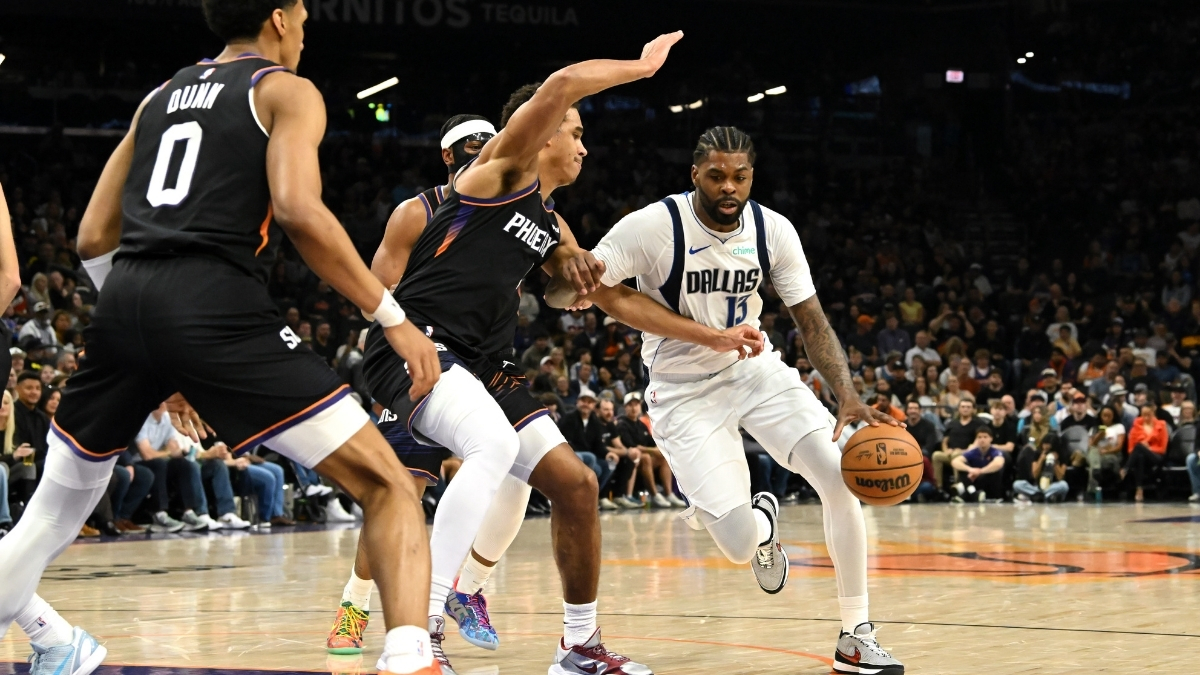
The Dallas Mavericks did not question their effort Tuesday night. They questioned their start.
After falling behind by 31 points in the first half against the Phoenix Suns, Dallas responded with force — cutting the deficit to six late — but ultimately fell 120–111, extending its losing streak to eight games.
For head coach Jason Kidd, the explanation was not complicated.
“The physicality — they were physical, and we weren’t in that first half,” Kidd said. “I thought the group did a better job there in the second half with the physicality.”
Jason Kidd Points to Physicality and Three-Point Production
The shift was visible. Dallas attacked downhill, forced contact and lived at the free-throw line. The Mavericks attempted 44 free throws. Phoenix attempted nine. That disparity reflected the identity Dallas believes it has.
“We’re a downhill team,” Naji Marshall said. “When we get downhill, we’re tough to guard and tough to stop. Tonight the whistle just went our way. But I think that’s a testament to our character — physical drivers who live in the paint.”
But even as the Mavericks imposed themselves physically, the math of the modern NBA remained unforgiving.
“We got to the free throw line 44 times, but we’ve got to be able to produce some more threes,” Kidd said. “We just didn’t do that this evening. You get to the line 44 times, you’ve got to take advantage of that. But the group fought. We cut the lead and had some good looks that just hit back rim.”
The gap ultimately came from the perimeter. Dallas finished with five made three-pointers. Phoenix made 16. Even with the free-throw advantage, the Mavericks were climbing uphill against a scoring imbalance that physicality alone could not erase.
And that imbalance began early.
Naji Marshall and Cooper Flagg Power The Second-Half Rally
Once Dallas steadied itself after a sluggish start, the tone shifted behind the aggressive downhill play of Naji Marshall and Cooper Flagg. The pair combined for 58 points, repeatedly collapsing the defense and forcing Phoenix to react at the rim rather than dictate from the perimeter.
Kidd said the production was less about shot-making and more about approach, particularly Marshall’s willingness to adjust roles without disrupting the group dynamic.
“Those two have been playing well for us,” Kidd said. “We asked Naji to come off the bench and it didn’t change his mentality. He played well. Tonight, we were looking at a different group, and those two were playing at a high level. They got us back into the game.”
Marshall described the second-half surge in direct terms, pointing to effort and activity rather than scheme.
“Just played hard,” he said. “Played with energy, got some steals, rebounded, got out and hit some shots.”
Flagg, who has recorded three 30-point games in his last eight outings, said the growth he’s feeling offensively is rooted in understanding tempo and shot selection.
“We’re starting to understand the game more — how to get to my spots, shoot shots I’m comfortable with, and just staying in the gym,” Flagg said.
Even as Dallas generated consistent paint pressure, Flagg acknowledged the next step is what happens after the defense collapses.
“Staying spaced, making the right read when the defense collapses,” Flagg said. “We do a good job of getting to the paint, so making the right play after that will help us. Sharing the ball more, getting stops, getting in transition. They limited our transition in the first half by hitting everything.”
Kidd said the math of the modern game remains a hurdle when perimeter shots don’t fall, particularly against a defense committed to crowding the lane.
“We got some looks there — they just haven’t gone down,” Kidd said. “Sometimes when they don’t go down early, we get discouraged, and we’ve got to be better. In this league you’re going to miss some, and you’ve got to take the next one. Especially against a team like this that’s going to pack the paint. Early on, we missed some threes that normally we’ve made. Right now we’re just not shooting the three well.”
Ahead of the All-Star break, P.J. Washington emphasized what the team believes must anchor them.
“Come out here, play hard, play a good brand of basketball,” Washington said. “Obviously we’ve been losing a couple games, so trying to get back on track.”
Khris Middleton and Tyus Jones Begin To Provide Structure
Tuesday also marked continued integration for veteran additions Khris Middleton and Tyus Jones — players brought in to stabilize moments exactly like this.
Kidd did not hesitate when asked about Middleton’s impact, pointing first to the veteran’s poise and feel for the moment rather than his scoring line. In a game where Dallas has often struggled to organize itself late, Kidd said Middleton brought a level of calm and intentionality to each possession.
“A veteran who knows how to play,” Kidd said. “I thought he was playmaking through Gaff a lot, which is something we’ve missed — being able to get a big involved in pick-and-roll. He can shoot the ball, too. But defensively, his ability to understand what teams are trying to do — I thought he helped us down the stretch.”
Flagg saw that same command of spacing and timing from the wing. For a rookie still adjusting to the league’s counters and coverages, Middleton’s ability to manipulate defenders stood out immediately.
“He’s a vet who knows the game,” Flagg said. “He can get to his spots, create disadvantages, draw two defenders and open someone else up. Just a great player who knows the game at a high level. I’m looking forward to learning from him.”
Jones’ influence has been more subtle, rooted less in scoring bursts and more in tempo and structure. Kidd emphasized that for a team still integrating new pieces, having a guard who can settle possessions and get everyone aligned matters as much as any individual stat.
“We’ll look at it, but his ability to get us into plays and provide structure — and then his passing and shot-making,” Kidd said. “He can shoot the floater, the mid-range, and he had some good looks from three. It’s just about him getting comfortable with the group. That takes time.”
From the floor level, Marshall described the impact in practical terms. With multiple ball-handlers sharing responsibility, Jones’ presence shifts the burden and clarifies roles.
“He takes the pressure off the wings who bring the ball up and have a lot of usage,” Marshall said. “He’s a vet who knows how to set guys up and has played for a lot of great teams. Just learning from him and sharing the floor with him is beautiful. We’ve just got to get more reps and learn how he likes to play.”
Washington echoed that sentiment, noting that the adjustment period is as much about communication and trust as it is about scheme. As one of the longer-tenured Mavericks, Washington has taken on part of that bridge-building responsibility.
“Obviously, we got some new faces, so just trying to incorporate them, trying to help them a little bit better, learn our needs and rotation,” Washington said. “I just want them to be able to know that I’m a guy that’s here to help. Anything they may need.”
Dallas Mavericks Cannot Afford To Wait
When the deficit swelled to 31 in the first half, the message in the huddle was not about overhaul or panic. Jason Kidd said the issue was identifiable — and correctable — if the group was willing to respond with force.
“There’s a lot of basketball left,” Kidd said. “The fix was physicality. We caved in early. In the second half we were better with the physicality, took care of the ball, and getting to the free throw line was big for us.”
Flagg pointed to the opening stretch, when Dillon Brooks caught rhythm and forced Dallas to chase the game.
“He was hot and hit some tough shots,” Flagg said. “Some of those you have to live with — tough contested twos. We just stayed with our game plan and worked ourselves out of it.”
Dallas did work its way back — just not soon enough. Marshall kept the focus direct heading into the final game before the break.
“Play hard. Get a win. Get back on track,” he said. “Play Mavs basketball and keep getting better at our concepts.”
Washington echoed that approach, centering execution over emotion.
“Next man up mentality,” Washington said. “Just come out, play together, move the ball, and just try to make the right play every time.”
At their best, the Mavericks define themselves through downhill drives, physical defense and rim pressure. That identity showed up in flashes against Phoenix — particularly after halftime.
The next challenge is ensuring that identity appears from the opening tip — and pairing it with enough perimeter pressure to balance the scoring equation.
Because 44 free throws can shift momentum, but five made three-pointers cannot erase a 31-point hole.
Latest Dallas Mavericks News & Trade Rumors