
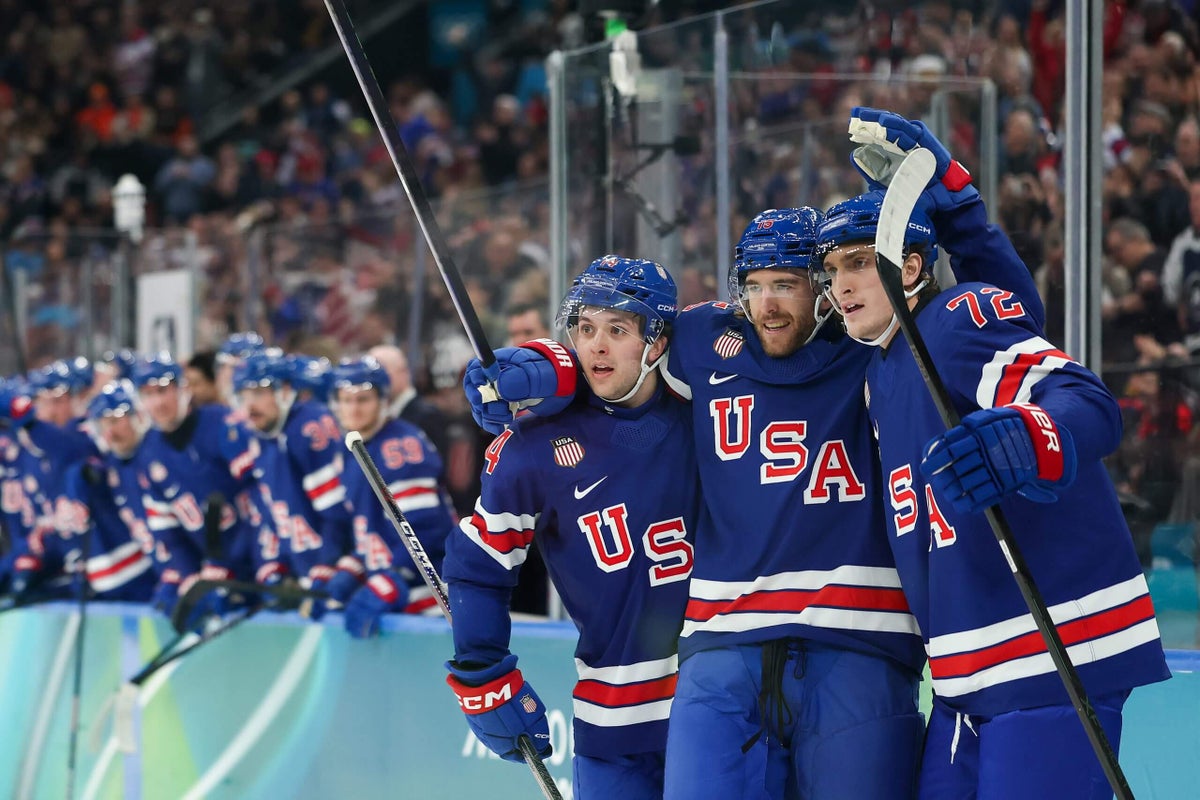
MILAN — Well, that was probably Jeremy Swayman’s last start of the Olympics.
Despite Jake Oettinger backing up the U.S. at last year’s 4 Nations Face-Off, the Dallas Stars goalie has been relegated to the third goalie spot to start the Olympics.
On Saturday night, in a game the Americans should have skated easily to the finish line of a blowout, the Boston Bruins goalie gave up a couple big-time softies, including one off a shot that was teed up from the other side of the red line near Denmark’s bench, before the United States survived a group stage game by rallying for a 6-3 win.
Matt Boldy, Brady Tkachuk, Jack Eichel, Noah Hanifin, Jake Guentzel and Jack Hughes scored for the United States and Swayman made 18 saves.
But Swayman, maybe lulled to sleep in the second period with the play largely spent in Denmark’s end, gave up a bad goal with 2.6 seconds left in the period to turn the game into a one-goal nailbiter entering the third before Guentzel and Hughes took care of business.
The U.S. got much-needed insurance goals, first, from its 4 Nations leading goal scorer, Guentzel, when Auston Matthews scooped up a loose puck in the slot and teed up Guentzel for a one-timer, then Hughes after he sped around a defender and banked a puck off the skate of Frederik Dichow, who replaced Mads Sogaard a few minutes earlier.
U.S. coach Mike Sullivan hasn’t really provided a specific reason why Swayman has overtaken Oettinger as the No. 2 other than that he’s had a good year in Boston. The American brass could have also determined that Swayman earned the role by leading the United States to its first World Championship gold medal last spring by going 7-0 with a 1.69 goals-against average and .921 save percentage.
Nevertheless, Swayman probably saw the net for the final time despite something unforeseen.
The United States plays its final preliminary game Sunday night against Germany, which was upset by Latvia on Saturday.
Swayman’s swing and miss
When Swayman was beaten cleanly by a 95-foot wrist shot from Denmark defenseman Nicholas B. Jensen to put the U.S. down 2-1 in the first period, it was hard not to wonder if a goalie change was in order. But Sullivan, somewhat inexplicably, had Connor Hellebuyck dressed as the backup, not Oettinger. And Hellebuyck is expected to start Sunday against Germany. So even if Swayman was visibly nervous in net in his Olympic debut, he wasn’t getting yanked.
It was a shocking goal, met with an audible gasp by the heavily pro-American crowd. Olympic hockey fans of a certain vintage couldn’t help but think of Sweden’s Tommy Salo, who gave up perhaps the worst goal in the history of the Games during Belarus’ monumental upset in Salt Lake City in 2002. With 2:24 left in a tied quarterfinal, Salo was stunned by a slap shot from the neutral zone from defenseman Vladimir Kopat. Salo leapt to block the rising shot — which was almost certainly going over the net, not in it — and the puck deflected off the goaltender’s helmet and into the net, giving Belarus a 4-3 victory that knocked Sweden out of the tournament.
The goal that Swayman gave up wasn’t nearly as significant — it came in the first period of a group-stage game, not the third period of an elimination game — but it might have been worse from a pure goaltending standpoint. Jensen’s shot was from farther away, more than 90 feet, from just inside the red line, and Swayman didn’t even get a piece of it. The puck may have hit Boldy’s shin, but that was at center ice and Swayman didn’t seem to see it at all — he had his glove raised as the puck sailed by on the other side.
Both NBC and CBC broadcast crews wondered if the dark Olympic banner over the boards may have caused him to lose the puck.
That couldn’t be blamed for the goal he allowed at the end of the second period. After the Americans stormed back from a 2-1 deficit with three goals in a seven-minute span, Swayman gave up another bad goal on a slap shot from the blue line by Phillip Bruggisser. The goal cut the lead to 4-3 in a period where Denmark only had four shots.
Differential diagnosis
The Finns came into their game against Italy on Saturday afternoon knowing that every goal counted, and they piled them up, winning 11-0. It wasn’t very nice, but it was important. For Finland, goal differential could have been the difference between a bye to the quarterfinal and a do-or-die qualification game.
“This was probably the only game I didn’t feel bad just because (of) the goal differential, I knew how much that matters for second place, to get the bye to the quarterfinals,” Mikko Rantanen said. “So today I didn’t feel bad.”
The U.S. didn’t play with nearly the same aggression. Denmark might not be as weak as Italy, but it’s not exactly a superpower, either. This was a squandered opportunity for the U.S. to pad its stats.
The big picture here is that the U.S. is fighting Canada for the tournament’s top seed, assuming the U.S. beats Germany on Sunday in regulation and Canada does the same against France. That would leave both the U.S. and Canada with perfect records and nine points in the standings, and the tiebreak would come down to goal differential. Canada is at plus-9 through two games, while the U.S. is now at plus-7. So the Americans will have to beat Germany by three more goals than Canada beats France by, in order to take the top seed.
What’s at stake is that the second seed is likely to face powerhouse Sweden in the quarterfinals, while the top seed would most likely face either Switzerland or the Czech Republic.
Eichel has another strong game
One game after a couple of assists against Latvia, Eichel continued his strong play against Denmark with a goal and an assist.
Tkachuk’s second goal of the tournament — a tying goal in the second — came off an Eichel faceoff win, then Eichel scored a go-ahead goal off Matthew Tkachuk’s solid play.
Eichel between the Tkachuk brothers has been the United States’ most consistent line thus far, two games into the Olympics.
“Jack’s 200-foot game is incredible,” U.S. GM Bill Guerin said. “Ever since he went to Vegas, he just really matured, and he kind of transformed into this — he’s always been able to produce, that’s not the issue — but he’s become an elite two-way forward.”
Sticking to sports
Despite the backdrop of President Trump’s saber-rattling about taking Greenland from Denmark, there was no sign of frustration or anti-American sentiment from the Danish partisans. Other than one Greenland flag that was briefly displayed by a fan during warmups, the game went off without any political fanfare.
At the 4 Nations Face-Off last February, Canadian fans booed the U.S. national anthem in Montreal amid Trump’s talk of making Canada “the 51st state.” The political moment became a central part of why the 4 Nations Face-Off drew so much attention, with hockey making its way onto national news and politics programming.
Interestingly enough, they don’t play the anthems before Olympic games the way the NHL does. Only the gold-medal winner gets its anthem played at the end of the tournament.