
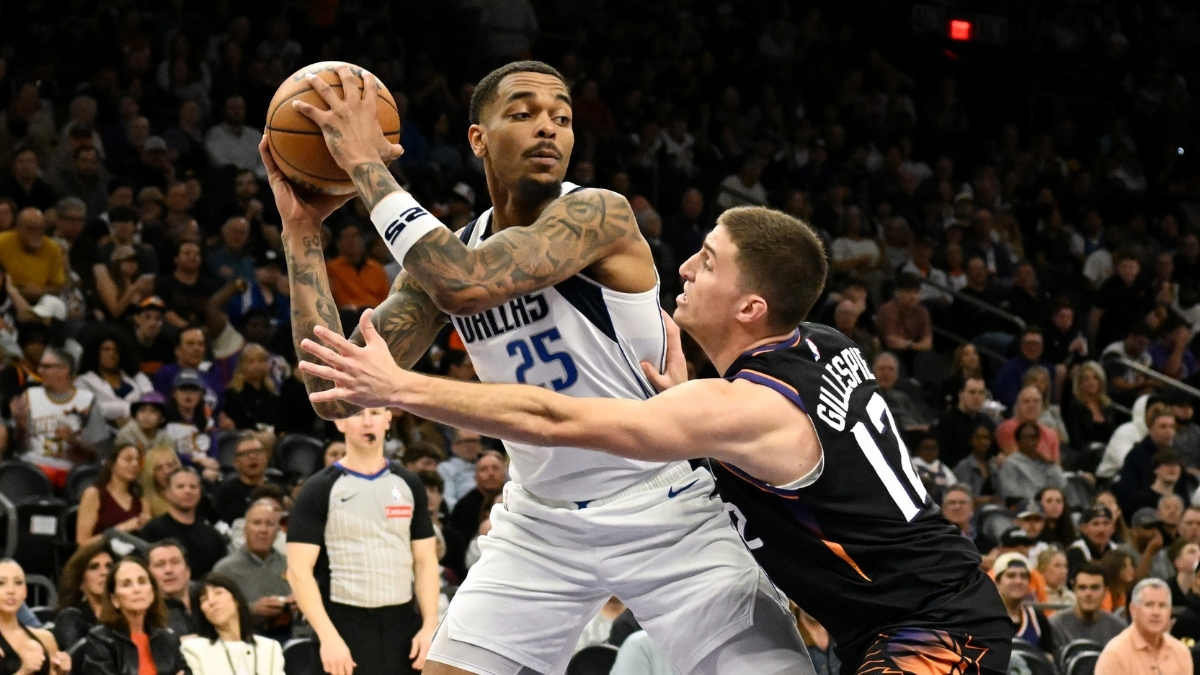
The Dallas Mavericks showed resilience Tuesday night in Phoenix. They attacked the paint, won the free-throw battle decisively, and controlled stretches of the second half. But by the time their identity fully emerged, the deficit created in the opening quarter had already reshaped the game.
Dallas fell 120–111 to the Phoenix Suns at Footprint Center, extending its losing streak to eight games. The Mavericks attempted 44 free throws and outscored Phoenix after halftime, yet a 31-point first-half hole — fueled largely by first-quarter struggles — proved too steep to overcome.
Dallas Mavericks Struggle With Early Physicality and Perimeter Math
The first quarter once again defined the climb. Dallas missed its first nine shots and did not record a field goal until a Max Christie dunk with 6:13 remaining in the period. During that same stretch, Dillon Brooks scored 15 points on 7-of-9 shooting, helping the Suns surge to a 36–16 lead. By the 3:08 mark of the quarter, Brooks had 15 points. The Mavericks had 13.
Head coach Jason Kidd identified the issue as one of tone and competitive engagement from the opening tip.
“The physicality — they were physical and we weren’t in that first half,” Kidd said. “I thought the group did a better job there in the second half with the physicality. We got to the free throw line 44 times, but we’ve got to be able to produce some more threes. We just didn’t do that this evening. You get to the line 44 times, you’ve got to take advantage of that. But the group fought. We cut the lead and had some good looks that just hit back rim.”
When asked what message he delivers during a large early deficit, Kidd did not pivot to tactical adjustments. The focus was on heightened physicality to set a new tone.
“There’s a lot of basketball left,” Kidd said. “The fix was physicality. We caved in early. In the second half we were better with the physicality, took care of the ball, and getting to the free throw line was big for us.”
The numbers illustrate how frequently that opening stretch has dictated outcomes during the skid. Over the eight-game losing streak, Dallas owns a first-quarter net rating of minus-26.7. Its first-quarter defensive rating sits at 127.6, while its offensive rating is 100.9. Shot efficiency has dipped to a 47.2% effective field goal percentage and a 50.1% true shooting percentage in those opening periods. Opponents are averaging 34.8 first-quarter points, and Dallas’ first-quarter pace has climbed to 108.00 — a tempo that has often favored transition-oriented opponents able to build early separation.
Against Phoenix, the three-point disparity compounded the issue. Dallas went 1-of-11 from three in the first half. The Suns made 10.
“We got some looks there — they just haven’t gone down,” Kidd said. “Sometimes when they don’t go down early, we get discouraged, and we’ve got to be better. In this league you’re going to miss some, and you’ve got to take the next one. Especially against a team like this that’s going to pack the paint. Early on we missed some threes that normally we’ve made. Right now we’re just not shooting the three well.”
Defensive rebounding has also played a role in early deficits. During the losing streak, Dallas’ first-quarter defensive rebounding percentage has dipped to 64.3% allowing opponents to extend possessions and dictate rhythm.
“We were getting out in transition, making a lot of three’s and limiting Dallas to one shot,” Brooks said. “I was getting to my spots, playing right off the catch, finding my mid-range and they were falling down.”
Naji Marshall and Cooper Flagg Lead the Rally
Once the game settled, the Mavericks leaned into their preferred identity. Naji Marshall and Cooper Flagg combined for 58 points, repeatedly attacking downhill and forcing rotations that translated into free throws and paint touches. Dallas generated 26 free-throw attempts in the second half alone and finished with a 44–9 advantage at the line.
“Those two have been playing well for us,” Kidd said. “We asked Naji to come off the bench and it didn’t change his mentality. He played well. Tonight we were looking at a different group, and those two were playing at a high level. They got us back into the game.”
Marshall explained the momentum shift as a product of sustained effort and defensive energy rather than schematic adjustment.
“Just played hard,” Marshall said. “Played with energy, got some steals, rebounded, got out and hit some shots.”
He also clarified the offensive identity the Mavericks believe gives them their best chance to succeed.
“We’re a downhill team,” Marshall said. “When we get downhill, we’re tough to guard and tough to stop. Tonight the whistle just went our way. But I think that’s a testament to our character — physical drivers who live in the paint.”
Flagg, who has recorded three 30-point games in his last eight outings, said his offensive rhythm continues to evolve as he gains experience.
“We’re starting to understand the game more — how to get to my spots, shoot shots I’m comfortable with, and just staying in the gym,” Flagg said.
He acknowledged that increasing three-point volume must come from disciplined spacing after the initial paint touch.
“Staying spaced, making the right read when the defense collapses,” Flagg said. “We do a good job of getting to the paint, so making the right play after that will help us. Sharing the ball more, getting stops, getting in transition. They limited our transition in the first half by hitting everything.”
Integrating New Pieces While Searching for Balance
The game also marked Khris Middleton’s debut and Tyus Jones’ first start, adding new variables to a rotation still finding cohesion.
“A veteran who knows how to play,” Kidd said of Middleton. “I thought he was playmaking through Gaff a lot, which is something we’ve missed — being able to get a big involved in pick-and-roll. He can shoot the ball, too. But defensively, his ability to understand what teams are trying to do — I thought he helped us down the stretch.”
Kidd framed Jones’ presence as stabilizing, emphasizing his ability to organize possessions and create structure within the offense.
“We’ll look at it, but his ability to get us into plays and provide structure — and then his passing and shot-making,” Kidd said. “He can shoot the floater, the mid-range, and he had some good looks from three. It’s just about him getting comfortable with the group. That takes time.”
Marshall noted that Jones reduces ball-handling pressure on high-usage wings by initiating sets and setting up teammates efficiently.
“He takes the pressure off the wings who bring the ball up and have a lot of usage,” Marshall said. “He’s a vet who knows how to set guys up and has played for a lot of great teams. Just learning from him and sharing the floor with him is beautiful. We’ve just got to get more reps and learn how he likes to play.”
Urgency Before Facing the Los Angeles Lakers
The Mavericks now turn their attention to the Los Angeles Lakers in their final game before the All-Star break. Los Angeles (32–21) has defeated Dallas twice this season and remains one of the league’s most dynamic offensive teams, led by Luka Dončić, who is averaging 32.8 points, 7.8 rebounds, and 8.6 assists.
Austin Reaves is contributing 25.7 points, 5.1 rebounds, and 6.0 assists, while LeBron James is averaging 21.8 points, 5.7 rebounds, and 6.9 assists. Dončić is expected to miss the upcoming matchup with a strained left hamstring, but the Lakers’ offensive versatility remains significant.
For Dallas (19–34), the formula is becoming clearer. The downhill pressure that defines the Mavericks must appear from the opening tip, not after a deficit forms. At the same time, the three-point production must complement that paint attack to prevent early separation from widening.
“Play hard. Get a win. Get back on track,” Marshall said. “Play Mavs basketball and keep getting better at our concepts.”
Washington reinforced the urgency surrounding the team’s approach heading into the final stretch before the break.
“Come out here, play hard, play a good brand of basketball,” Washington said. “Obviously, we’ve been losing a couple games, so trying to get back on track.”
The identity is visible when the Mavericks settle into it. The challenge now is balance — establishing physicality early while generating enough perimeter pressure to keep the math from tilting before halftime.
Latest Dallas Mavericks News & Trade Rumors