
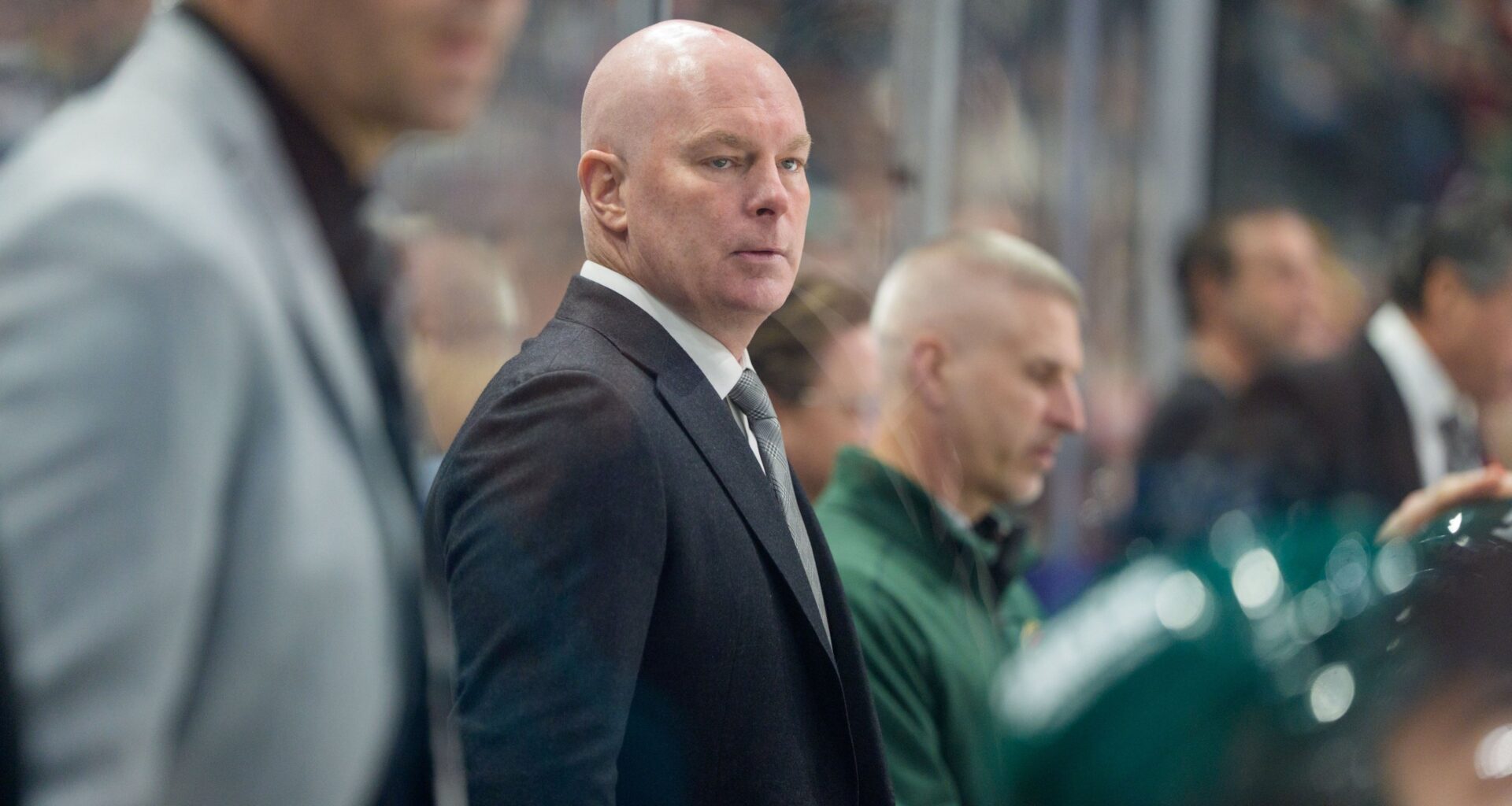
A little over two years into John Hynes’ tenure with the Minnesota Wild, it can be difficult to identify what sets him apart from other coaches in team history. Most in his lineage are defined by a commitment to defensive excellence. That extends from the legends like Jacques Lemaire and Bruce Boudreau to the less-decorated names like Dean Evason and Mike Yeo.
In both Hynes’ full years in Minnesota, the Wild haven’t been a top offensive or defensive team. They haven’t had a top power play, even if this year’s squad is trending up after adding Quinn Hughes. Their penalty kill is improving, but only from “awful” to “below-average.”
So, what would you say Hynes does here? At least, at an exceptional level?
The answer is less about what’s happening and more about what’s not happening. Specifically, Hynes’ Wild aren’t taking many penalties, showing more discipline than we’ve seen from this squad in a long time.
Teams can take on their coach’s personality, and Hynes’ 180-degree change in demeanor from Evason is evident in this turnaround.
As a player, Evason was a power forward who wasn’t afraid to take on anyone in a fight. That extended into his coaching. He wore his emotions on his sleeve, punching assistant coaches in excitement to celebrate wins. That would work against him when he lost his mind on officiating, with his frustrations seemingly seeping into the team.
(Credit to Dean-o, though: As fiery as he got during games, he was ice-cold when Rick Bowness challenged him to that fight one time. Mad respect.)
The Ur-example of this was the 2023 playoffs against the Dallas Stars, when Evason’s Wild collectively lost their damn minds. Stars coach Pete DeBoer pushed all of Evason’s buttons, and the result was Marcus Foligno, Ryan Hartman, and Ryan Reaves essentially forgetting to play hockey. Minnesota blew a 2-1 series lead as those three racked up 65 penalty minutes in six games.
The names on the team haven’t changed much, but the results are drastically different now. In Evason’s final season, Minnesota was a top-10 penalized team in the NHL. Now, Hynes’ Wild are the second-least penalized team in the NHL, with just 2.68 minor infractions called on them per hour.
That’s precisely what’s required for a team that is still a bottom-10 penalty-killing unit. Even better, the Wild gives itself a chance to turn the tide on special teams by drawing significantly more penalties than they take.
Minnesota is middle-of-the-pack at drawing penalties (15th in the NHL with 3.38 minor calls per hour), but the differential is enormous. They’re plus-0.69 per hour in penalty differential, meaning that every three games, they can count on drawing two more power plays than their opponents.
It’s a big swing, particularly since NHL officials tend to keep calls even over games. Most teams draw about as many penalties as they commit, with 19 of the league’s 32 franchises having a penalty differential per hour between -0.25 and 0.25.
However, Hynes is leading the Wild into rarified air, set to join the 24 teams since the 2007-08 season who have drawn more than 0.50 penalties per hour than their opponents. A little digging shows these teams have a strong track record. 16 of them made the playoffs, seven of them advanced at least a round, and four of them advanced to the Conference Final.
Even better, two of them — the 2014-15 Chicago Blackhawks and 2021-22 Colorado Avalanche — won the Stanley Cup.
It also seems that regular-season discipline tends to carry over into the playoffs. Of our 16 teams that out-drew opponents to an extreme, 11 of them had a positive penalty differential in the playoffs. Players like Hartman and Foligno have to keep their good habits, but history suggests that’s doable, especially if Hynes keeps setting a calmer tone for the franchise.
Of course, getting more penalties than your opponents isn’t an automatic advantage. But Minnesota is built in a way that can take advantage of this. Few power plays can match the raw talent that Hughes, Kirill Kaprizov, and Matt Boldy can offer. Fewer trips to the box also means their biggest weakness is mitigated.
Special teams still have to perform, but Hynes is coaching the Wild the way they need to succeed this spring. We’ll have to see if they can amass the depth of talent to take advantage of their strategy.
Think you could write a story like this? Hockey Wilderness wants you to develop your voice, find an audience, and we’ll pay you to do it. Just fill out this form.