
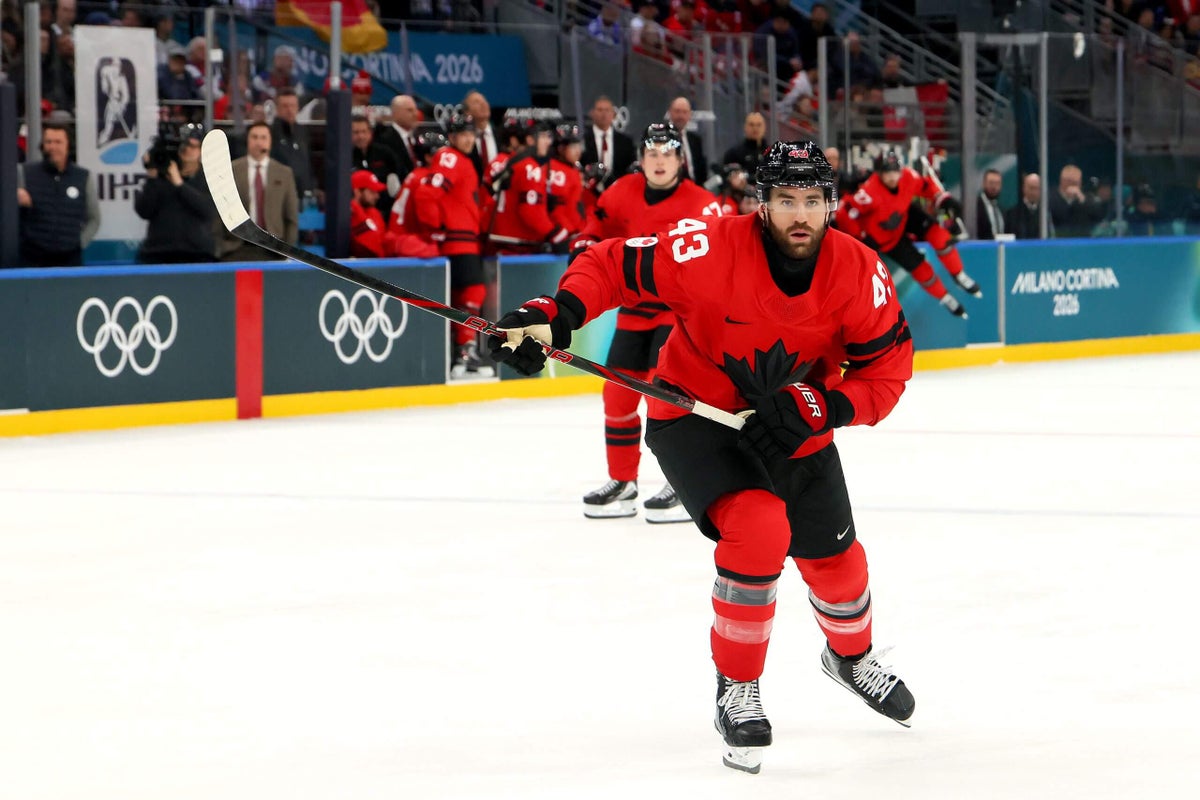
Tom Wilson was on the phone and ready to bargain.
An ultra-rare combination of skill, skating and frightening physicality, with a game that now toes the line of legality after a multitude of trips to the other side, Wilson had spent years stating his case to make the Canadian men’s national team for a best-on-best tournament.
In 2025, he’d fallen short. The 4 Nations Face-Off, widely seen as a dry run for the 2026 Olympics, came and went, highlighted by a preliminary-round game between Canada and the United States that featured three fights in nine seconds and reminded the sport just what it had missed during the NHL’s 12-year Olympic absence. Wilson watched from his couch.
As the Olympic roster announcement on Dec. 31 loomed, on one of his regular calls with Matt Nichol — the Ottawa Senators’ director of player health and performance and Wilson’s offseason trainer since he was 16 years old — Wilson went through his competition for a roster slot. Over the summer, he was one of 42 NHL players to skate at the Canadian national team orientation camp. He understood the enormity of the task.
On the phone with Nichol, Wilson rattled off star after star, wondering how he’d leapfrog enough of them, laying bare just how badly he wanted to make it happen. Two minutes of ice time per game? Zero minutes? Whatever. He just wanted to be on the roster.
“Dude,” Nichol responded, “you have more goals than seven of the guys you just mentioned.”
Wilson, one season after scoring a career-high 33 goals for the Washington Capitals, was already on track to be a point-per-game NHL player for the first time. Not only did Wilson make the team, he’s been taking regular shifts with Connor McDavid, the best player on Earth, and Macklin Celebrini, the possible heir to McDavid’s throne.
It’s a role Wilson is qualified to fill, and it’s certainly one he accepts.
“If I have to block a slap shot in the last minute of the game, you bet I’m going to do it. And if I have to play five minutes, that’s fine,” Wilson told The Athletic before the Olympics. “If I have to play 15, 18, whatever, and bring energy and offense or whatever the coach needs of me, I’m prepared to do that, too.”
All signs point to him again playing a big role again in Canada’s quarterfinal game against Czechia on Wednesday. Wilson will be in the lineup despite a brief, bizarre fight with France’s Pierre Crinon late in Canada’s 10-2 win in the preliminary round. Crinon had just exited the penalty box after elbowing Nathan MacKinnon in the chin; Wilson target-locked on Crinon and hit him cleanly before things devolved.
“Yeah, that guy obviously didn’t want to fight Tom. He just wanted to wrestle,” MacKinnon told reporters in Milan. “I wouldn’t want to fight Tom either.”
The French hockey federation suspended Crinon for the remainder of the tournament for egging on Canadian fans as he left the ice.
Canada? They get to luxuriate in the full Tom Wilson experience. The guy who chased down Crinon is also the guy who opened the scoring with some net-front clean-up work, and the guy who started a warp-speed rush by Celebrini and McDavid, resulting in a goal by the latter.
“That was the conversation I had with him the day he left for (orientation camp),” Nichol said. “‘We’ve known each other for 16 years. I love your attitude. I love everything about you. I love your humility. But you’re there because you deserve to be there. You’re a hell of a f—ing hockey player. You’re not just there to bang and smash. You can do other stuff.’
“(He hasn’t just) opened other people’s eyes. I think he’s opened his own eyes.”
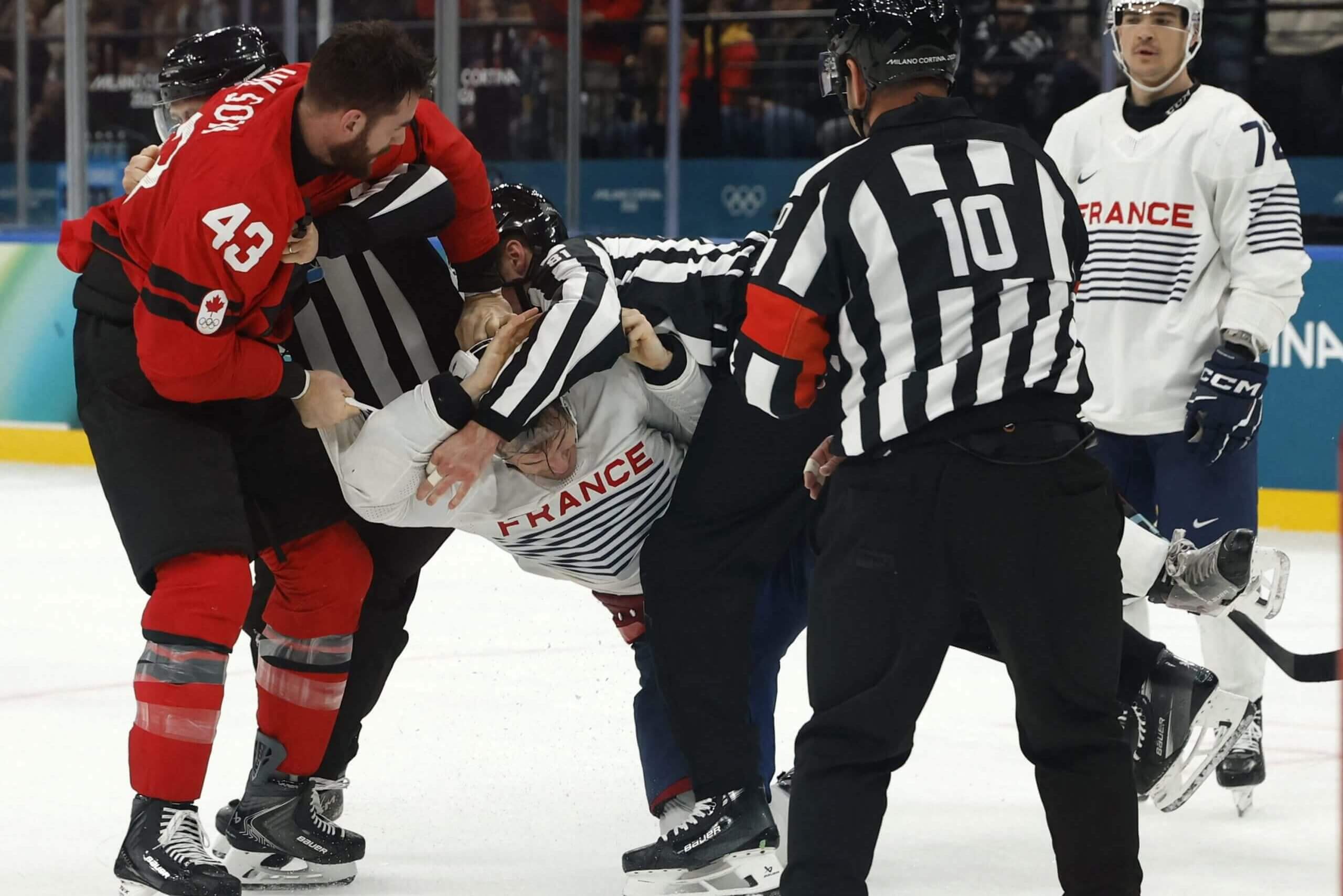
Tom Wilson fought France’s Pierre Crinon during the preliminary round. (Geoff Burke / Imagn Images)
Sixteen years ago, Nichol (also the creator and founder of BioSteel sports nutrition products) wasn’t accepting new clients, and he certainly wasn’t in the business of taking on minor hockey players. Former NHL goalie Curtis Joseph told Nichol about a “big, athletic kid” playing for the Toronto Jr. Canadiens in the Greater Toronto Hockey League, though, and piqued his interest.
“I knew right away he was special — not necessarily physically, but very mature, very focused,” Nichol said. “It’s a different level of being polite and respectful and highly, highly, highly coachable.”
After three years of work with Nichol, and two seasons with the Plymouth Whalers of the Ontario Hockey League, Wilson, then 6-foot-3 and more than 200 pounds, was the No. 15 North American skater heading into the 2012 draft. Washington selected him at No. 16. He was in the NHL by the following spring, seeing time in a pair of postseason games against the New York Rangers.
By fall, he was a regular in the Capitals’ lineup, playing fourth-line minutes with the likes of Jay Beagle and Aaron Volpatti. Wilson’s rookie contract helped Washington navigate the salary cap as they chased the Stanley Cup, and his skill set — fast enough to track down anyone, physical enough to make them pay, willing enough to fight without provocation — made him a seamless fit.
“He was going to be a physical player. He was gonna be someone that won puck battles, was strong on the walls and went to the net front, up and down your wings,” said Spencer Carbery, Washington’s coach since the 2023-24 season. “And yeah, you hope when you pick someone in the first round that they’re gonna blossom into more, but that was all he was really asked to do coming into a really good Washington Capitals lineup.”
The challenge, Capitals president of hockey operations Brian MacLellan said, was finding a way to help Wilson hit his top-six potential while also contributing down the lineup as a more traditional bottom-sixer out of necessity.
“You see that pattern all the time, where a physically developed kid comes in, and everybody pushes these guys into the league early, and they don’t develop their offensive game. They don’t go to the AHL and play power play and learn all that stuff,” MacLellan said. “He was that guy, but he learned it on the fly here, which took a number of years.”
Along the way, Wilson earned a spot on the penalty kill. Later, he got time with the second power-play unit. By 2017-18, he was regularly the third man on a line with Alex Ovechkin, the leading goal scorer in NHL history, and Nicklas Backstrom, one of the best playmakers of his generation.
McDavid and Celebrini, in other words, aren’t the first ultra-elite talents to find success with Wilson as their linemate. They’re just the most recent.
“I found that I could complement those guys. ‘I’ll be the guy to go get the puck and get it back to you. I want you to have the puck, Nicky. I don’t want the puck. I want you to have it, and then you’ll give it back when the time’s right,’” Wilson said. “So I just transitioned to (asking) ‘How can I help those star players? How can I complement them? How do I get to the point where they are OK, and they want me to play on their line?’
“Nick and Ovi, the first couple of times, were like, ‘What’s this guy doing on our line?’ Then you make some good plays and they’re like, ‘You know what …’ That was a big realization for me, when those top-six guys started feeling a lot more comfortable having me go into the dirty areas, getting them the puck and understanding that I could help their game.”
In the 2018 postseason, largely playing with Ovechkin and Evgeny Kuznetsov, Wilson produced 15 points in 21 games. The Capitals outscored their opponents 20-11 in his five-on-five minutes, and he scored two goals in the Stanley Cup Final win over the Vegas Golden Knights.
His days of producing like a bottom-sixer were over. The mindset, though, persisted in ways that caused problems for Wilson, the Capitals and other NHL players. He was suspended four separate times from 2017-18, including for three games during the Capitals’ Cup run. Wilson hit Pittsburgh Penguins forward Zach Aston-Reese in the head, concussing him and breaking his jaw.
The NHL doesn’t hand out postseason suspensions lightly. Wilson’s history and Aston-Reese’s injury forced their hand — and the message, to a significant extent, was received. Wilson has been suspended twice since the Aston-Reese hit: once for boarding in 2021 and once for high-sticking in 2024.
“He’s always going to have that (reputation). It’s always going to be with him,” Carbery said. ”But if you’ve looked at him over the past few years, I think he’s genuinely learned and become so much better when it comes to making sure he stays inside the rules.”
Bone-rattling hits are undeniably still part of his game. Those hits can be borderline, as Filip Chytil and Logan Stankoven learned this season. Wilson’s approach to delivering them, though, has changed sufficiently enough to stay on the right side of the disciplinary line. Part of that was understanding that he was big enough and fast enough to demolish opponents, whether or not it was his primary intention.
“I grew up watching ‘Rock’em Sock’em,’ Don Cherry, finishing hits,” Wilson said. “That’s part of my game. … Every shift, I play one way, and I think I had to learn a little bit like, ‘Hey, that kid in preseason cutting across the middle, it’s maybe not worth making that hit.’ At the end of the day, I was missing too much time and it was hurting our team, and I had to change my mentality in my game a little bit to grow and to add to other parts of my game, which I think ended up benefiting me a little.”
Around that time, Wilson switched up the mix in his offseason work with Nichol, focusing less on pure strength. A torn ACL in the spring of 2022 was a roadblock, but it also offered a change in perspective.
“In some ways, it opened his eyes and opened opportunities to play a different way,” Nichol said. “You don’t have to be going 1,000 miles an hour. He has the skill.”
As the Caps’ elite offensive players aged out, Wilson kept adding to his bag, and kept watching his role grow, by his count, “10 percent” every season. These days, he’s Washington’s emotional talisman and, outside of Ovechkin, its leading locker-room voice. During Ovechkin’s pursuit of Wayne Gretzky’s goals record last season, Wilson was a spokesman of sorts for the roster, speaking at length day after day about his teammate’s greatness, contextualizing each moment even as the attendant circus mushroomed around him.
That, Wilson said, was a privilege — something he took on because Ovechkin deserved it, and because the team needed it.
“I tried to create a standard for myself early in my career that I was going to be one of the hardest-working guys. I was gonna do whatever it took to make the NHL, then I was going to do whatever it took to stay in the NHL,” Wilson said. “Now I’m going to do whatever it takes to help the team win every single night.”
Two years out from the ACL injury, Wilson is more productive than ever, partially due to what Carbery calls a “masterful” ability to turn information into action. Early in their time together, Carbery told Wilson to be on the lookout for more power-play opportunities from the front of the net. Wilson had typically stayed further back in the slot, in a shooter’s spot favored by former teammate T.J. Oshie.
“Now all of a sudden, he’s scoring from the Oshie spot, but he’s also adding five, eight, nine goals from the top of the crease, whether it’s a tip or a rebound goal,” Carbery said. “Good luck moving Tom Wilson from the net-front. He’s gonna set up camp there and you’re not moving him.”
The end result, Capitals teammate Trevor van Riemsdyk said, is a “unicorn” among NHL players.
“He’s one of the best teammates you could have and a nightmare to play against,” van Riemsdyk said. “He can go through you, he can go around you, he can do whatever. He’s turned himself into a high-end player, a point producer, a power-play guy, a penalty killer — he does it all. I can’t think of another guy like him in the league that does everything he does at such a high level.”
To anyone in the Capitals’ orbit, no part of Wilson’s contribution in Milan qualifies as a surprise. Ahead of the tournament, general manager Chris Patrick, an American, said Wilson “plays the way every Canadian parent would want their kid to play hockey.”
“He plays honest, he plays hard, he plays physical, he plays offensive, he’s a great teammate, he has guys’ backs,” Patrick said. “He checks every box of ‘What’s our identity as a national program?’”
Oshie, also an American and now a broadcaster, said on television Saturday morning that the presence of Wilson, his “little brother,” might make him root for Canada against the United States.
Capitals goaltender Logan Thompson, a more conspicuous 4 Nations snub by Team Canada, said he was happier to see Wilson’s name on the Olympic roster than his own.
Carbery, a Canadian, was already projecting Wilson’s linemates — one in particular — weeks before Team Canada’s first practice.
“He can play with McDavid if you want him to play on the wing,” Carbery said. “He can get pucks off the (boards). He can help McDavid get a puck out of the corner and get it up top. And now it gets into 97’s hands, and then 43 (Wilson) goes to the net.”
Carbery also called back to the Capitals’ first-round victory over the Montreal Canadiens last spring, when a open-ice demolition by Wilson on Canadiens defenseman Alex Carrier — brutal, borderline, ultimately legal — quite clearly decided the series. The Capitals tied Game 4 as a direct result of the hit, eventually winning 5-2 and taking a 3-1 series lead.
“That hit, 18,000 people (in Montreal) were like … what? Goal immediately,” Carbery said. “Series over.” He snapped his fingers. “Just like that.”
Then Carbery fantasized about a similar scene playing out in Milan.
“The tensions are high, every puck battle’s important, it’s a one-goal game. And next thing you know, Tom’s in on the forecheck, wins a puck battle, gets it out front — goal, Canada. You could absolutely see that happening.”
Some would say it’s why he’s there.