
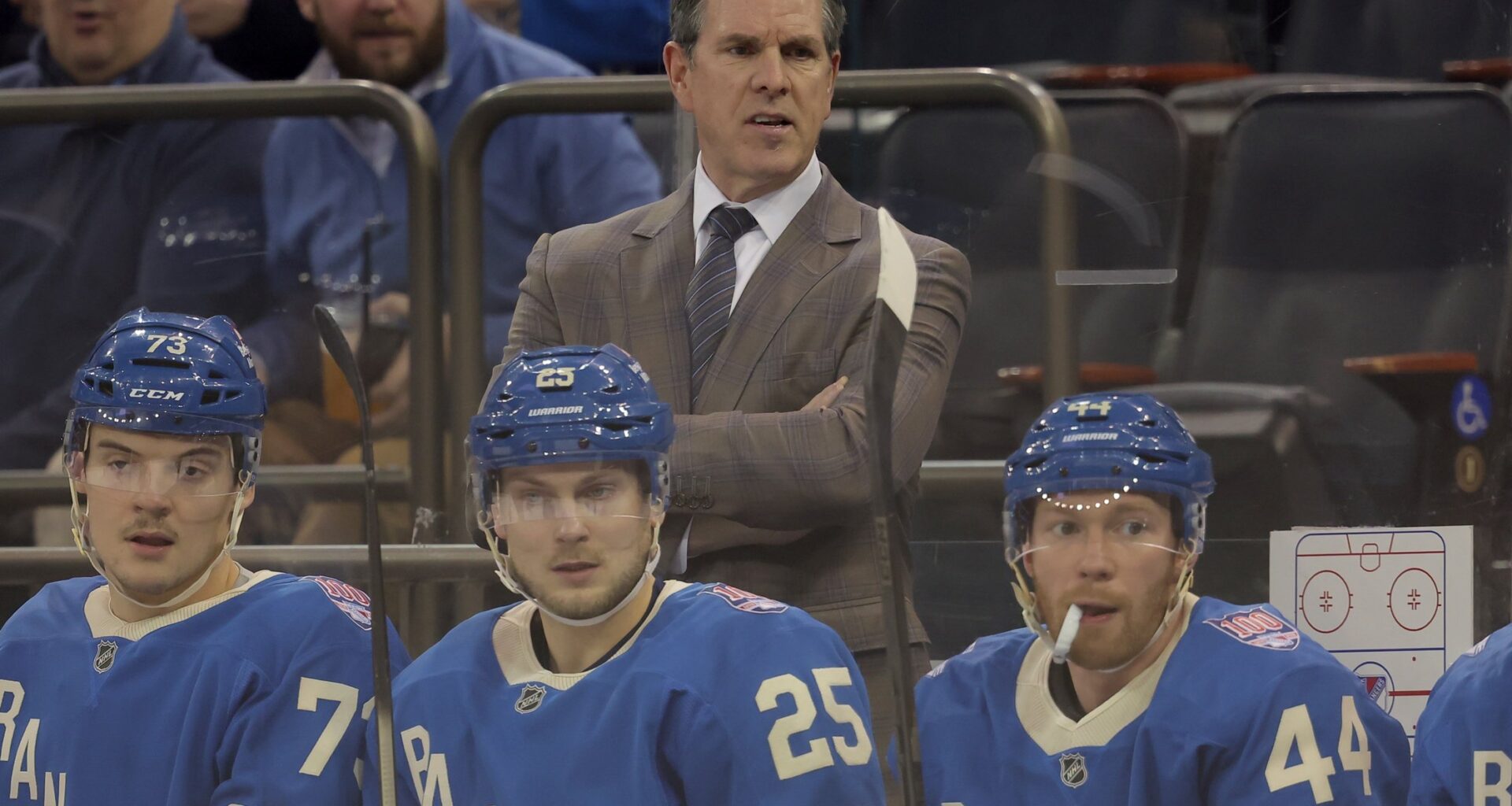
Team USA has been accused of losing itself in the story of the 1980 Olympic team. Snubbing skilled players like Adam Fox and Jason Robertson in favor of role players certainly made headlines around Team USA.
The common response: They’re not looking for the best players; they’re looking for the right ones!
But that erases the actual identity of the 1980 team: “Skating, passing, flow, and creativity.” The US hasn’t overindulged on Herb Brooks’s secret sauce; if anything, they’ve lost it.
It’s not an issue with the roster either. Overall, Team USA sports a roster stuffed with exceptional playmakers. Both forwards and defensemen possess world-class vision, stickhandling, and edgework, rivaled only by the Canadians’.
That skill has led to exceptional scoring chance numbers, as tracked by Dimitri Filipovic. Team USA dominated their opponents through the group stage.
Of course, that’s to be expected against the weaker teams in their group — Germany, Denmark, and Latvia. Still, USA’s numbers are on pace with Canada, which played an arguably weaker group.
So, the team has performed steadily against weaker competition. So, what am I so worried about?
Put simply, head coach Mike Sullivan’s coaching staff lacks a creative plan. Even worse, their current systems don’t take advantage of USA’s strengths.
The offense is old-fashioned and stagnant. That’s no surprise, given that three of the four coaches on the US staff run a very vanilla offense: the 2-1-2.

In Jack Han’s Hockey Tactics 2025, he diagrams the offenses of Mike Sullivan (2024-25 Pittsburgh Penguins) and assistant coach John Tortorella (2024-25 Philadelphia Flyers). David Quinn, another Team USA assistant, worked under Sullivan in Pittsburgh at the time.
Both Pennsylvania franchises ran the 2-1-2 as their primary offense.
The 2-1-2 is your garden-variety (dare I say beer-league?) offensive system. Two players post up at the blue line (usually defensemen), and two players attack deep. The third forward patrols the medium-danger areas of the ice.
It builds strong-side attacks and allows all five players to get involved in the offense, which should open space on the weak side of the ice for an offensive attack. However, it’s hard for anybody but the weak-side defenseman to get into that space, and the defense can clog up passing lanes because play is compressed to the strong side.
That typically means the only way to generate high-danger chances is small-area plays or shooting for rebounds, which aren’t very sustainable.
In fairness to Sullivan, this is one area that could potentially change as the Americans play stronger competition. It’s possible that the top teams at the Olympics took notice after Slovakia upset Finland in the first game of the tournament.
A great way to avoid this problem is to take advantage of shots wherever they come. Given the Americans’ exceptional shooting talent, it’s hard to get goalie’d if you take a high volume of medium- and low-danger shots.
Against stronger competition, though, the Americans need to find a more creative offensive state. John Hynes is an assistant on this staff, and his Minnesota Wild ran a 3-2 shape in 2025. It’s diagrammed below, also from Hockey Tactics 2025.

The system above creates opportunities for long shifts with the puck, which tires out opponents. It also takes advantage of offensive defensemen by providing them opportunities to attack downhill. It’s an exceptional fit for players like Zack Werenski, Quinn Hughes, and even Brock Faber.
Hughes should be an X-factor for Team USA, but he’s been relatively quiet so far compared to his impact in Minnesota. Sullivan’s offensive shape is likely one reason for that.
It’s notable that John Cooper, head coach of the Tampa Bay Lightning and Team Canada, loves to create opportunities for his offensive defensemen to attack downhill.
The 2-3 also starves its opponent for the puck. And, even if someone turns the puck over, there are three players ready to defend the rush — a great way to keep skilled opponents like Sweden and Canada off the scoreboard.
The other phase of USA’s game that I hate is the breakout. In both the defensive and neutral zones, the breakout sacrifices speed for security.
Minnesota Wild fans are probably used to seeing Quinn Hughes snap absurd breakout passes from his own zone into dangerous rushes. That’s because John Hynes’s breakouts have a disciplined plan of attack: one forward stretches past the red line, and two intermediate targets get open beneath that.

That creates chances for three-man rushes from the underneath options, or a stretch pass to a lone man near the offensive zone.
It’s somewhat aggressive because it demands a long, accurate breakout pass from the defensemen. Passing through more opponents presents more opportunities for a misread and a turnover.
Neither Sullivan and Quinn nor Tortorella runs these aggressive breakout plays.
Their breakouts are much more stagnant. Tortorella, for example, has this simple and effective breakout. The defensemen work with two forwards to methodically exit the zone and reach the red line. From there, they have the option to hit a streaking weak-side forward for a rush into the zone or dump the puck.

That makes sense for Tortorella’s NHL teams, which he molds around a defensive, forechecking identity. However, this has its advantages under a salary cap or when rebuilding around young players. However, there are no constraints on the roster except for headcount in the Olympics. With an infinite skill ceiling, this play doesn’t maximize a medal contender.
Sullivan’s defensive-zone and neutral-zone breakout plays both feature a forward facing his own zone as an easy target.


I won’t lie: this sometimes creates beautiful passing plays. But, sometimes it’s flashier than it is effective, because it forces one forward to lose his momentum into the zone.
There are two advantages to this play. First, it presents an easy passing target for the defenseman on the breakout. Back-checking opponents usually try to stay between the “bumper” and their own net, and the “bumper” isn’t moving. However, Team USA has elite passers on their blue line, so there’s no need to baby them on the breakout.
Another advantage of Sullivan’s breakout is that it can lead opposing defensemen to make mistakes. If they pressure the bumper, the streaking F2 and F3 can create a two-on-one rush.
Realistically speaking, though, it won’t be Canada’s or Sweden’s defensemen making that mistake. Their blue lines feature defensemen with elite lateral skating and vision. It simply doesn’t make sense to pair these breakouts with a USA roster that’s aiming for Gold.
As with the Offensive Zone system, American coaches could tweak the existing system to modernize it.
The Vegas Golden Knights run a bumper breakout in which the weak-side defenseman joins the rush, replacing the bumper forward.

It allows Vegas to keep three threats off the rush while still getting the easy pass to the bumper. If their opponent covers the rim play up the boards, they can pass to F2 for a four-man rush.
This system does require the bumper player to be capable of replacing the rushing defenseman in some cases. With Team USA’s deep stable of two-way wingers (Matt Boldy, the Tkachuk brothers, and many of their bottom-six forwards as well), that could be a good fit.
It’s also an obvious fit with USA’s long list of mobile defensemen. From top to bottom, their defense corps can skate as well as any other team — including Canada. Including their defensemen in the rush – again, something with which assistant coach John Hynes is familiar – would fit the X’s and O’s to their Jimmies and Joes.
To Sullivan’s credit, the rest of the team’s systems are acceptable. More than that, the team is well-coached. It’s not as sexy as routes on a breakout, and you can’t really put it into a diagram, but discipline and details are just as much of a coach’s job. In a short tournament like this, you could argue that they’re even more important due to limited practice time.
And, these iterations that I’d like to see are very natural to integrate. It could already be part of the plan for the knockout rounds. Perhaps they’re waiting for stiffer competition before they put it on tape. After all, there’s no reason to blow through all their best material against Germany, Latvia, and Denmark. They already beat all of them with Sullivan’s current systems.
Time will tell if the current systems are sufficient or if they’ve already planned improvements. The knockout game against Sweden will be a major test.
But the stakes are high. This could be the most talented US men’s hockey team ever assembled — past, present, or future. The National Team Development Program has put the USA at the forefront of international hockey, but they won’t be able to retain those secrets forever.
If an unimaginative coaching staff fumbles this elite roster, they’ll take it to their graves.