
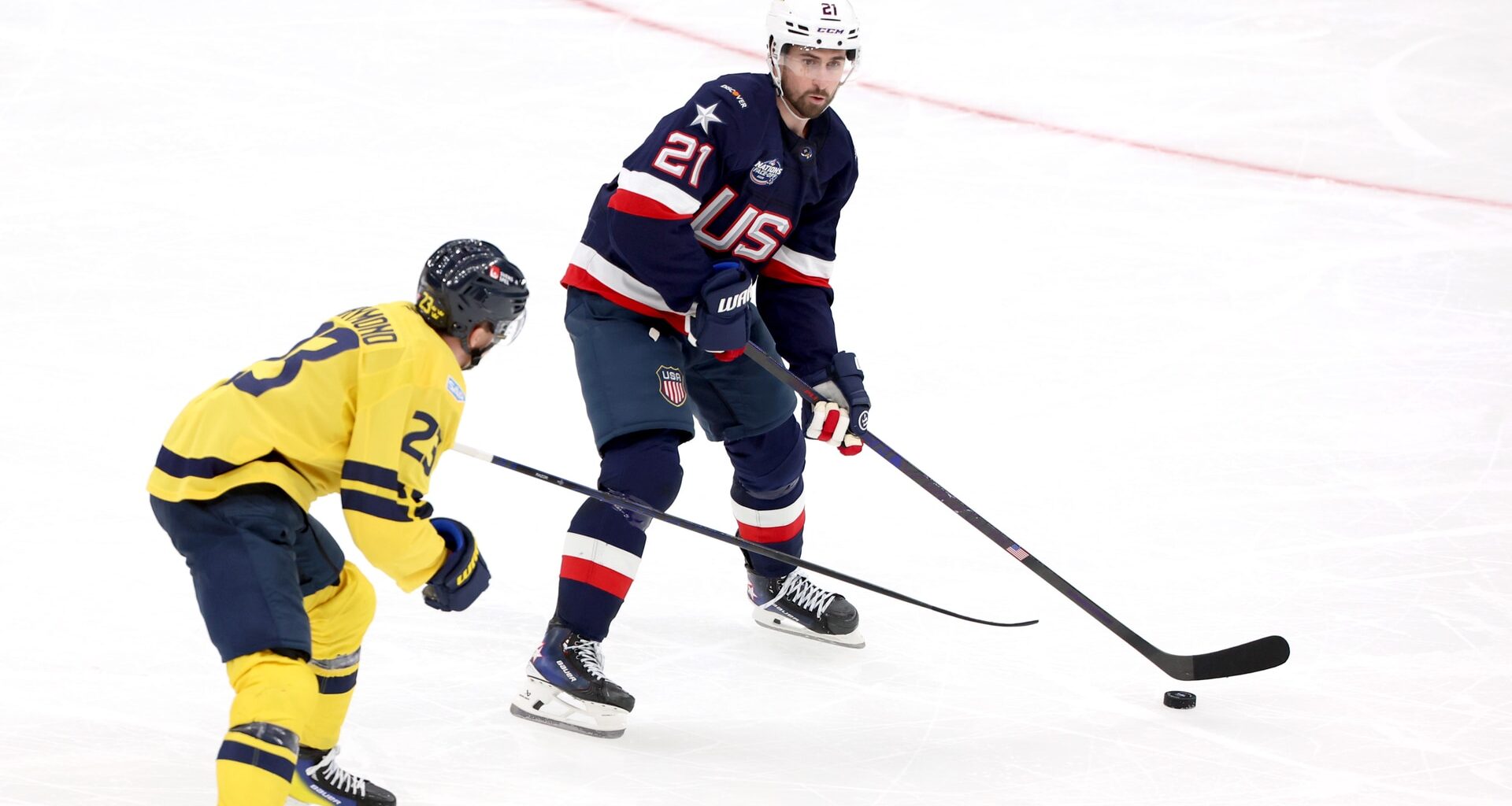
Wednesday at 3:10 p.m. ET
What could’ve been a semifinal or even a medal match is instead a quarterfinal. The U.S. and Sweden are two of three teams in the tournament with only NHL players, and now, one of them will be eliminated before even having a chance to win a medal. The Swedes have to feel especially frustrated with how things have played out. They averaged nearly 50 shots on goal but a non-score-changing, last-minute goal against Slovakia knocked them from the No. 3 to No. 7 seed. But nothing has been lost that they can’t make up for on the ice.
This Swedish team has plenty of skill up front and on the backend, plus stalwarts such as Gustav Forsling and Victor Hedman in back. They’ve limited shots at a nice clip and only allowed one goal on the penalty kill. By the numbers, there’s no luster worn off their shine. It’s easy to write off struggling to score against Italy as a one-off against a locked-in goaltender. They wound up outshooting the Finns by a wide margin, but that’s what usually happens when you give up an early goal or two (something that’s also been a bit of a problem for the U.S.) and are chasing all game.
It helps that Filip Forsberg is no longer being used as an afterthought, as his goal against Latvia on Tuesday showed. Nine different players secured a point in that win. Only Elias Pettersson and William Nylander have multiple goals (two each), so you could argue that no one is truly at peak powers (although Nylander did score a nasty power play goal on Tuesday). Lucas Raymond has looked legit, though, scoring a goal-of-the-Games candidate against Slovakia and is tied with McDavid for the tournament lead with seven assists. His Detroit Red Wings teammate Dylan Larkin of Team USA knows just how filthy he can be.
Sweden decided to go with Jacob Markstrom in net Tuesday after he and Filip Gustavsson split the net in the round robin. Neither was outstanding in those games, so it will be interesting to see if the Swedes ride the veteran Markstrom or go with the rested Gustavsson.
This will definitely be Team USA’s biggest test either way. Sweden’s ability to roll all four lines and three defense pairings should mitigate some of the fatigue disadvantage, but that could still be a factor. There are no red flags with the U.S. performance so far. They have the highest percentage of shots on goal of any team in the tournament. Both special teams units are clicking. Connor Hellebuyck has been excellent. But in a one-game sample size, anything can happen.
This is the biggest game for Team USA since last year’s 4 Nations Face-Off final. In that game, Matthew Tkachuk played less than seven minutes due to injury and Chris Kreider was under that threshold as well. Quinn Hughes was also absent from the entire tournament due to injury. There are a lot of players who will have their legacies significantly affected by the result of this game.
So far, Team USA’s focus on two-way talents such as J.T. Miller and Vincent Trocheck over high-scoring threats such as Jason Robertson and Cole Caufield has paid off. With Kyle Connor likely to be the scratched forward (as he was in that 4 Nations final), it appears the U.S. will double down on that approach. That increases the onus on Matthews and Jack Eichel (nine combined points) to continue their dominant play.
One final player that could be a key factor: Tage Thompson. The two-time 40-goal scorer was one of the bigger names left off the 4 Nations team but has two goals so far in the Olympics. If Sweden matches its top lines against the United States’, Thompson could be in a position to get more favorable matchups on the third line.
This is a matchup between two of the top three teams in shots on goal percentage, two of the teams tied for second in total goals, and two of the top three penalty kills. By every metric, the Sweden-United States quarterfinals matchup figures to be an epic game.