

The following is an excerpt from “Black Aces: Essential Stories from Hockey’s Black Trailblazers” by The Athletic’s Julian McKenzie, copyright @2026 and reprinted with permission from Triumph Books. All rights reserved. The book is available for purchase here.
No one knows for sure how long the referees needed to review the play in Helsinki. It could have been 15 minutes. But players felt like they were waiting for hours.
Anson Carter was sure that puck was in the net. He hoped the referees would see things his way. It meant he wouldn’t have to play the rest of the gold-medal game on a sprained knee.
Moments earlier, Carter — nicknamed “Ace” after originally being nicknamed “AC” for his initials — sped into the offensive zone as Canada battled Sweden for the gold medal in the 2003 International Ice Hockey Federation World Championship final in Finland. Canada sought its first World Championship win in five years but needed an overtime period against the Swedes to secure the victory. The Canadians were tired and would’ve benefited from an overtime winner sooner than later, but were already planning ahead for a shootout if necessary.
“Krys Kolanos was really good in shootouts, and he hadn’t had a shift the entire game,” Team Canada’s Shane Doan remembered. “Underneath the stadium was another practice sheet. (Canada head coach Andy Murray) tapped Krys Kolanos and was like, ‘You haven’t skated here in, like, three hours. Go take a couple drives and start getting warmed up for if we go to a shootout. You might have to go in it.’”
Carter fired the puck on net, trying to beat Sweden’s Mikael Tellqvist. The forward grabbed the rebound and raced behind the net with a wraparound attempt. When he slid the puck into Tellqvist’s pad, Carter immediately celebrated the goal. His teammates followed suit, flooding the ice and throwing their sticks and gloves in the air.
“When I shot the puck initially and I saw the rebound, I came around and had so much momentum and speed coming around the net,” Carter said. “My only concern was, will (the referees) have the vantage point or the viewing point, or the technology, to show that puck was in? Because I clearly saw the separation between the puck, the white and the goal line.”
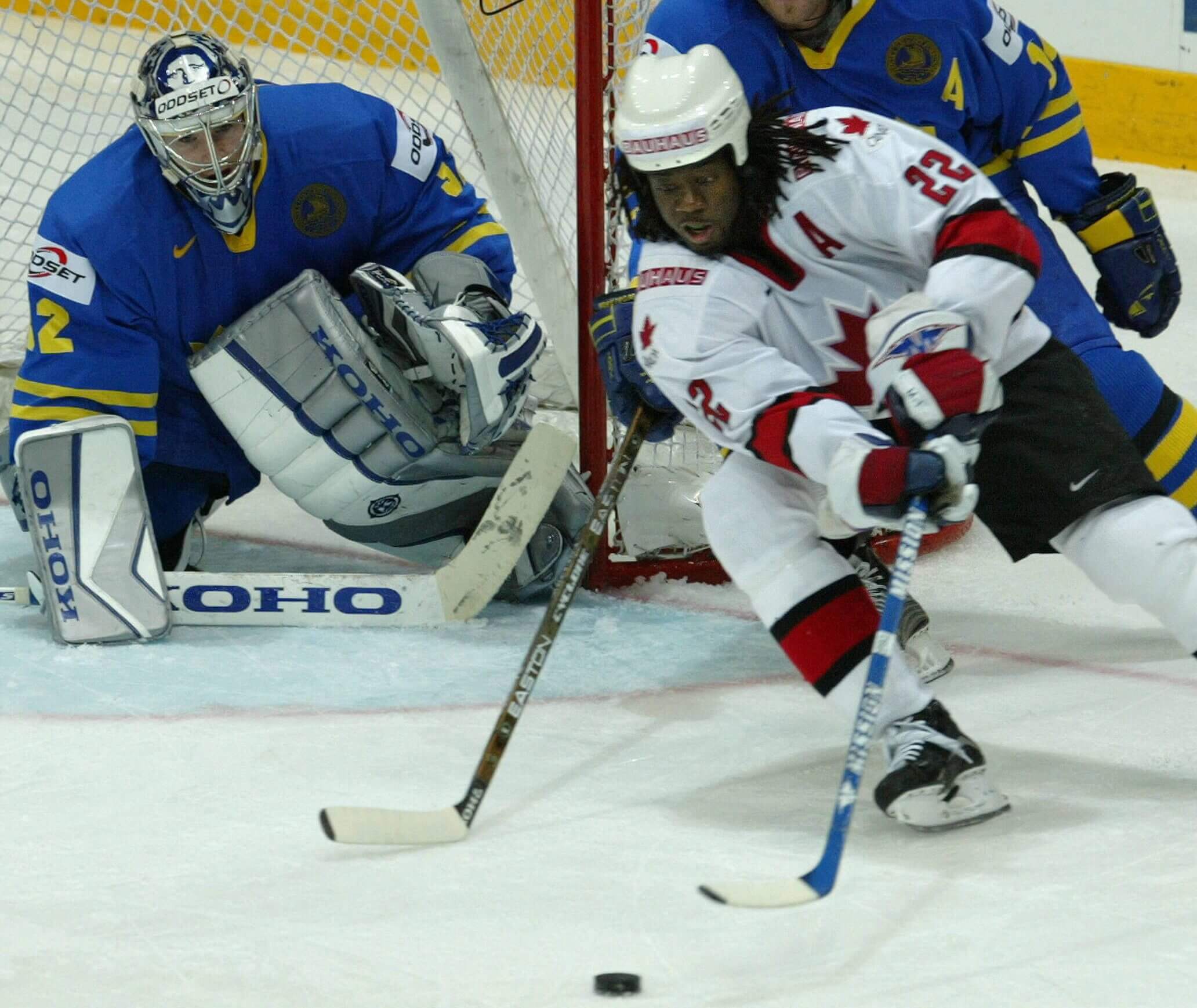
Canada’s Anson Carter (22) ended up scoring the winning goal in the 2003 IIHF World Championship final against Sweden. (Alexander Nemenov / AFP via Getty Images)
As Canada’s bench cleared, a cluster of players jumped atop Carter at the blue line. But the Swedes tried to keep playing.
“They had a two-on-one or a three-on-one going the other direction,” teammate Shane Doan said. “We were like ‘Oh, oh.’ We just all jumped on the ice because the best way to stop this was to jump on the ice and start celebrating.”
Carter’s knee felt every bit of the growing dogpile.
“I tweaked my knee in the celebration,” Carter said. “I don’t think people understand that the weight of 20 players jumping on you when you’re trying to support everyone. When they’re jumping on you, something’s going to have to give.”
A referee skated by the Canadian celebration and cautioned that they needed to look it over. Canadian faces went from joyfulness to confusion. As time went by, with officials looking over every possible angle, doubt crept into the minds of the Canadians.
“We’re just all sitting there,” Canada’s Daniel Brière said. “It felt like we were there for two hours just waiting for the call to come. We had a replay that would show the puck was in. And at first you’re like, ‘OK, this is over, they’re gonna find it. It’s a win.’ We knew the puck crossed the line.
“But then the longer it takes us, then you start wondering, why are they taking so long? What’s the problem? What are they looking at? Maybe they don’t have this replay that our video coach was relaying in.”
All eyes fell on referee Vladimír Šindler, who had a handheld phone to his ear listening to goal officials pore over the instant replays. One point of his hand toward center ice would give Canada the gold they felt they deserved. Otherwise, more hockey would be needed, and Team Canada would have to soldier on without one of its better scorers.
Officially, the IIHF says its review took 10 minutes. When the goal judge gave him enough confirmation over the phone, Šindler pointed to center ice and the Canadians resumed their celebration. The IIHF says it’s the first gold-medal goal to ever be confirmed by video replay.
“He endured the longest replay review in history at the World Championship,” Gord Miller said.
When the goal was confirmed, Carter raised his arms and stick, skating up ice in triumph. He wasn’t thinking about his throbbing knee, still in pain from the premature celebration.
“It was clear as day to me. There was no doubt in my mind. It was in,” Carter said.