
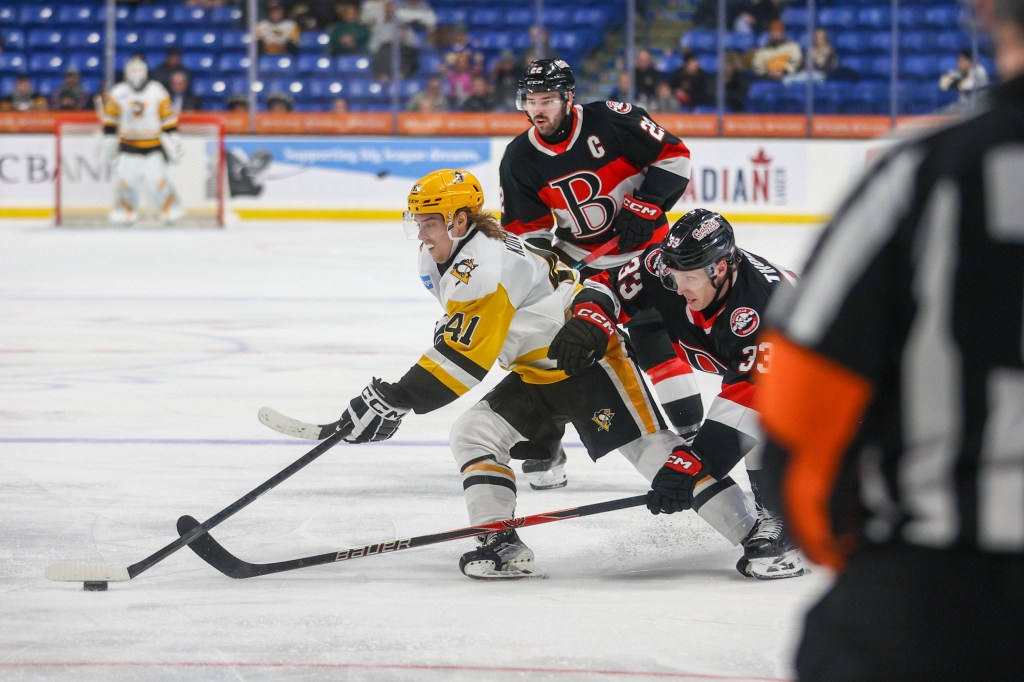
By any meaningful statistical measure, the 2025-26 Wilkes-Barre/Scranton Penguins are an exceptional professional hockey team.
Coming into the weekend, only two teams in the entire AHL — a 32-team circuit spanning North America from British Columbia to North Carolina — could boast a better winning percentage than the Penguins’ .696 clip through 51 games. They are on pace to finish with their best regular season record in nine years.
Objectively but perhaps more importantly from a business perspective, they’re playing an entertaining style of hockey. The Penguins lead the AHL in goals scored. They also rank second in accrued penalty minutes, a statistic that may seem like a negative on paper, but one that also stands as a badge of honor in hockey. It’s a characteristic of the grit, toughness and determination that draws interest in hardscrabble, blue-collar towns like the one in which the Penguins play.
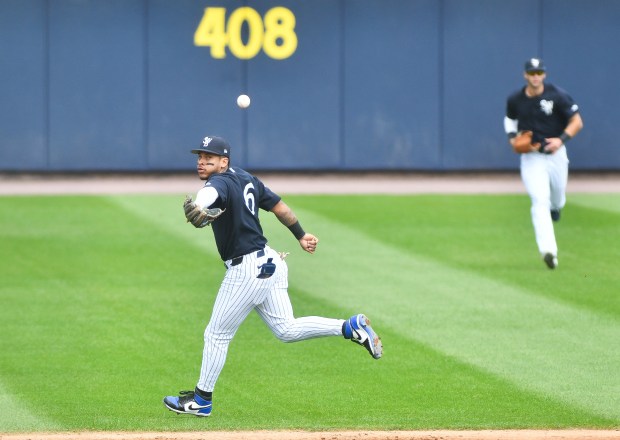 Railriders’ Jorbit Vivas makes a back-handed catch to close out the second inning against the Lehigh Valley IronPigs at PNC Field in Moosic on Wednesday, Sept. 10, 2025. (SEAN MCKEAG / STAFF PHOTOGRAPHER)
Their leading goal scorer, feisty winger Avery Hayes, remains the apple of Pittsburgh hockey’s eye after a two-goal performance in his National Hockey League debut on Feb. 5. Steady center Tristan Broz and winger Ville Koivunen, who has piled up a difficult-to-fathom 29 points in 23 games, are among the better Pittsburgh prospects seeing significant ice time.
Despite it all, the Penguins enter the last two months of the regular season hoping to avoid a record of a different kind. Their 25 home games at Mohegan Arena at Casey Plaza this season have drawn an average of 4,236 fans. If that doesn’t change, it will represent the lowest per-game average attendance the team has drawn in its 26 seasons of existence.
It is hardly a battle they are fighting alone.
In 2025, the Scranton/Wilkes-Barre RailRiders saw breakout seasons from pitcher Cam Schlittler and slugging outfielder Spencer Jones, got standout performances from veteran utility man Jose Rojas and right-hander Alan Winans, and came within one game of winning the International League championship. Yet, that team’s total announced attendance of slightly more than 261,000 fans at PNC Field in Moosic marks the first time the team ever drew less than 314,000 in a full season.
In a region where minor-league sports reshaped the entertainment landscape decades ago, attendance numbers have long been looked at as the singular sign of a fan base’s interest level and the franchises’ respective abilities to wrangle a crowd. Brian Coe, the Penguins’ senior vice president of business operations, called attendance “the number one indicator for how we’re doing.”
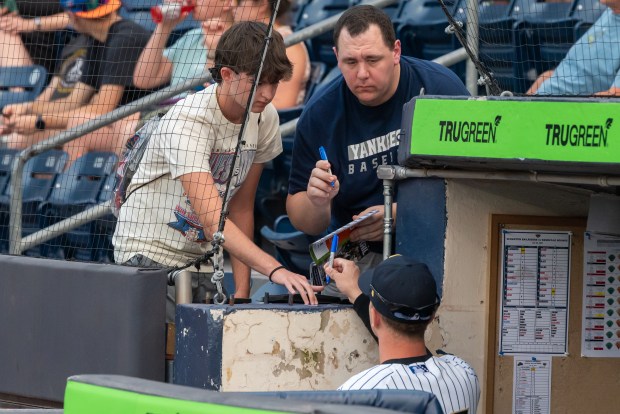 Fans get an autograph from the RailRiders’ T.J. Rumfield before Wednesday’s game at PNC Field in Moosic. (REBECCA PARTICKA / STAFF PHOTOGRAPHER)
Yet, he concedes that comes with some nuance now.
“The entertainment dollar is at a premium, and people have to be a little bit choosy with where they’re spending their money,” Coe said. “It’s up to us to show them that we provide good value and good entertainment for them, and make sure it’s something they want to come back to.”
Both franchises can be classified firmly in the category of legacy brands in minor league sports. Different iterations of the RailRiders have been entertaining area fans since 1989; the Penguins started play at the Wilkes-Barre Twp. arena to much fanfare exactly a decade later.
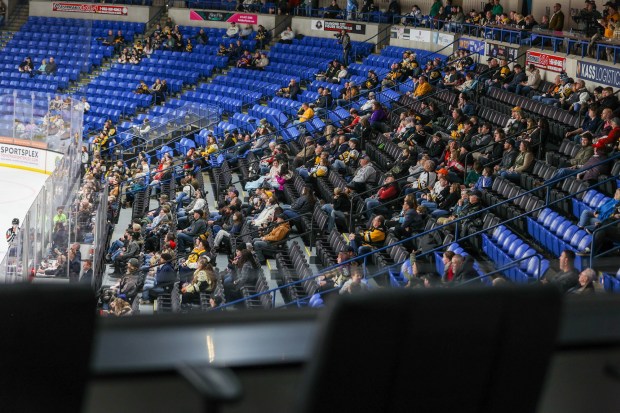 Audience members look on during a Wilkes-Barre/Scranton Penguins game on Wednesdsy, Jan. 21, 2026. (JASON ARDAN / STAFF PHOTOGRAPHER)
Their legacies are clear. By bringing professional sports to Northeast Pennsylvania, they revitalized its entertainment landscape. Now, as they continue to battle for limited entertainment dollars, both teams respond with constant efforts to feel fresh in a region loaded with entertainment options that have raced here since on a road paved by their success.
Innovating experiences
After the 2025 season wrapped, the management group that owns the RailRiders, Diamond Baseball Holdings, made what has become a rather common move for the franchise. It made a change at the top of the front office.
In the 12 seasons played since an expensive renovation sent the team on the road and shut down PNC Field in 2012, the RailRiders have employed six team presidents and general managers. They’ve ranged from the affable P.T. Barnum-like promoter Rob Crain, to steady-as-they-come local institutions Jeremy Ruby and Katie Beekman, to the more brief tenures of area outsiders John Adams and Josh Olerud mixed in between. None comes from a background quite like Shawn Reilly’s.
For starters, he wasn’t exactly looking to leave his old job with the Frontier League’s New York Boulders, an independent team based in New York’s Rockland County that he founded in 2011, owned and had an extended run of success overseeing as team president and general manager. Without the advantage of a major league affiliation — never mind a brand like the revered New York Yankees providing prospects — Reilly’s Boulders routinely sat at or near the top of their leagues in annual attendance. They averaged 2,570 fans per game last season.
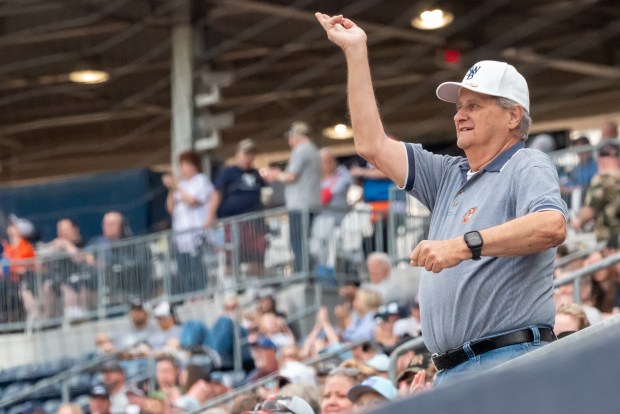 RailRiders Fans celebrate outfielder Brennen Davis’ home run during the game at PNC Field in Moosic on Friday, June 13, 2025. (REBECCA PARTICKA/STAFF PHOTOGRAPHER)
Perhaps as valuable to RailRiders’ ownership was his job before that, which had nothing to do with baseball. For 15 years, Reilly worked as a senior vice president at Core Communities in Port St. Lucie, Florida, where he helped develop a pair of now-popular planned communities, St. Lucie West and Tradition.
“Sometimes when you’re young and working in baseball, you wind up thinking the entire world revolves around baseball,” said Reilly, who held several jobs with upstate New York minor league clubs in the early 1990s. “Getting away from it taught me about business and what makes business successful. It’s not just opening the doors and playing baseball, hoping people come in to watch. It really teaches you a lot about community engagement from a business perspective. I thought it was invaluable to me.”
He said the lessons he learned there reinforced ideals many successful minor-league executives were among the first to accept within the last decade in an ever-changing sports landscape. The result of the games, and even the players who affect them, are usually forgotten long before the experience of being in the ballpark or arena.
During his first trip to PNC Field last summer to watch a RailRiders game, Reilly said he paid little attention to the action on the field but monitored the fan experience with a sharp eye. He said he “wanted everything to be Disney-like,” which he classified as clean, professional, first-class and customer-focused. That went from everything to the way employees dress, to the on-field promotions between innings to the video and audio production engaging fans between pitches.
He said there were obvious areas to improve, adding that he thinks fans who return to PNC Field will have a difficult time not noticing them, starting with the season-opening game against Durham on April 7. Among the biggest are a new 3,000-square-foot, 2.5 million pixel video board — more than twice the size of the old one — and LED wall in the outfield. All speakers at the stadium are being replaced and upgraded too, to modernize the stadium’s sound system.
To keep their fan experience fresh and attract season-ticket subscribers, the Penguins made several notable changes to their gameday experience at the arena as well. They installed some loge boxes and expanded party areas that have been “incredibly successful,” according to Coe.
An ice-level lounge located behind the goal sold out for the season.
“If you can get a new fan into the building,” Coe said, “you always feel good about getting them back.”
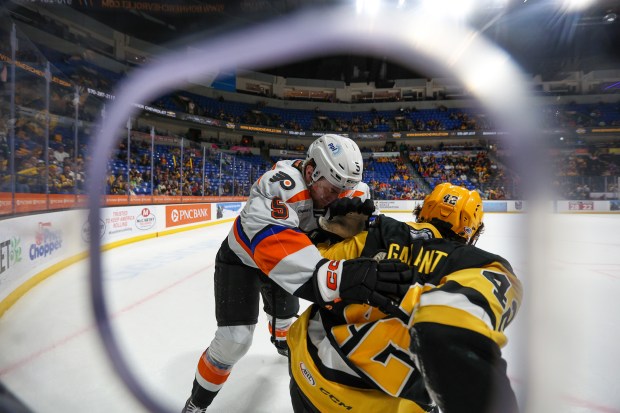 ‘Pens Zach Gallant is on the receiving end of a push during an AHL playoff game against the Lehigh Valley Phantoms on Wednesday, April 23, 2025. (JASON ARDAN / STAFF PHOTOGRAPHER)
Getting them back
Six years ago, minor league sports came to a standstill. Since, few franchises like them haven’t dealt with at least some of the issues the RailRiders and Penguins have.
Five of the six lowest per-game average attendance figures in RailRiders history, and the five lowest in Penguins history, have all come in seasons played since the pandemic. Yet, neither Reilly nor Coe blamed health fears for any of it.
Instead, they look at how COVID-19 opened the public’s eyes to a changed world.
Local pro teams aren’t competing solely with high school sports, a slew of entertainment venues like the F.M. Kirby Center in Wilkes-Barre and the Scranton Cultural Center, or myriad movie theaters and the Mohegan Pennsylvania casino that moved into the area since they opened up shop. They’re also competing with cellphones, first-run movies that can be streamed from the comfort of a family’s living room, and even with a burgeoning youth travel sports culture born of interest they generated in their product.
With 10 home games left in the regular season after Saturday night’s clash with division rival Bridgeport, the Penguins have at least a puncher’s chance of avoiding their historic low-water mark for attendance.
Per-game attendance has risen steadily each month from October through February, with a chunk of the more innovative promotions and theme nights both they and the RailRiders have come to rely on for big crowds in recent years coming up. That included Saturday’s Military Appreciation Night, which Coe expected could draw a season-best crowd, and extends to the St. Patrick’s Day game on March 14, the always popular Star Wars and Boy Scouts Night on March 28 and their Community Series game on April 11, during which the Penguins will pay homage to the area’s railroad history by rebranding themselves for one night only as the Steamtown Gandy Dancers.
“We know how the season ebbs and flows, and when we’re putting everything together, we kind of keep that in mind about where people’s attention is at certain points of the year,” Coe said.
The RailRiders are planning much of the same when it comes to accentuating the popular. They added Saturday night fireworks shows to the well-attended Friday night extravaganzas starting May 30 at PNC Field, and kids now will be able to run the bases after just about every home game this season, weather permitting.
The games they promote couldn’t be different. But, for those behind the scenes with the Penguins and RailRiders, increasing attendance remains both the primary goal and one that comes about through the same diligent measures. It is a matter of finding new things that will interest fans, and continuing to improve on what already works.
For the local pro franchises, the foundation of that is fairly clear, leadership with both teams say. Fans still flock to games for popular promotions, and they come back because they know they’ll get a comfortable and friendly experience that still feels fresh, fun and innovative every time they do.
“The biggest challenge for a legacy brand is complacency,” Reilly said. “People get used to doing things a certain way with the fan experience. As much as I want to tie in to the whole nostalgia angle … I think we have to keep modernizing our entertainment and innovate our promotions to get young families to come out.
“That complacency is not just from the team end. It’s on the community end, too. People know we’re there. It’s like, ‘Oh, we love the RailRiders. We just don’t go more than once a summer because it’s out of sight, out of mind.’ So, we’re going to try to be more top-of-mind, to create an immersive experience.”