
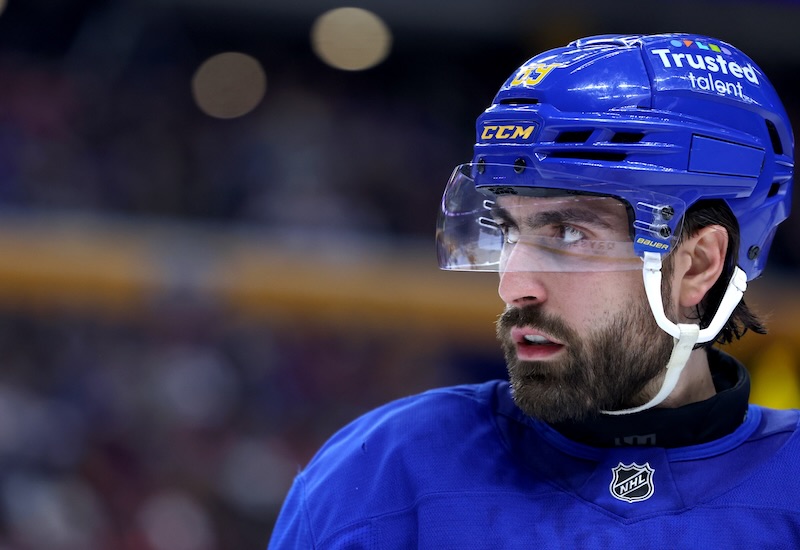
The Buffalo Sabres are buyers at the 2026 NHL trade deadline — an almost-unthinkable position after a decade-plus of rebuilding — but Alex Tuch’s expiring contract has become the franchise’s defining dilemma.
At 29 and playing the best hockey of his career, Tuch is a top-six power forward staring down a contract year. His $4.75 million AAV expires this summer while his camp reportedly seeks $10.5 million AAV.
That gap forces GM Jarmo Kekäläinen to answer a blunt question — keep a playoff-ready core piece for a genuine run, or trade him now for team-controlled help rather than lose him for nothing on July 1.
What Teams are Getting in Tuch
Tuch’s 22 goals and 48 points in 56 games project to roughly 30 goals and 70 points, that translates to .857 points-per-game, a career high pace. Perhaps just as important, 16 of his 19 even-strength goals this season have come at 5v5, not on the power play.
That’s the profile contenders actually pay for at the deadline: offense that survives when the man advantage disappears in April. Add nine shorthanded points, 113 blocked shots, and a plus-16 over 82 games last season and you have Selke-caliber production attached to a genuine top-six scorer at just $4.75M.
“I’m just focused on being a Buffalo Sabre,” Tuch told the Buffalo News — a public posture that hands Kekäläinen full control of the process.
Sportsnet’s Elliotte Friedman put it plainly: “They’re not gonna make their team worse.” Buffalo won’t accept picks alone. The return must help this April.
New York Rangers
The Rangers sit last in the Metropolitan Division and traded Artemi Panarin to Los Angeles in February — they are sellers, not buyers, in the traditional sense.
But that’s the wrong frame, especially with GM Chris Drury framing this as a rebuild, not a retool.
New York projects significant cap space this summer, and with most of the attractive UFA class already signed to extensions elsewhere, acquiring Tuch now is a cut-rate path to a wing they’d otherwise overpay for in July.
The Rangers are already fielding calls about Vincent Trocheck from contenders — they’re open for business, which means prospect capital is available. It’s a financial play dressed as a deadline move, and one of the few teams that could meet a $10.5M AAV ask without roster disruption.
What Buffalo would demand: A controllable top-six forward or high-end NHL-ready prospect plus complementary depth. Not picks.
Los Angeles Kings
The Kings are the most urgent buyers in the West. They’re scoring just 2.54 goals per game — last in the NHL — and lost Kevin Fiala to a season-ending leg injury at the Winter Olympics.
They just acquired Panarin from the Rangers, which signals Holland’s intent, but insiders confirm the forward search has “amplified” since Fiala went down.
Tuch fills a specific gap: Panarin and Kopitar need a physical finisher on the right side who won’t disappear in a seven-game series. That’s not a role the Kings have had reliably in years. Fiala’s injury also opens LTIR room that absorbs Tuch’s $4.75M hit cleanly, making this is the clearest hockey fit of the three potential destinations.
What Buffalo would demand: A prospect plus a roster contributor — a two-piece package that replaces Tuch’s production immediately and extends Buffalo’s control beyond this spring.
Minnesota Wild
Minnesota drafted Tuch 18th overall in 2014, and the reunion is backed by genuine need.
The Wild are second in the Western Conference, but the Quinn Hughes trade cost them Rossi, Öhgren, Buium, and a first-round pick, depleting the depth behind Eriksson Ek and leaving behind a hole that Tuch fills perfectly.
With Kaprizov’s contract climbing to $17M next season, the window is now. The complication: Minnesota doesn’t own a 2026 first-round pick.
Their most credible currency is goalie prospect Jesper Wallstedt, who owns a .914 save percentage and legitimate top-10 NHL upside. Filip Gustavsson is already locked in long-term, which could make Wallstedt expendable. The only real question is whether Guerin is willing to move him.
What Buffalo would demand: A Wallstedt-centered package, or Ryan Hartman plus a high-end prospect like Danila Yurov. Either way, Minnesota has to blink first.
Bottom Line
Every deadline runs on leverage. Buffalo currently holds it.
The Kings have the most urgent need; the Rangers offer the most logical long-term fit; and Minnesota holds a wild card in Wallstedt that no other team can match.
But trading your second-leading scorer mid-playoff-push without a comparable return is a franchise-defining gamble — and unless one of these suitors three clears that bar before the buzzer, expect Tuch to finish the season in Buffalo.