
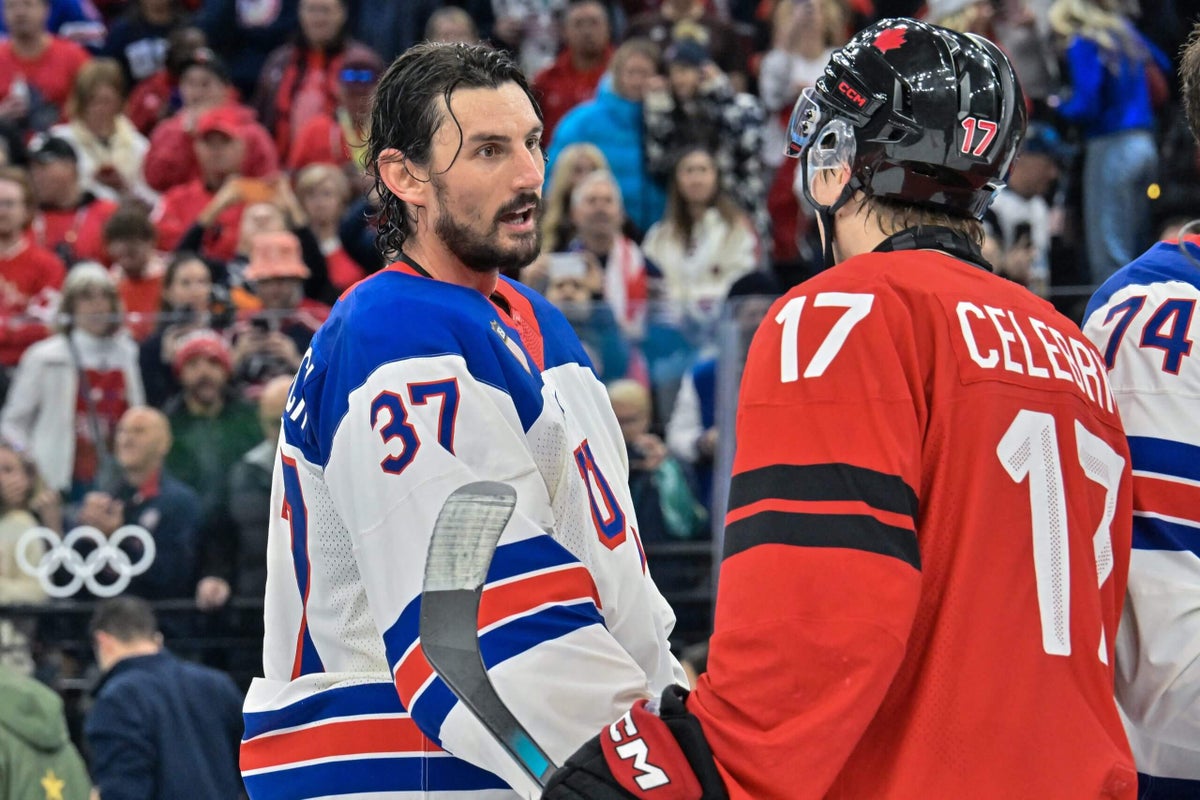
Twelve years and three cycles later, NHL players returned to the Olympics, and the tournament delivered.
There was an appetite for best-on-best international hockey in the men’s game — 4 Nations proved that last February, as the first tournament with NHL talent since the 2016 World Cup of Hockey. But that was just a sampler of what was to come. The Olympics were the main course.
The bar was set high, and while the tournament wasn’t without its kinks — the rink-size drama, gimmicky rules like three-on-three overtime, extremely stringent rules around highlight distribution — it started with a bang with Slovakia upsetting Finland in the prelims, and ended with a classic.
And in between, international star power was on display. Juraj Slafkovský and Dalibor Dvorský showed what difference-makers they can be, without much NHL support. Zach Werenski showcased his elite game to the rest of the world that doesn’t tune into Columbus Blue Jackets hockey on a nightly basis. Prospect Alberts Šmits showed how he can compete against the game’s biggest stars, while non-NHLers like Leonardo Genoni, Martin Gernat and Frederik Tiffels all had standout performances.
From the 4 Nations to the “Heated Rivalry” effect, and now the Olympic stage, it’s been a big year for hockey. Now, as the season resumes, the NHL has to build on that momentum.
Hellebuyck’s MVP-caliber play
Narratives around Connor Hellebuyck’s play in high-pressure situations have swirled over the last few years. While his defense left him exposed in the 2024 playoffs against the Avalanche, he didn’t handle his workload well, either. When it seemed like he was in for a redemption arc last spring, with more defensive support and arguably his best regular season yet, Hellebuyck wilted against the Blues in Round 1.
So one of the big questions for Team USA was who would earn the starter’s net, considering 1) the depth at the position and 2) Hellebuyck’s more pedestrian numbers (relative to his usual heights) since returning from injury.
Hellebuyck answered those questions with sparkling play. And in the highest-pressure situation, he was absolutely phenomenal.
Hellebuyck was the driving force behind Team USA’s gold medal. He only gave up one goal against Canada, despite facing 42 shots from some of the best offensive threats in the world, including 23 slot shots and 12 chances off the rush, all of which added up to an xG of 5.8 per Sportlogiq’s model. He came up with the stop of the tournament, with a paddle save against Canada’s Devon Toews to keep the game tied 1-1 early in the third.
THAT WAS ONE HELLE-BUYCK OF A STOP. 😳 pic.twitter.com/N3wCimdBGw
— NBC Olympics & Paralympics (@NBCOlympics) February 22, 2026
Hellebuyck didn’t just have the hot hand for one game. He was the best goaltender of the Games, and a key reason why the penalty kill went 18-for-18. Through five starts, he allowed six goals on 137 shots for a .956 save percentage and earned a tournament-high 5.92 goals saved above average.
Between a solid showing at the 4 Nations and a game-breaking performance for the USA, Hellebuyck has changed his reputation. It’s just unfortunate he likely won’t get to ride this clutch gear into the playoffs; that could have been a real test between pressure and fatigue, considering how much he generally plays by April.
Big Game Matthews
Auston Matthews hasn’t earned a reputation as The Guy in big moments, either. Instead, the fact that his regular-season goal-scoring rate (0.62 goals per game) hasn’t translated to the playoffs (0.38 per game), with only two playoff series wins under his belt, tends to be the focal point.
While Matthews wasn’t the hero for Team USA, he wasn’t just along for the ride. His two-way game was a pivotal part of the USA’s success throughout the tournament. Offensively, he stepped up with three goals and six points heading into the gold medal game. Matthews added to that total with a primary assist on Matt Boldy’s opening goal against Canada. That assist brought him up to a team-high 31 scoring chance contributions (tracked by the amazing Dimitri Filipovic of the PDOCast).
Defense is tricky to measure because it’s hard to quantify a player essentially stopping something from happening. But against Canada, his backchecks — first on Brad Marchand, then to break up a rush chance from Macklin Celebrini — set the tone. Every detail matters in tight games, and Matthews’ all-around game was clutch.
The Hughes brothers’ next level
The word ‘gamer’ gets thrown around in hockey — it’s usually thought of as a clutch player, who embraces a playoff style and thrives in the big moments. So players like Matthew and Brady Tkachuk generally get branded as gamers, not Quinn or Jack Hughes.
Some of it is due to opportunity — Quinn and Jack aren’t super brash and don’t have much playoff experience. Quinn wasn’t healthy enough to play at the 4 Nations, while Jack had some ups and downs. His injury woes this year added another question mark to his role for Team USA.
This time, the Hughes brothers rose to the occasion.
Despite limited usage (73:40 through six games), Jack Hughes was one of the best American offensive generators. And he did all of that damage on the wing, on Brock Nelson’s right on the fourth line, then Dylan Larkin’s left on the third. Heading into the gold medal game, his shooting and playmaking combined for 27 scoring chance contributions, which ranked third on the team and in the top 15 of the tournament. In the final, he added another two chances and two chance assists, including the golden goal. When accounting for minutes played, Hughes’ scoring chance contributions shook out to 26.9 per 60, which ranked second in the tournament to Connor McDavid. It was a reminder of what a game-changer he can be when healthy (and outside of the Devils’ system, considering how many of his teammates excelled away from New Jersey at the Games).
Quinn Hughes, on the other hand, logged heavy minutes for Team USA — a team-high 141, to be exact, which ranked third behind only Miro Heiskanen and Esa Lindell of Finland. Hughes was a one-man breakout machine whose decision-making and pace sparked the team from the back end. He gave the USA a jolt off the rush and bought his teammates time and space in the offensive zone with his possession-heavy game and evasiveness. It’s all an extension of what the Wild have been getting out of their new No. 1 defenseman; if he can keep up his post-trade levels down the stretch, Hughes could jump into consideration for both the Norris and Hart.
Passing the Canadian torch
Despite missing a few Olympic cycles, due to the NHL’s absence and a snub back when he was 18, Sidney Crosby is one of the faces of Canadian hockey. At 38 years old, he is still performing at an elite level. While he probably has the chops to be a difference-maker in the next four years, it’s way too early to predict his status for 2030.
But if this is it for Crosby, it does feel like the Team Canada torch has officially been passed to Connor McDavid and Macklin Celebrini.
Even with some lapsed coverage on the golden goal, McDavid still had a dominant tournament. He led the entire field in points (13) and scoring chance contributions. But that was, honestly, all to be expected at this point. McDavid is a force whenever he is on the ice, and his game always rises to match the moment.
The more surprising element for Canada was what a difference-maker Celebrini was on this stage at 19 years old.
In just his second NHL season, Celebrini is establishing himself as one of the best players in the world. He can be dynamic off the rush or slow the game down with his patience and puck-handling. That, paired with the massive gap in value between him and the next best player in San Jose, has fueled his place in the Hart Trophy conversation as a sophomore.
All of that earned him a place on Team Canada, but the question was how much he would actually play. Head coach Jon Cooper answered that early, with a top-line placement that he maintained throughout the tournament. Celebrini was one of the most noticeable players for Canada throughout the games; his speed and ability to drive right to the slot were on display every game. He generated a tournament-high 35 scoring chances, according to Filipovic’s tracking, and contributed to another 14 chances. And that offense led to his second-best 10 points in six games.
Canada’s future blue line
After Josh Morrissey was sidelined, a potential flaw for Canada became glaring: the lack of puck-moving defensemen behind Cale Makar and Thomas Harley. As much as Shea Theodore stepped up to add a spark at the bottom of the lineup, he just wasn’t deployed enough. He contributed to three scoring chances in less than nine minutes of play in the gold medal game, in favor of players like Travis Sanheim and Colton Parayko, who each played upwards of 15 minutes.
There was always a risk of some redundancy, with Sanheim, Parayko and Drew Doughty all on the roster, leaving out more offensive options like Matthew Schaefer and Evan Bouchard. So with this tournament in the books, it’s something Canada’s management has to learn from ahead of the World Cup of Hockey in 2028 and the next Olympics in 2030. Changes on defense may not have stopped Canada from getting goalied in the gold medal game. But having more skill on the back end could have better activated the bottom-nine forwards and given the team a deeper approach.
Stone and Marner’s chemistry
International rosters are a blend of the best talents from around the professional world. Without much time to practice as a group, it helps to find some common links to build off, whether it’s past combinations in these settings or regular-season chemistry. On the women’s side, for example, Team USA rolled out an all-Seattle Torrent line of Hannah Bilka, Alex Carpenter and Hilary Knight to kick off the tournament. Team Canada rolled out Mitch Marner and Mark Stone together on the third line.
Marner only shared the ice with Stone in 27 percent of his five-on-five minutes this season with the Vegas Golden Knights. But the two showed a lot of promise on both ends of the ice for Canada, while playing as Crosby’s wings (and then Nick Suzuki’s). And that may be something for the Golden Knights to try and tap into as play resumes, especially with Marner playing center. While it obviously stacks two of Vegas’ best two-way threats together, Stone’s defensive game could help ease Marner’s transition back to playing the middle.
Necas’ power play impact
Colorado’s power play is far too talented to sit dead last in the league in scoring rate, with just 5.08 goals per 60. Makar, Nathan MacKinnon and Martin Necas are all staples of that top unit, with players like Brock Nelson, Gabriel Landeskog, Artturi Lehkonen and Victor Olofsson all rotating through that top unit to find the right balance. But what if a tweak in strategy, with some Olympic insight, could help unlock what should be a dangerous unit?
All three of Necas’ goals for Team Czechia were one-timers from the left circle on some sort of man-advantage. Against France, David Pastrnak teed him up on the power play from the point. Two days later, against Switzerland, Filip Hronek’s lateral pass set up Necas scoring a six-on-five goal to tie the game with two minutes left in regulation. Then against Denmark, Hronek assisted on another Necas one-timer, this time on the power play.
Two of Necas’ four power-play goals this season were scored similarly in Colorado, but it’s not his primary position. MacKinnon is generally stationed on the left, while Necas (before getting bumped off PP1 for the last few games heading into the break) was the bumper. But maybe it’s worth leaning on Necas’ hot right-handed shot from the left circle, and either shifting MacKinnon to the slot or letting him rove around the formation to make the power play an actual advantage again for the Avs.
Hlavaj’s rising stock
Genoni of Switzerland, Samuel Hlavaj of Slovakia and Damien Clara of Italy all earned praise for their Olympic efforts. Genoni has been a staple for Switzerland for some time, and at 38 doesn’t exactly have an NHL future. But Clara (who was drafted by the Ducks) and Hlavaj (of the Iowa Wild) may.
Hlavaj is such an interesting one, because his 3.33 goals-against average and .884 save percentage are among the worst numbers in the AHL — a league that isn’t exactly filled with elite goal scorers. But before Slovakia’s Cinderella run came to a crashing halt in the semifinal round, Hlavaj’s 0.932 save percentage was top-five in the tournament.
What makes his story even more intriguing is the fact that his 2024-25 regular-season numbers were actually better than his goalie partner in Iowa: Jesper Wallstedt.
As much as stellar goalie performances against some of the superteams of the world can generate attention, realistically there is only so much to learn about a player in a tournament setting. It’s only one small chapter of a player’s career, and in Hlavaj’s case, it was only a five-game sample. But stack this experience with his 2024-25 season, and his 2023 World Championship play that put him on the Wild’s radar in the first place, and it gives the situation a little more substance. His status as an RFA this summer, the fact that teams around the league could use inexpensive goalie depth, and the possibility Wallstedt could become expendable in a true needle-moving trade are something to keep an eye on in the future.
The PWHL draft is loaded with star power
No one got a bigger boost at these Olympics than some of the up-and-comers in the women’s game. Caroline Harvey has developed into an MVP-caliber defender in Wisconsin and is likely to be the first pick in the PWHL draft this year. Laila Edwards, who set up Hilary Knight’s tying goal in the gold medal game, and Abbey Murphy, whose combination of elite skill and pesky play was a standout for the USA, are likely top-five as well.
After backstopping Switzerland to the bronze medal, Andrea Brändli could become a starter in the PWHL very soon. Between Nelli Laitinen, Petra Nieminen, and Tessa Janecke, teams are going to infuse even more skill this summer. Any of these players could become a future cornerstone for a PWHL franchise, just like Taylor Heise, who assisted on the golden goal, is for the Frost, or Alina Müller of the Fleet, who scored her second bronze-medal-clinching goal for Switzerland.
The PWHL’s impact was strong across the tournament, and there is even more talent incoming.
Data via Dimitri Filipovic and Hockey Stats