
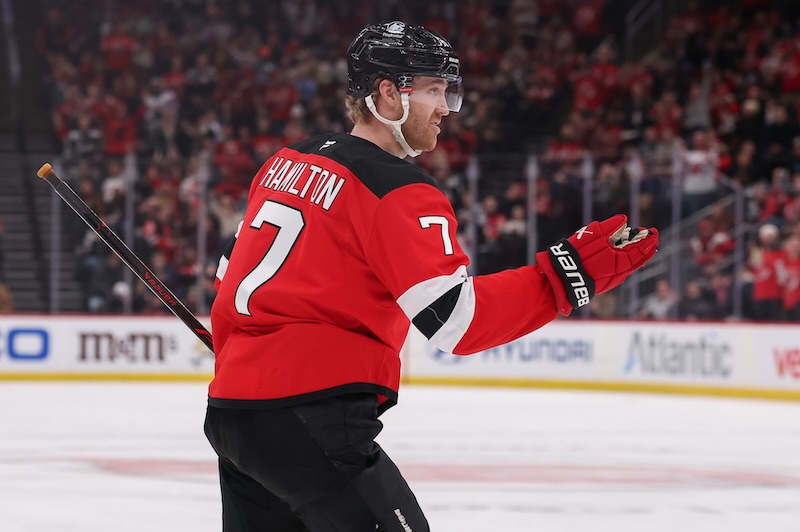
The trade deadline is March 6. New Jersey’s most obvious movable piece is Dougie Hamilton.
He’s a 6-foot-6 right-shot defenseman carrying a $9 million AAV through 2027–28, and has been one of the most productive power-play defensemen in the league over the past four seasons.
Hamilton has averaged 0.98 power-play points per 60 minutes with the man advantage since 2021, ranking among the top five defensemen in that category.
Shed him cleanly and GM Tom Fitzgerald creates immediate cap flexibility; hold him and the rebuild stalls under the weight of a contract the roster can no longer justify.
Why Dougie Hamilton is on the Trade Block
Hamilton’s $9 million cap hit is genuine value for what he produces, but that number is a liability when the team around him isn’t competing.
He also carries a modified no-trade provision, which hands him meaningful leverage over his destination and limits the pool of suitors.
Fitzgerald isn’t desperate, but he’s motivated.
The question is whether the right buyer materializes before the deadline compresses every option.
1. Carolina Hurricanes
Hamilton spent three productive seasons in Raleigh and would slide directly back into Carolina’s puck-possession system.
The Hurricanes have the cap architecture to absorb a meaningful retention split and a track record of aggressive deadline additions on the blue line. Familiarity matters in March: a player who already knows the coaches, the system, and the locker room needs no runway.
A realistic framework: a 2026 first-round pick, a B-level prospect (think the tier just outside Carolina’s untouchable core), and 25–30% salary retention from New Jersey.
That gets the deal done without either side overpaying.
The sticking point is whether Carolina will surrender a first without demanding full retention relief — they’ll push hard on both levers simultaneously.
2. Dallas Stars
Dallas is built to win now and has fallen short in back-to-back postseasons.
Hamilton would allow Miro Heiskanen to settle into a defined defensive role while Hamilton runs the right-side power play, exactly the complementary piece Jim Nill’s front office has been searching for.
The Stars have dealt futures for rental help before and understand the cost of a deadline upgrade.
A workable structure here looks like: a 2026 second, a 2027 first (conditional on a Cup Final appearance), and an NHL-ready depth forward such as a bottom-six winger with term remaining.
That’s something that helps New Jersey’s immediate roster while Dallas avoids sending two premium picks.
Dallas likely needs at least 15% retention to make the cap work without restructuring other contracts mid-season.
3. San Jose Sharks
San Jose has the room to absorb all $9 million without retention, which would be the cleanest possible outcome for Fitzgerald.
The Sharks’ rebuild is further along than expected, with top prospects arriving and a defined role available for Hamilton as a power-play driver and veteran presence for a young defensive corps.
The problem: Hamilton reportedly blocked a proposed deal to San Jose once already.
Trade lists evolve, and a package built around a 2026 first, a top-five protected 2027 first, and San Jose’s most attractive available prospect could change the calculus.
But Fitzgerald would need Hamilton’s cooperation before the structure even matters.
The Luke Hughes Complication
Every Hamilton conversation has to account for one variable: Luke Hughes is on LTIR with a shoulder injury sustained in January, leaving the Devils thin on the left side and exposed if Hamilton moves.
Trading Hamilton doesn’t just free cap space, it opens a hole Fitzgerald would need to patch immediately, either through a secondary deadline acquisition or by promoting a depth option with real risk.
That tension makes Fitzgerald pickier, not more desperate. He’s not selling Hamilton cheap because the roster is depleted; he’s selling Hamilton only if the return is right.
How This Plays Out
Carolina and Dallas are the most natural buyers if either is prepared to move a 2026 first.
San Jose is the cleanest financial solution but requires Hamilton to say yes. If Fitzgerald can’t get the draft capital he wants alongside near-full cap relief, Hamilton becomes a summer trade candidate.
Hamilton is expensive in the short term but highly valuable to the right contender.
The deadline just determines whether Fitzgerald extracts that value now or makes every GM earn it again in July.