
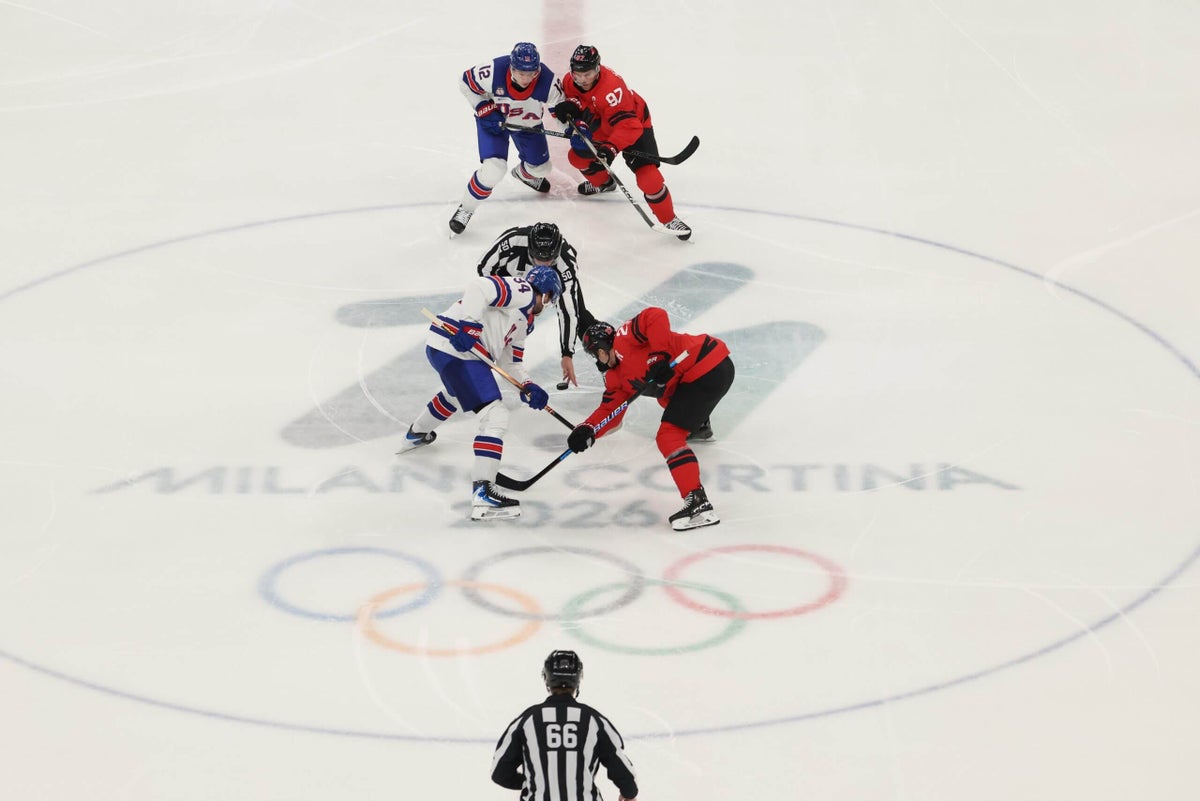
With the Olympics in the rearview mirror, we’re back to … what was it again? That league with all the teams and the six-month season? Right, the NHL, that was it. The NHL is back. Feel the excitement.
But while the Olympic tournament is over and some of us might be eager to move on, now might be a good time to wonder about whether the NHL could learn something from how the tournament was structured.
No, I don’t mean using three-on-three overtime to settle championships — fans around the world seem to agree that part was bad. And I don’t mean the smaller rules we debated last week in Rules Court. I’m thinking of an element you may have already forgotten about, since it was only in place for the round robin: Should the NHL borrow a page from the Olympics and move to a 3-2-1-0 points system?
That’s where teams receive three points for a regulation win, two points for an overtime/shootout win, one point for an overtime/shootout loss and zero points for a regulation loss. Is that better than what we have now?
I think so, because the loser point is bad and the hockey gods hate it. And while the 3-2-1-0 system still has a muted version of the loser point, it fixes most of the other problems the current system produces. So I’m on board, and I know I’m not alone.
But not everybody is, and that list includes a guy whose opinion counts for a bit more than mine: Gary Bettman, who’s never shown must interest in 3-2-1-0 and who recently reaffirmed his support of the status quo.
But is he right? Maybe. Given that the NHL is closing in on two decades of its current points system, we should at least consider the idea they’ve got it right and the 3-2-1-0 fans have it wrong. So today, let’s do that. Let’s run through six of the most common arguments against a three-point format, and see how many of them hold up.
Argument 1: The current system keeps the playoff races close
Point: You can complain about loser points and artificial parity all you like, but you can’t deny recent seasons have served up some great theatre, especially down the stretch. The races are closer than ever before, certainly more so than they were back in the pre-cap days before the current standings system was implemented.
That makes for good entertainment, but also good business. It’s not easy to sell tickets when a fan base knows a team is already out of the running by December. Keeping as many teams as possible in the hunt for as long as possible is good for the league, its fans and the bottom line. Switching to a system that jeopardizes that would be foolish.
Counterpoint: All of that makes sense, except for one minor problem — the central premise isn’t true. The current system doesn’t make the playoff races any closer than they’d be under any other system.
Oh, it could do that, as I showed in this tongue-in-cheek post. But nobody would want that, nor should they. And luckily, we don’t have to worry, because when Bettman tries to pretend the current system leads directly to close races, he’s not telling the truth.
Is there more parity now than there was in the pre-cap era? Sure, but that’s because of the cap itself, not the points system that happened to come along with it. Playoff races would be just as exciting with a 3-2-1-0 system, and maybe even more so because of the extra dynamic of teams trying to win in regulation.
Counterpoint to the counterpoint: I mean, sure, if you want to get all mathy about it. But at the very least, having fewer points up for grabs makes the gaps between teams feel smaller. And aren’t feelings really what matters most?
Does it hold up?: Nope. And that should be a problem since it’s the main argument Bettman and friends like to use. But it’s not the only one, so let’s keep going.
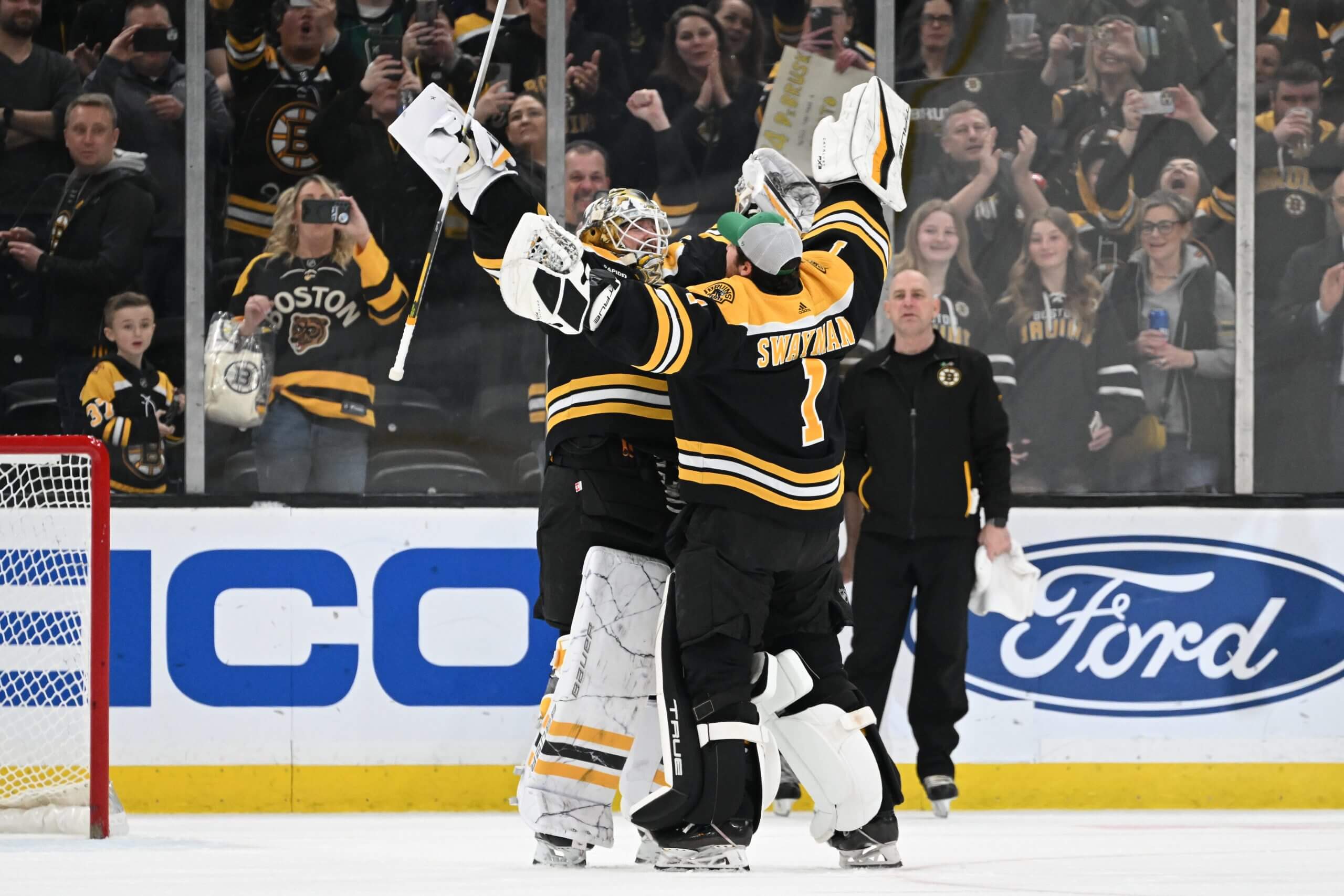
The 2022-2023 Boston Bruins set the NHL’s current points record, with Linus Ullmark and Jeremy Swayman excelling in net. (Brian Fluharty / Getty Images)
Argument 2: Changing the standings now will screw up history
Point: The record for points in a season by an NHL team is 135, set by the Boston Bruins a few years ago. That broke a longstanding mark held by the 1976-77 Montreal Canadiens, who had 132. The 1995-96 Detroit Red Wings fell just short at 131, while the 2018-19 Tampa Bay Lightning came close with 128.
Cool history lesson, right? Except that once we switch to 3-2-1-0 and start handing out three points for each and every game, all those records would be shattered in year one. Any comparison across eras suddenly becomes impossible.
Counterpoint: Impossible, sure … if the idea of multiplying by 1.5 makes your eyes glaze over. For the rest of us, it wouldn’t be that hard to compare one era to another, even by total points. Or even better, just use points percentage.
If anything, that sort of adjustment is preferable to the way the current system inflates everyone’s record, and leaves us wondering if a team like those 22-23 Bruins were really better than the 76-77 Habs, or if they just benefited from loser points and teams playing for overtime.
Counterpoint to the counterpoint: Just keep that same energy when we implement 3-2-1-0 and the Avalanche or Lightning or whoever shatter the all-time single-season points record in February and we have to pretend that’s not weird.
Does it hold up?: Not really.
Argument 3: The standings are complicated enough without having four columns
Point: Quick, your team just finished the season 37-14-6-25, is that good? Are they better than the team that’s 33-18-9-32? Doesn’t that feel like way too many numbers? Do we all need to take an advanced math course just to understand an NHL team’s record?
The NHL standings have always had three columns. We should keep it that way.
Counterpoint: It would be awkward at first, sure. But we’d get used to it. And in fact, the NHL did have four-column standings from 1999 to 2004, back when they introduced the loser point for overtime losses but also still had ties. See for yourself. We didn’t love it, but it wasn’t the end of the world. You just looked at the points column and went from there.
Counterpoint to the counterpoint: Hockey’s already the only one of the big four North American sports with more than two columns, except when there’s a tie in the NFL, which everyone hates. If you need four columns to tell who’s good and who isn’t, maybe your simple system isn’t all that simple. It’s the standings page, not a spreadsheet.
Does it hold up?: Honestly, it does a little bit. But would it be any more annoying than having to talk about winless streaks, or having philosophical arguments about where the extra point even comes from?
Argument 4: I don’t like the current system, but I have a better idea than 3-2-1-0
Point: What about just having wins and losses? Or bringing back ties? Or this other system that’s kind of like what you’re proposing but with a few minor tweaks?
Counterpoint: All of those systems might be better than what we have now. But if every time the topic comes up, we all break into small clusters and insist on our preferred solution being the only one, nothing will ever change.
Counterpoint to the counterpoint: OK, but what if the idea we all agreed on was the one I personally like?
Does it hold up?: It shouldn’t, but go check the comment section of any post on this topic to see it in action. And yes, that probably includes this one.
Argument 5: The current system may not be perfect, but it’s good enough
Point: When in doubt, stick with the status quo. Changing to a 3-2-1-0 system would be a big change, and a league like the NHL shouldn’t make a big change absent a compelling reason. There isn’t one here. The current system, even if it’s not perfect, is good enough.
For what it’s worth, this is basically Bettman’s argument: “We like what we have … We’re not in search of a problem to fix.” Maybe he’s right, especially in a league with as much history and tradition as the NHL.
Counterpoint: It’s true enough that we shouldn’t fix what isn’t broken. But the current system is broken, and not just because it makes some games more valuable than others. The status quo very obviously encourages teams to play for overtime, which transforms the third period of a tie game from edge-of-your-seat suspense to a just-get-it-over-with slog. (And yes, if your own eyes or common sense aren’t enough for you, the “play for OT” effect has been mathematically proven.)
Oh, and despite the whole “keep the races close” mantra, every fan knows the feeling of watching their team reel off a few wins down the stretch and barely gain any ground at all, because everyone else is going to OT every night to make sure the loser point fairy visits.
That’s the beauty of the 3-2-1-0 system. While it doesn’t actually eliminate the loser point, it takes away its power. Teams now have an incentive to try to win in regulation. And they can actually gain ground far more quickly on any teams that still try to play for OT.
Counterpoint to the counterpoint: It’s nice to imagine an NHL where teams go end-to-end late in regulation, but we don’t know that would happen. Old habits die hard, after all, and teams might still prefer to know they’re locking down at least one point rather than risk a goose egg. It’s at least possible that we could make this major change, sit back to watch it play out, and find out that teams are just as conservative and risk-averse as ever.
Does it hold up?: Clearly it does for Bettman. And so far, that’s all that matters.
Argument 6: I am an NHL GM and I love how the current system inflates my record
Point: We can argue about this stuff all we want, but ultimately it would be the NHL GMs who vote on this stuff. And that just happens to be the same group of people who benefit the most from a system that rewards (or at least obfuscates) failure.
Imagine you were one of the 32 people who’d managed to land one of these coveted jobs, and really wanted to hold on to it for as long as possible. Wouldn’t you want to keep a system where almost everyone can finish over .500 every year, and teams who lose more than they win can still claim winning records? When it was time to sell your success to your fan base, local media and (most importantly) the team owner who’ll decide whether you keep your job, couldn’t you use all the help you could get?
Counterpoint: All of that may be true, but none of it is good for the fans or the product or the sport itself. Are we really going to keep this broken system just for sake of 32 guys trying to pad their resumes and cover their behinds?
Counterpoint to the counterpoint: (Hanging “Finished over .500” banner to commemorate 34-33-15 season.) Sorry, what?
Does it hold up?: I mean, you have to at least give this one credit for honesty.
OK, I’ve made the case against 3-2-1-0 as best I can. Did it stick? I’m not sure, so let’s turn it over to you.
Loading…