
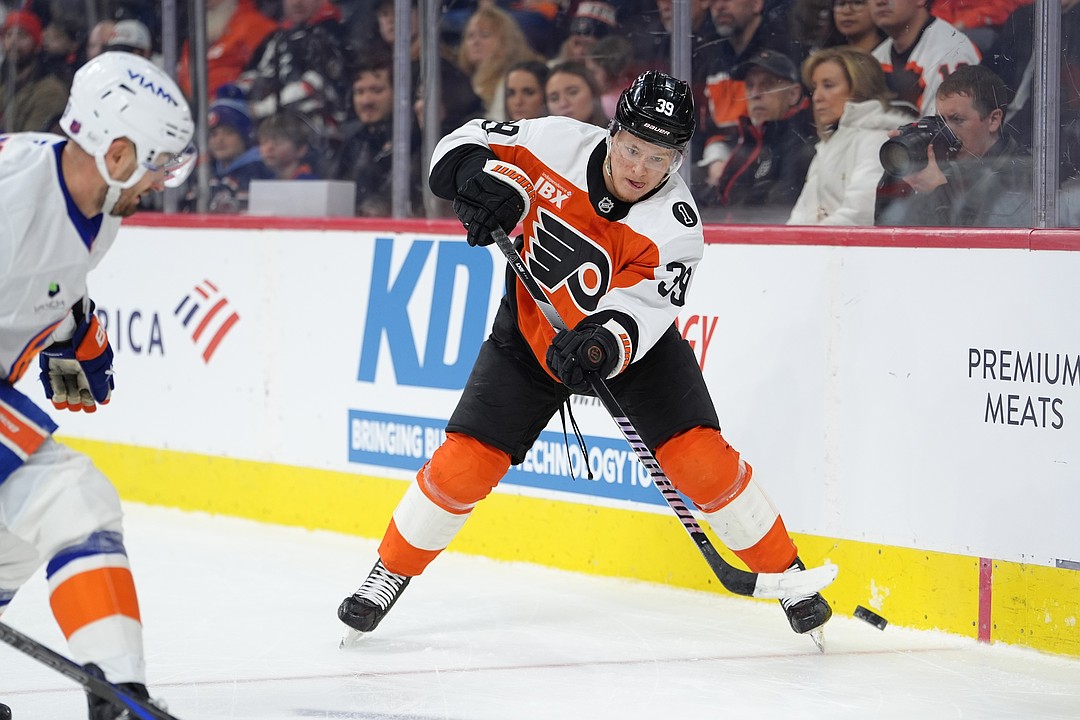
(Note: I unfortunately could not be present at Flyers practice on Tuesday as I spent the day with a relative in the emergency room at Bryn Mawr hospital, so my reaction to Michkov’s availability below is based on seeing the same thing you have seen and not any additional unrecorded or unshared interaction.)
In sports, it’s commonplace for an owner or a team executive to go two months (or longer) without speaking publicly in-season.
When it comes to players, usually it would take an injury to have such a hiatus. But active players don’t usually go that long without being heard.
And active players who are considered one of their team’s most important players never go that long.
And yet, we had that happen here in Philadelphia with Matvei Michkov recently.
The inflection point of all conversation about the Philadelphia Flyers this season spoke for the first time on Tuesday since December, and it was good to hear from him, because, with all of the noise around him over the past two months, it was seemingly unfair to him that he had not had a chance to weigh in on the conversation.
It was a perfect storm, I guess, as to why he didn’t speak. Initially, there weren’t a lot of requests for him. For the better part of January, there were so many other concerns for the Flyers, that talking to Michkov seemed a bit secondary.
Plenty had already been made about his season to that point. Beating the dead horse of him not being in shape wasn’t good for anyone’s sanity.
But then there were reasons to start to wonder what Michkov was thinking. His ice time was not where a lot of people wanted it to be. Some of it was strategic, other parts of it were on the player himself, coming off the ice early on the shifts he was having.
There was the fluctuation of shifting from right wing to left wing and back again. All, with a statistically insignificant difference in results, but still, worth asking about.
Then there was the firestorm that was born out of coach Rick Tocchet’s comments at the Flyers’ Charities Carnival on Feb. 1. And then there was the video breakdown of Michkov’s play by former NHL video coach Steve “Petey” Peters that went viral.
And there was the Olympic break, when Michkov had previously committed to training during it while other players would use the opportunity to rest, heal and reset for the final push, only to then post videos of himself on Instagram on vacation in the Dominican Republic (albeit including one video if him working out).
And all the while there was silence from Michkov. Not because he didn’t want to talk, mind you, but rather because his interpreter, skating coach Slava Kuznetzov, had departed for the Olympics early because he was coaching New Jersey-based figure skated Isabeau Lovito during her competition in Milan and the Flyers didn’t have a backup option.
So, everyone had to wait for Michkov to talk, and many opinions were formed without his input as context. It was not fair to him to not be able to address the firestorm.
He finally did on Tuesday.
With Kuznetzov back from Italy, Michkov finally had the opportunity to talk about all of these things.
Here is the transcription.
On going to the Dominican Republic:
“I was training every day. I was not resting there.”
On whether he brought a trainer with him to the Domincan Republic.
“Yes.”
On who the trainer was:
“(I) don’t want to disclose it.”
On what specifically he was working on:
“Two trainings a day, first one was in the gym. Second one was conditioning and stamina. Seven days of the same training… Off ice.”
On how he feels going into the final stretch of the season:
“I feel a lot better. I hope to feel a lot better in the games as well. The training as well. The main point right now is to help the team and to help the team to win.”
On his relationship with Tocchet and the coaching staff:
“It’s a very common relationship between a player and a coach. Everybody has the same goal – the coaches and players – to win. So we work in that way.”
On if he benefitted mentally from the Olympic break in anticipation of the final push:
“I’m always ready. My mind is always ready to go. Always ready. I was working on a couple things to be ready in total and be ready for the second half. Summer break was way too long and everything was feeling like a new thing (to me). It was hard to go right into the first games after the summer break. Before the Olympic break I was already feeling better. I started getting chances for myself and [my teammates]. The first 10 games I had no chances, no moments for myself or [my teammates]. That was definitely not helping in the mind. In those moments I need to concentrate on the work and working to get myself better. There’s no other way.”
On what he can do to replicate his strong play after the Flour Nations break last season:
“Last year, the Four Nations break was not that long of a break, so I was just resting. This time I was not planning to rest. I was not happy with how [my] game was going, so I was working the entire break. My emotions depend on how the hockey goes. That’s why I decided to work instead of rest.”
On what he learned about the NHL and himself this season:
“There’s nothing new in the NHL. The NHL is hard work. If you take a four-month break, it can affect your game. You have to concentrate on hockey all the time. You can not take even a (one) month break. You have to be smart when you are training in the [summer]. You can’t take an injury, but the training must go.”
On if he pays attention to the chatter in the media and on social media:
“What’s happening in the media?”
(after a clarification of the question)
“I’ll play as much time as I’m being given and I have to do my job. That’s the only thing I care about. The way [Tocchet] decides to play me is the way I play. I’m a player and I have to concentrate 100% on what I’m doing at the moment.”
On adjusting to playing left wing more than right wing.
“I don’t know. I’ve always played on the right. I was always happy. Now I’m playing on the left. It’s a new role. If the coach sees me there, I have to adapt as quick as I can. For me, on the right, I can create a lot more moments. Now I have to switch everything to the left and do the same thing.”
On how much a difference he can make for the team trying to make a playoff push this season.
“I’m feeling 100% right now. I’m feeling very light on the ice. I’m feeling everything is going to be good – at least at practice. We’ll see tomorrow at the game. These are (all) hard games and they are very important for us. I’m sure every single player (in the locker room) are looking to win those games. There are 26 games left and it’s hard work. Everybody wants to make the playoffs and that is our goal on the ice – for me, for the coaches and the staff as well. So, everybody’s thinking about the group, how to win those games and make the playoffs.”
Every one of his answers was fair and honest. It likely would have diffused a lot of the heat had we been able to hear these things weeks ago, but we can’t live in the past.
What we can live in is the present, and at present, we know that Michkov has been unhappy with his season, takes accountability for not training properly last summer, has been training hard to get to the level he feels he needs to get to, does not have a bad relationship with Tocchet, understands why he is being deployed the way he has been deployed, and although he prefers to play on the right wing feels that he can adjust to playing on the other side.
And while that is the one answer that is certain to draw the most attention of the most vociferous in online discourse (or lack thereof) it should be noted that this is not just some thing that came up under Tocchet’s coaching.
Here’s an interview we did with the Flyers bras prior to last season – as in September 2024 – and in talking about MIchkov, after G.M. Danny Briere talked about his playmaking ability, Chris Therien asked if there was a possibility of him playing center.
After Briere said he’s more likely to stick at wing, President Keith Jones jumped in and said Michkov can play both sides – was doing so in training camp – can switch mid-game and that he doesn’t care which side he plays on in a game.
And this was all before he ever played a game in the NHL.
But the false narrative is that this is a Rick Tocchet creation and abomination. That’s only because everyone tends to only focus on the present and forgets about the past.
Which is why, the more access we have to Michkov and hearing his take on things, the better off we will all be going forward – and by we I mean everyone – the Flyers organization, Michkov, Tocchet, fans, and yes, those of us who write about and comment on the team as well.
This 10 minutes of Michkov was like when Jimmy Chitwood got up to speak at the town hall meeting in Hoosiers.
Not because he was speaking up in defense of Tocchet, like Chitwood did for coach Norman Dale, but rather because he proved he can speak for himself and doesn’t need the masses to speak for him.
When that environment is created, it allows for the trash can bangers to be the loudest noise makers and set the narratives.
Letting the kid answer for himself, while there is still the possibility of something being lost in translation, that’s less burdensome than radio silence for weeks on end allowing for the creation of a firestorm.
Lesson learned, I hope.