

Editor’s note: The Denver Gazette presents a three-part investigative series on health after hockey for NHL players. Part I examines the life and death of Colorado Avalanche enforcer Chris Simon.
Chris Simon found peace on the north shore of Lake Superior, where pristine beaches meet lush forests, rocky bluffs, and clear waterfalls in the same Canadian wilderness of his native ancestors.
He found pain on the ice.
Long dark hair that spilled from his helmet and covered the name on his jersey symbolized Ojibwa roots in Wawa, Ontario, where Simon grew up hunting and fishing. Bravery. Sacrifice. Humility. The same principles guiding his native culture also defined his role in the National Hockey League.
Simon played in 15 NHL seasons and won the Stanley Cup in 1996 with the Colorado Avalanche. He stood taller than 6-foot-3 in skates with jackhammers for fists. He used them to beat anyone with unholy retribution who broke the hockey code or targeted captain Joe Sakic. He fought more than 100 times with 1,824 penalty minutes in his professional career.
It can be difficult to reconcile two images of Simon.
First: The father. The quiet but respected teammate across NHL locker rooms in Quebec, Colorado, Long Island, Calgary, New York, Chicago and Minnesota. The two-way forward who once led the Washington Capitals in goal scoring. The prodigal son of Wawa who returned and started a hockey school.
Second: The enforcer. The 25-game suspension for a two-handed stick swing at a face. The 30-game suspension for stomping on a leg. The struggle in retirement with divorce, bankruptcy, depression and physical pain. The failed hockey school in Wawa. The lingering unanswered questions.
Simon has joined a growing list of NHL players from a bygone era to meet a similar and tragic fate.
On March 18, 2024, Simon died by suicide. He was 52. A postmortem diagnosis confirmed Stage 3 chronic traumatic encephalopathy (CTE).
Simon’s death emphasizes the risk of brain injuries in hockey.
“Looking back, we now realize that Chris likely started suffering from CTE in his late 20s to early 30s. Our entire family suffered for many years as we saw our son, brother, father, husband slip away from us, and we couldn’t do anything to help him,” the Simon family — Linda and John Simon (parents) and Charlee Simon (sister) — said in a statement to the Concussion Legacy Foundation. “Before we lost Chris to CTE, he was a very gentle, loving man whose family meant the world to him.”
***
A brain is donated to Boston University by a grieving family questioning why their loved one changed.
Dr. Ann McKee helps to find answers.

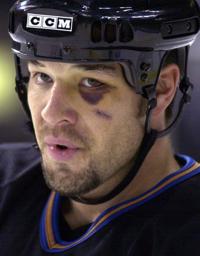
Washington Capitals enforcer Chris Simon is battle-scarred from previous games as he leaves the ice after a first-period shift against the Tampa Bay Lightning on Friday night, Oct. 25, 2002, in Tampa, Fla. (AP Photo/Chris O’Meara)
CHRIS O’MEARA
Her research as director of BU’s CTE Center established that repetitive head impacts — both concussive and non-concussive — can lead to progressive brain disease without a known cure. Experts believe CTE occurs when a structural protein called ‘tau’ malfunctions, causing a reaction that slowly kills brain cells and spreads with severity. It is currently impossible to diagnose CTE in a living person.
McKee identified Reggie Fleming in 2009 as the first known case of CTE in a former NHL player. That list has grown to 19 ex-NHL players since April when McKee diagnosed Simon. BU also released a December study which confirmed 42 cases of CTE in men’s ice hockey players among 77 total brain donors.
One key discovery: The odds of CTE increased by 34% with each year played.
“It was the first time we showed a direct relationship between the number of years playing hockey and the risk for CTE,” McKee told The Denver Gazette in a phone interview about CTE research and Simon’s diagnosis. “His Stage 3 was on the severe side. … The only thing we found in his brain at the time of death was CTE. So, I think it’s likely that his decline — which was really quite profound, especially in the last 10 years — accounted for that.”
NHL commissioner Gary Bettman denies a link between the league and CTE. He reiterated that stance in a 2023 radio interview with NPR when Bettman said: “We listen to the medical opinions on CTE, and I don’t believe there has been any documented study that suggests that elements of our game result in CTE. There have been isolated cases of players who have played the game (who) have had CTE. But it doesn’t mean that it necessarily came from playing in the NHL.”
The league is also the defendant in a wrongful death lawsuit filed by the father of former NHL defenseman Steve Montador — diagnosed in 2015 with CTE at age 35 — as part of a nine-year legal battle. The case is nearing a potential trial in Cook County (Chicago) Circuit Court with a case assignment call scheduled for July 17, according to online court records.
“Gary Bettman has been adamant that there is no association between hockey and CTE — which is preposterous,” McKee told The Denver Gazette. “He’s flying in the face of tremendous evidence, looking at the number of players that have been reported. … I think it’s a very willful misunderstanding of the issue. There is a clear attempt to obfuscate the science and deny its applicability to hockey players.”
***
Craig Wolanin recalled a photograph when asked about Simon.
They were former teammates with the Nordiques and Avalanche.
A single image captured their bond outside of hockey.
“Christian, my son, was born in Quebec in 1995,” Wolanin said in a phone interview. “The second male to hold my son was Chris Simon. My wife has a picture with Christian, my son, in his hands.”
Simon made his NHL debut on March 4, 1993, after overcoming addiction problems as a teenager. He entered the league during the era of intimidation. Every team had at least one player like him — strong, heavy, fearless — who set the tone with physicality and never turned down a fight.
Simon played in 89 games over his first three NHL seasons in Quebec.
He totaled 304 penalty minutes.
“When we initially met and became teammates, he battled alcoholism, and he was beating it at that point,” said Wolanin, who played 13 NHL seasons (1985-98). “In the early years of Quebec, that’s when he started to establish himself as a legitimate pro hockey player. He had matured and started to control himself both on and off the ice. One thing that I remember significantly about him is that he used to drink so much coffee at all times of the day. He had this big, deep, low voice.
“Chris is someone that got along with the whole locker room. Everybody respected what he did for us and what he meant to us.”
Simon elevated his game when the Nordiques became the Avalanche in his fourth NHL season. He set career-best marks in games played (64), goals (16) and assists (18). Simon also fought more than a dozen times. A YouTube channel called “Hockey Fight Legends” documented each bout in a compilation video of the 1995-96 season.
Press play on the video. Simon is rarely knocked off balance. His helmet never comes off. He lands punch after punch after punch until multiple referees finally end his opponent’s suffering. Blood trickles from Simon’s nose as he skates into the penalty box. Rinse and repeat.
“He was one of our role players, and it was a role I think that he probably did a little bit more reluctantly than he wanted,” Wolanin said. “I think, oftentimes, that may be the case with guys who have roles like that — understanding that it does take a toll on you physically and mentally.”
***
Mark Kiszla covered the 1996 Avalanche run to win the Stanley Cup.
Fast forward 30 years. The Denver Gazette sports columnist said Simon was “miscast as the hockey version of a classic WWE villain” with a personality that did not match his reputation.

The Colorado Avalanche pose for a team photo with the Stanley Cup after defeating the Florida Panthers 1-0 in triple overtime to sweep the finals Monday, June 10, 1996. (AP Photo/Hans Deryk)
HANS DERYK
“Chris was soft-spoken in the Avalanche dressing room. So soft-spoken that I often wondered where the rage he could show on the ice came from,” Kiszla recalled. “And he had skills. He often played on the same line as Joe Sakic in 1996 and scored plenty of goals as a force in front of the net. But he was also a healthy scratch late in the playoffs, and I know that hurt his pride.
“The relationship between Simon and coach Marc Crawford was volatile during that championship run. And here’s the weird thing: unlike Simon, ‘Crow’ was fiery. The coach took pride in being a pain in the ass.
“The image that sticks with me about Simon is counter to everything we think about a hockey enforcer. I can still see Crawford dressing down Simon in a very vocal, almost embarrassing, way when he was upset with ‘Chief’ the day after a playoff game against Vancouver.
“Crawford railed against Simon on the ice at an Avalanche practice for all, including teammates and I to see. Crow was mad at Chief for not sending a message to Gino Odjick, the Canucks’ resident tough guy. What I recall more than Crawford’s harsh words was the way Simon reacted. As he took the coach’s heat, Simon’s eyes were downcast and his shoulders slumped, like a child admonished by an angry parent for not doing his chores.”
***
Rick Berry shared a locker room with Simon in 2002 after being claimed on waivers by the Capitals.
Simon’s game had evolved from a Colorado enforcer to a true two-way Washington forward. He accounted for 100 points — 53 goals and 47 assists — over his last three full seasons with the Capitals. He led their 1999-2000 team in scoring with 29 goals. He had proven NHL skeptics wrong.
“I first got to know Chris when I was trying out for the Avs,” said Berry, who played four NHL seasons from 2000-04. “He wasn’t really the most vocal guy. But you saw the way he carried himself, and you obviously respected him. He played a big role. He was a big, tough guy. … He got known for being a goal scorer for a while.”
Your daily report on everything sports in Colorado – covering the Denver Broncos, Denver Nuggets, Colorado Avalanche, and columns from Woody Paige and Paul Klee.
Success! Thank you for subscribing to our newsletter.
The prevailing media narrative suggested Simon discovered life balance. He told Sports Illustrated, “Scoring is much more fun than fighting.” He got married and started a family. Simon told ESPN he’d been sober since New Years Day 1992.
“He was actually a big teddy bear, right?” Berry told The Denver Gazette. “As tough as he was on the ice and intimidating, he wasn’t that way off the ice. He was making sure you were settled. He was just a good leader. … That’s why when I first heard the news, I was shocked. Just absolutely shocked.
“The Chris Simon that I knew, I could never imagine he would take his own life.”
***
Simon asked for sympathy when everything fell apart.
Counting five KHL seasons in Russia, he played 20 years of professional hockey and retired in 2013.

New York Islanders Chris Simon fights with Washington Capitals John Erskine during the second period of their hockey game, Saturday, Nov. 25, 2006 at Nassau Coliseum in Uniondale, N.Y. (AP Photo/Ed Betz)
ED BETZ
Simon filed for bankruptcy about four years later.
The Ottawa Citizen newspaper cited May 2017 court documents with Simon’s affidavit. He wrote: “I have no ability to pay the alleged arrears or enter any form of payment agreement. My financial situation is bleak.” Simon owed $182,625 to creditors even after all his property and assets were sold.
Simon claimed two years of income from his hockey school but stopped working in November 2015. He told the court that NHL injury symptoms — anxiety, depression, post-traumatic stress disorder and arthritis in his hand, shoulder, knees, back and neck — prevented him from employment.
“Chris’ short-term memory issues were ongoing for many years,” the Simon family said in a statement to the Concussion Legacy Foundation. “We also learned that he had lost most of his hearing, had daily headaches, light sensitivity, paranoia, was easily frustrated with tasks, had extreme anxiety, difficulty navigating in a vehicle, apathy, lack of feeling and emotion. … Chris really distanced himself from his family and friends the last three years of his life.”
Former NHL teammates who spoke with The Denver Gazette did not keep in touch with Simon after retirement. Yet every member of the 1995-96 Avalanche is forever connected.
“For the last 30 years, we’ve been Stanley Cup champions,” Wolanin said.
But at what cost?
Wolanin, 57, is grateful for positive health in hockey retirement living in the Detroit area. He still skates with the Red Wings alumni. But he’s not ignorant of the risks playing in 695 career NHL games. Wolanin hopes to someday donate his brain to medical science.
“Back when we played, and certainly before us, it was a badge of courage to play through getting your bell rung. We know the ramifications now,” Wolanin said. “I understood at a pretty early age what I was getting into. I have no bitterness. But I do really feel an obligation to try and help.”
***
Simon’s Ojibwa spirit name is the native word for hummingbird: Naanookshkanse.
It’s one detail in his obituary posted last year that tells a deeper story.
“There was nothing more important to him than being a dad,” it reads on the Kerry Funeral Home webpage. “Chris encompassed the qualities of his spirit name by his way of kindness, compassion, loving heart and genuineness.”
His life wasn’t supposed to end this way.

Colorado Avalanche center Stephane Yelle, left, celebrates his goal with left wing Chris Simon against the Detroit Red Wings in the third period of the Stadium Series alumni game at Coors Field in Denver on Friday, Feb. 26, 2016. Colorado won 5-2. (AP Photo/David Zalubowski)
David Zalubowski
Simon discussed his future in the December 2000 issue of ESPN the Magazine.
He explained how hunting and fishing are integral to native life in Canada and protected under its constitution. Simon said: “An Indian has the right to harvest the land.” But he alleged the Ontario Ministry of Natural Resources violated those native rights with his family.
Simon was furious. He reportedly cut his long dark hair in protest.
“This whole thing has made me realize what I want to do when I get out of hockey,” Simon told ESPN. “I want to see that the rights of the Indian people are honored.”
Who will honor the sacrifices of Simon and his lost generation?
In June 2023, researchers at Columbia University published the results of a study which examined more than 6,000 NHL players from 1967 to 2022. It found that enforcers, defined as having 50 or more career fights, died a decade earlier on average in comparison to their peers. The study also found that enforcers were more likely to die of suicide and drug overdose.
The two images of Simon — inspiring and tragic — might contrast upon first glance. Yet his story is all too familiar. Simon never turned down a fight.
Until there wasn’t any fight left.
CTE IN THE NHL
More than a dozen former players in the National Hockey League have been diagnosed with chronic traumatic encephalopathy (CTE), according to media reports. Listed in alphabetical order by last name.
—Ralph Backstrom
—Wade Belak
—Derek Boogaard
—Todd Ewen
—Reggie Fleming
—Bobby Hull
—Greg Johnson
—Stan Mikita
—Steve Montador
—Jeff Parker
—Bob Probert
—Henri Richard
—Rick Rypien
—Chris Simon