
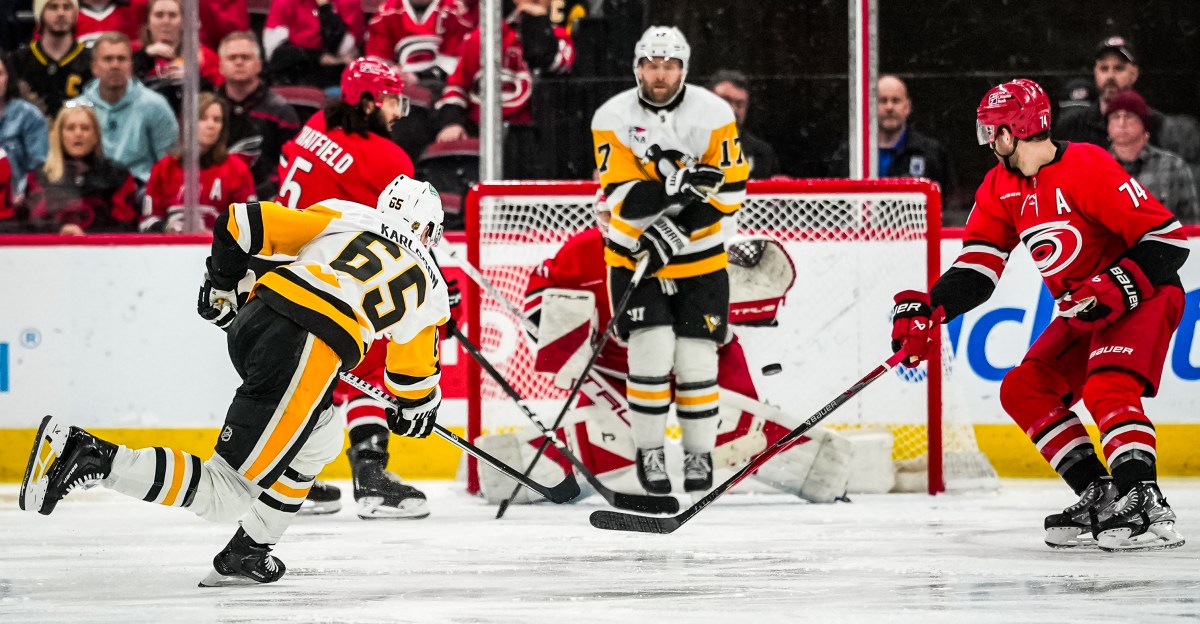
The Pittsburgh Penguins haven’t even qualified for the playoffs yet, with no guarantee that they will. However, after being picked as a last place team by just about every publication everywhere, the team already has more points in 68 games this season (84 and counting) than they managed in the entire 2024-25 season (80).
There’s nothing more sought after than using one team’s success or surprise performance as a template for another situation, and it’s not surprising that the Pittsburgh method has already started to attract attention.
The article, mostly paywalled, acknowledges that it’s impossible for a team to have Sidney Crosby and even Evgeni Malkin as point-per-player games despite their age. The focus is on the turn to youth.
Really, in a copycat league, what teams or fans or observers truly want is moves that pay off. The Pens did something similar from about 2014-16, where almost every move then-general manager Jim Rutherford made (Hornqvist, Kessel, Hagelin, Bonino, Daley trades) worked out to improve team performance.
The Dubas plan, as is has unfolded, has become in a succinct nutshell:
The key to a quick turnaround is aspirational for other teams, yet incredibly difficult to master because it relies on a series of successive wins. A team has to make the right trades at the right time (Chinakhov, Silovs, Skinner, etc) while also getting major hits on what usually pans out as modest impact from free agents (Mantha, Wotherspoon, Brazeau). Add in a draft surprise (Ben Kindel) and suddenly what was a stale roster in 2024-25 has now become rejuvenated — getting an entirely new coaching staff only adding to the pile of changes. That draws attention but is much easier said than done.
It’s more art of successful (and potentially sometimes beyond the realm of hopes) than it is a science to copy and paste. Guys like Parker Wotherspoon don’t grow on trees, sitting out there in free agency ready to seamlessly step into huge roles and perform to high levels. A team doesn’t often scare up a 16-goal performance out of a player like Justin Brazeau, who has doubled his career totals. It’s not every year a fourth round pick can be flung away to get the reigning AHL playoff MVP in Arturs Silovs who can be a solid 1A/1B goalie. These are moves every team would love to make but actually recognizing the opportunity becomes the tricky part.
It takes all of those moves, their impacts multiplied by the last one before it, to be the Penguins. Imitation is natural in a competitive world where others certainly should be looking on how to replicate another team’s success, results can vary. Dubas didn’t invent a new process or way to build a roster, he’s just in the midst of a streak where enough decisions have worked out almost perfectly, like it did for Rutherford a decade before. That is reminiscent of the managerial run the Capitals made last year where seemingly everything turned to gold, with staying power not assured as we’ve seen this year’s results.
What a team like the Rangers, or anyone down at the bottom, needs is to find a plan that works and then work the plan. Finding cap space and then using it has worked in the past, though with the cap expecting significant growth in the near future it might not be to the same degree moving forward. There’s no one-size fit all solution or roadmap to copy when it comes to improving a team. It just takes a series of good decisions that all come together in the right time.