
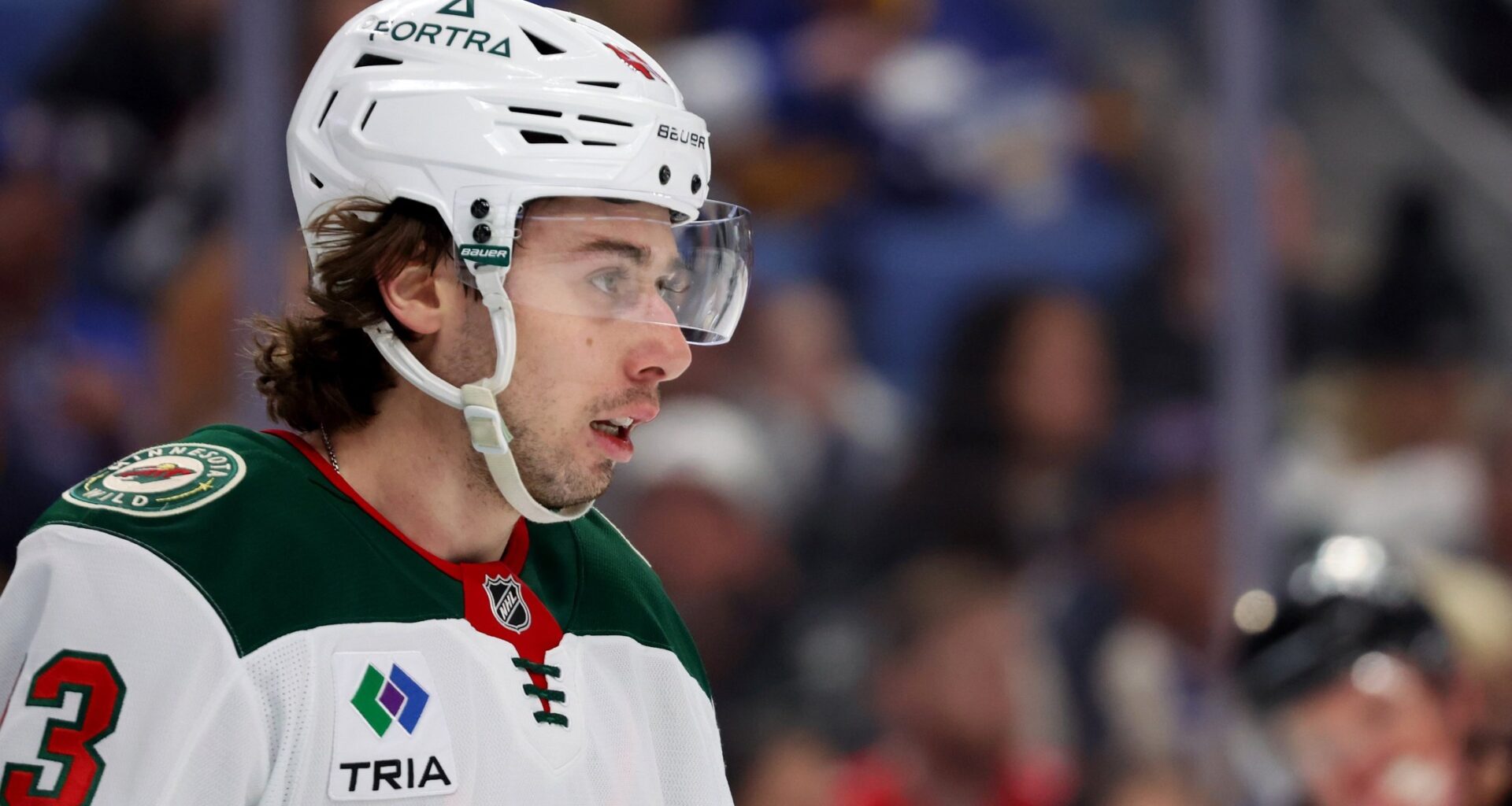
The Minnesota Wild’s recent losing run isn’t cause for alarm, at least not yet. Still, three losses to teams lower in the standings – the Philadelphia Flyers, the New York Rangers, and the Toronto Maple Leafs – raise questions about the team’s shape heading into the playoff season. Bill Guerin recently echoed that sentiment in a sit-down with The Athletic.
“Anytime it’s this late in the year and you’re losing three in a row, you have concerns,” Guerin said. “I think there’s a solution to it. We’re trying to figure out what that is, but it’s time for our players to reset.”
The Wild got back on the right track with a win against the Chicago Blackhawks on Tuesday evening, but even that victory came with concerns. The Wild let Chicago get back in the game and push it to overtime despite dominating the first period.
If Minnesota is still looking for a shakeup to fully break out of its slump, one option is to mix up its lineup. The Wild have plenty of options to throw their lines and pairs in a blender. However, there’s one in particular that Minnesota should consider.
Breaking up the Quinn Hughes and Brock Faber pair.
Quinn Hughes and Brock Faber have been joined at the hip since the blockbuster trade that brought Hughes to St. Paul. The pairing has been incredibly successful, producing eye-popping scoring numbers (Hughes has 44 points in 36 games for the Wild) and serving as a pivotal factor in the team’s 20-9-7 record since mid-December.
Despite the pair’s strong play, some cracks are starting to show, especially defensively. Since the Olympic break, the Hughes-Faber duo had given up the most 5-on-5 high-danger chances against (30) of any pairing on the team.
They’ve also been on the ice for more goals against (nine) than any other pairing in the NHL except for Sean Walker and K’Andre Miller (10), Adam Larsson and Vince Dunn (11), and Dmitry Orlov and John Klingberg (14) in that time frame.
More than just the raw numbers, some of those mistakes have come at crucial moments for Minnesota during its recent run. Look at the team’s matchup with the New York Rangers as an example.
Jaroslav Chmelař scored what ultimately became the game-winning goal on a play where Faber cleared the zone but couldn’t get the puck where he wanted. Hughes was caught too close to the blue line, and a nice feed from the Rangers’ wing sprung Chmelař on net.
Even in games where the Wild and the pair perform well, they’re starting to give up a dangerous amount of chances. In the Blackhawks game, Faber and Hughes had a fantastic game in the offensive zone, producing 1.856 expected goals for on the ice.
For as good as they played offensively, their defensive metrics were just as concerning. They gave up 1.44 expected goals against in the game and were on the ice for Ryan Greene’s goal to bring the Hawks back to within one on the scoreboard.
There are a couple of mitigating factors that have led to those outcomes for the duo. First, the team’s goaltending has been weaker with Hughes-Faber on the ice than normal. When the pair is skating together in the last ten games, Wild goaltenders are registering a .897% save percentage compared to Filip Gustavsson and Jesper Wallstedt’s average save percentage of .911.
Quinn Hughes and Brock Faber also play an absurd amount of minutes together. Hughes has eclipsed more than 40% of possible ice time in a game in nine out of his last ten appearances. Faber isn’t far behind and has always carried significant responsibility.
Faber has had to be the do-it-all defenseman in his short career for the Wild. The Gophers alum performs admirably, but it was certainly a lot to handle playing as the team’s No. 1 defender in his early 20s.
Ironically, the Quinn Hughes trade was supposed to lighten the young defender’s load. Hughes is a legit superstar and No. 1 defender who is also used to playing a lot of minutes. That should help Faber be more efficient. Instead, Faber is still regularly playing 25-30 minutes a night with Hughes.
Splitting up the duo could allow both to get some rest. Depending on the game, the pair playing better can take the big minutes, giving the other a chance to play as the secondary defensive option.
Separating a star partnership for a quick refresh is not an uncommon strategy either. The Edmonton Oilers regularly separate Connor McDavid and Leon Draisaitl when the team needs scoring from more than one line, but put them back together when they need a goal.
Following the strategy of separating top players to create depth could also help Minnesota find some offense in new areas. For as much coverage as Hughes and Faber get for their offensive exploits, it’s far less discussed how the rest of the team’s defense hasn’t been able to produce points during their partnership.
The second pairing of Jared Spurgeon and Jonas Brodin has been great at limiting chances, giving up just 2.56 expected goals against in their last eight games together, but they’ve also combined for only two points as a tandem and four goals for the team while the pair is on the ice.
With Minnesota’s current Hughes-Faber setup, the Wild are wagering that for half of the game, they’ll have the best offense from the blue line in the league. Meanwhile, they experience a dip in play from their blueliners during the rest of the game.
Changing the defensive pairings could also be a way to test lineup decisions in case either Hughes or Faber is injured. Faber has a long-standing history of positive results with Jonas Brodin. The pair has produced better than 50% expected goals percentage in multiple seasons. Still, we don’t really know how Quinn Hughes fits with the other players on the team.
At first glance, a Quinn Hughes-Jared Spurgeon pair could seem small, but Spurgeon is a savvy veteran presence who has always played strong defense. Spurgeon could be particularly valuable in limited high-danger scoring chances, while Hughes distributes and controls play as only he can. That duo could be an interesting mix of responsibility and play-making.
Hughes has excelled at playing with all sorts of player archetypes throughout his time in Vancouver. He produced a better than 50% expected goals percentage with players like Filip Hronek (puck-moving, versatile defender), Tyler Myers (physical presence with a mix of creation on the rush), and Carson Soucy (solid stay-at-home defender) in only the last two seasons.
Giving the Hughes-Faber duo a short break could give the Wild the chance to see if Hughes can develop similar chemistry with Minnesota’s defensive corps.
It’s crucial to note that splitting the pair up isn’t a long-term solution. The best version of the Wild is clearly one where Faber and Hughes are playing as the team’s top defenders. But even after acknowledging that, it would be ridiculous if the team didn’t consider it for a short time.
Especially at a time when the Wild is struggling against some beatable teams, and the Hughes-Faber pairing is starting to show some cracks, it would be a good idea to give the pair a short break from each other. They’ll be back together when the games matter the most, but for now, it could be a valuable experiment to break out of the doldrums of March hockey.