
People tend to misunderstand Down syndrome. We see limitation. We anticipate hardship. We brace ourselves for a life somehow diminished. But that’s not the life I’ve come to know.
When my son Jeremy was born 28 years ago, I was scared — not of him, but of everything I thought his diagnosis would mean. I worried about his future, about our life, about what it would mean for his sisters. He was very sick, spending his first three months in the hospital undergoing multiple surgeries. The future I had imagined shifted overnight. But life has a way of quietly correcting us, teaching us that what we fear can sometimes become what blesses us most.
If there is one thing worth understanding about many individuals with Down syndrome, it’s this: There is something wonderfully, refreshingly unfiltered about them. A purity at the core. No ego. No masks. Just an ease of being that feels increasingly rare, and a deeply authentic way of moving through the world. In a society that often feels guarded and performative, that kind of authenticity doesn’t just stand out; it disarms you in the best possible way.
Jeremy lives a full life, not in spite of his diagnosis, but because of how he chooses to live it. He attends Wagar Adult Education Centre in Côte-St-Luc three days a week and works a paid shift at McDonald’s every Thursday morning, a job he has proudly held for over a year and a half. For three years, he has commuted from Carignan on the South Shore to Montreal to attend both Wagar and a therapeutic fine arts program at Concordia University’s Loyola campus, navigating an Exo bus, the REM, the métro and an STM bus along the way. It’s a commute that would test many people, yet Jeremy handles it without hesitation and with great confidence.
He’s also a true social butterfly. He hosts parties for just about everything, including Saturday’s World Down Syndrome Day, Valentine’s Day, Halloween, Christmas and the start of summer, drawing friends from Laval, Châteauguay, the Laurentians, the Eastern Townships and even farther afield. Somewhere along the way, a microphone appears and Jeremy takes over, spinning and getting his guests moving and grooving and, of course, leading a rousing O Canada.
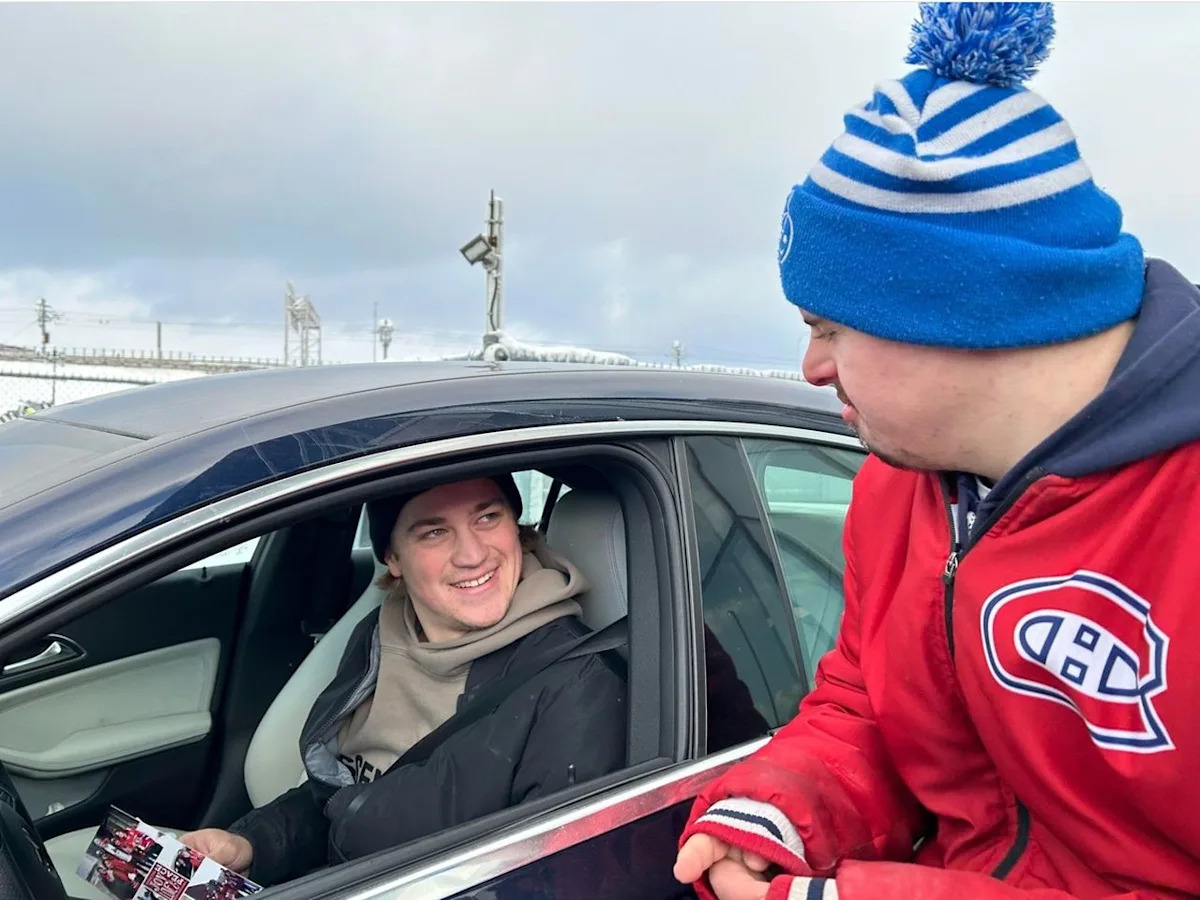
And then there are his beloved Montreal Canadiens. Jeremy doesn’t just follow the team — he inhabits their world. His room is painted in official bleu, blanc, rouge colours. He knows the staff at the Tricolore shops and at the Bell Centre, where he is often seen after school before heading home. More than one tour guide has been charmed by him, and over the years he has taken well over 100 photos with players, patiently waiting by the CN Sports Complex side door in Brossard after practices.
A few years ago, during a game, Jeremy excused himself for a “quick bathroom break” and returned having ordered a custom Canadiens jersey, complete with a captain’s “C,” his age, and his name on the back. I discovered the $270 receipt the next morning. There was no punishment. Just a conversation, an opportunity to turn it into a life lesson about money and budgeting. Jeremy agreed to give up McDonald’s for three weeks to balance his budget. It was a small consequence, but an important one. Independence isn’t built by protecting our children, including those with disabilities, from mistakes. It’s built by allowing them to make a few and learn from them.
These days, Jeremy FaceTimes before big purchases, not because he has to, but because he wants to. He better understands the value of money now and what it means to save. More often than not, he’s working toward the next dream. At the moment, he’s saving for Canadiens playoff tickets.
Last summer, he and two close friends took the train to Ottawa to celebrate Canada Day, a longtime dream rooted in his love of O Canada, first sparked by watching hockey. I helped with the planning, but once the Airbnb was booked and the route mapped out, they were off. Watching them leave on the train felt like something significant had quietly shifted, for all of them.
Parents of children with Down syndrome are often very protective, and understandably so, as our children can be more vulnerable. In Jeremy’s case, severe verbal apraxia adds another layer of complexity when interacting with strangers. But what I’ve learned, both through my graduate work on self-determination and through Jeremy himself, is that growth and learning require something else: space. Space to choose. Space to try. Space to stumble and, sometimes, space to fall.
Jeremy has taught me even more than that. He’s shown me how to move through our world fully in the present moment with unguarded joy — whether he’s belting out O Canada, talking hockey, planning a visit to St. Joseph’s Oratory or striking up a friendship with a neighbour over backyard chickens. Our world can often feel rushed and cynical, and Jeremy’s openness, authenticity and joy carry their own quiet wisdom.
People often tell me how lucky Jeremy is to have a supportive mother. However, the truth is, the blessing runs both ways. Through Jeremy, I’ve met extraordinary people, built unexpected friendships and been reminded, again and again, that kindness and joy matter far more than perfection and material possessions. If joy and authenticity were currencies, Jeremy would be a billionaire. And the world would be better if we all carried a little more of Jeremy’s spirit within us.
If you know someone with Down syndrome, take a moment on Saturday, World Down Syndrome Day, to reach out. Let them know how much their delightful, refreshing spirit adds to your world, and give a little of that love they so freely share back to them.
Lindi Ross lives in Carignan.
Related