
WOODLAND HILLS, Calif. — The Los Angeles Rams sprinted out of the starting blocks in free agency, doing almost all of their work before the league year officially began.
Now that it’s been two weeks since Trent McDuffie and Jaylen Watson arrived to retool the secondary, it’s time to let the dust settle and look over the landscape unfolding.
What’s clear from Matthew Stafford’s return and the push to upgrade the secondary is that the Rams are going for it in 2026 — as they should after falling a few yards short of a Super Bowl trip last season.
So, let’s work through the different questions remaining about where this team is and where it can go next.
Questions have been edited for length and clarity.
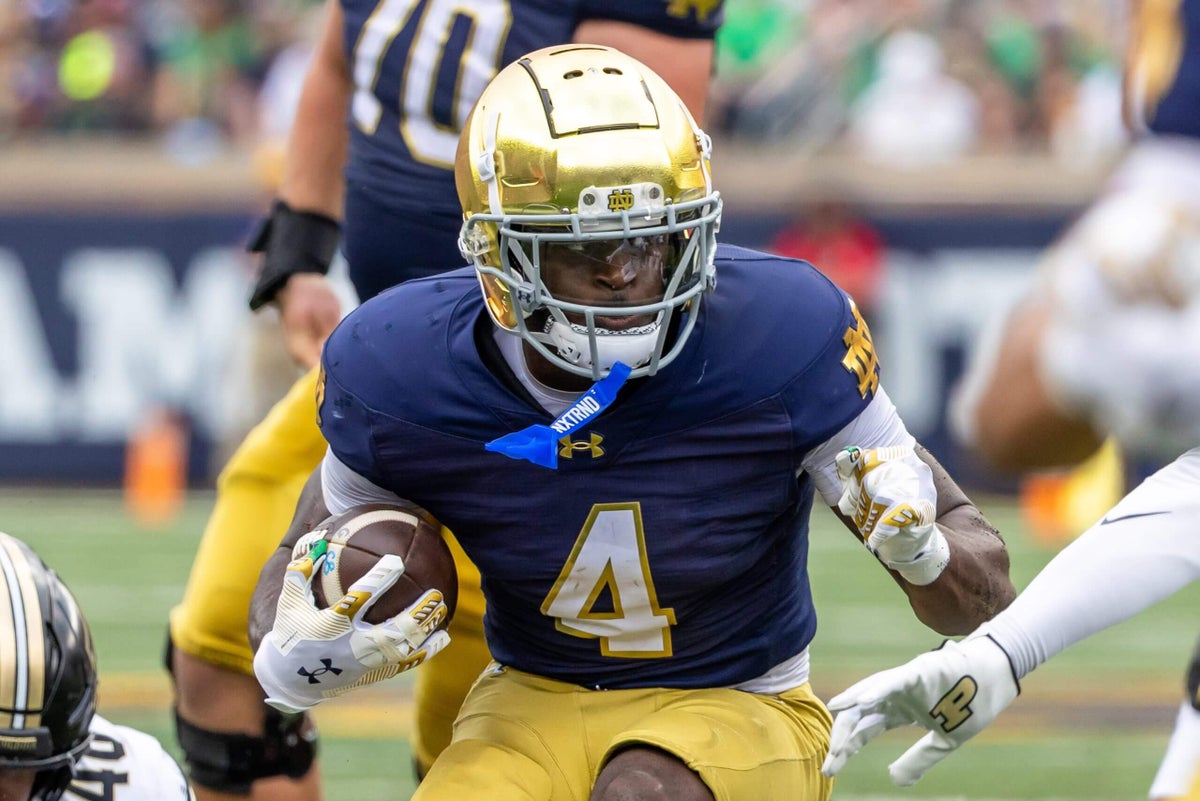
Why not trade up in the NFL Draft to get Notre Dame running back Jeremiyah Love? — Kevin J.
I ran into an interesting dilemma in our latest 32-team mock draft where Love and USC’s Makai Lemon were both available at No. 13. I went with Lemon, mostly because the format didn’t allow for a follow-up trade of Kyren Williams or Blake Corum. And without knowing the full trade package or market, it’s harder to evaluate the move.
That is all to say, I understand the fascination fans have with a home run-type running back such as Love. His production is elite, with back-to-back seasons of at least 1,100 rushing yards, 17 touchdowns and 6.9 yards per carry. And he projects as a three-down back, which is the separator that makes him worth a first-round pick.
But I think this upgrade idea is a bit more complicated, and not just because Williams and Corum are here.
Williams is one of the best pass-protecting running backs in the NFL, which has become central to how the Rams’ offense operates. They have good but not elite pass protectors across the line. And they have a 38-year-old quarterback with a degenerative back issue who lives in the pocket but can slice up defenses that like to blitz. That doesn’t work without a running back picking up that blitz the way Williams does.
That, combined with Williams’ strong play as a runner and receiver, explains why the Rams gave him a three-year, $33 million extension last training camp.
Love projects as a talented and fairly ready pass protector in his own right, but this area can be a sizable jump for any rookie. There’s plenty of reason to believe Love will develop into a very good pass protector, but can he do it fast enough to fit Stafford’s timeline?
You could argue that the Rams could draft Love and keep Williams as the primary third-down back. That setup could make the run game electrifying and set up the heir to Stafford with an easier role in a run-heavy offense.
But is a running back worth the No. 13 pick, or a trade up from No. 13, if he isn’t a three-down player right away? And how do the Rams effectively tap into Love’s strong abilities as a receiver in a crowded offense if he isn’t playing on obvious passing downs?
If the Rams can select Love and then move Williams or Corum for at least a fourth-rounder that would allow them to still fill the wide receiver need in the second round, it can be justifiable.
But this would be the definition of a luxury move, and it would come with some potential downside. Remember, this was still a top-five rushing team last season with Williams and Corum, who combined for nearly 2,000 yards and 16 touchdowns on 4.9 yards per carry. It was plenty explosive in 10-plus-yard runs.
It could improve on truly explosive gains — which I think will happen with more Corum touches — but that is less of a concern for a team as elite in the red zone as this one with Stafford, Davante Adams and 13-personnel sets.
Can you give us any insight into why we drafted a “home run hitter” running back in the draft last year, Jarquez Hunter, and why Rams fans have no idea how good (or poor) he can be because of a lack of playing time? Will we see him this year? — Dan V.
Interestingly, Hunter was the topic fans asked about most this week.
The Rams approached last year’s draft in a pretty future-forward way by trading back to take Terrance Ferguson in the second round, knowing the longer development path that comes at tight end. And they doubled down on that approach by taking Hunter in the fourth round via a trade up, only for him to be third, at best, on the depth chart.
That move was about drafting for the future, but also for insurance. Running back is a volatile position, and the Rams wanted to keep it a focal point of the offense to allow Stafford to play under center with play action and blur the lines between run and pass. Given that Williams is seeing his mileage increase as he runs with a physical style, it was a worthy investment, but a bit bold to make in the fourth round, given the Rams’ needs at cornerback and on special teams.
And then Williams and Corum missed zero games between them, and Hunter saw just five active games and zero snaps on offense.
So last season became a redshirt year for Hunter. He told me his biggest adjustment in the NFL came sharply in the passing game after running so few routes at Auburn. That became a focus of his in practice last season while staying ready if needed.
I expect him to have the same role this season, and the likelihood of getting 40 combined games from Williams and Corum just isn’t high. In a future mindset, Hunter’s ascension should line up with the ends of Williams’ and Corum’s contracts, so he offers a future No. 2 back who could ascend higher based on how he ends up playing when given an opportunity.
How do the Rams address the linebacker spot? Draft, late free-agency addition or trade? What’s the best way to get another playable body in there with the available assets? — Master Broshi
This spot is interesting because it’s the one left on defense that I think provides a legitimate chance for an upgrade, though it’s mostly a non-premium position that should ideally be insulated by what the Rams have in Nate Landman, the safeties and the defensive line.
Los Angeles traditionally hasn’t invested much in linebacker, though it did break that trend in extending Landman for three years and $22.5 million in November. It’d be hard to envision them investing heavily in two linebackers with the league-high rate of dime personnel. They should lean even harder into it after the latest secondary investments. But I also don’t put any aggressive move off the table for general manager Les Snead in a year when he’s clearly gunning for a Super Bowl.
There is a free agent who could make a lot of sense if the price is right: Bobby Okereke. He was a cap cut of the Giants this offseason, but he put together three strong seasons in New York with 19 tackles for loss, 5.5 sacks, four interceptions, seven forced fumbles and an average of 128 tackles per season.
I covered Okereke in Indianapolis, where he broke out as a three-down linebacker after developing as a special-teamer under Bubba Ventrone, who is now the Rams’ special teams coordinator. At 29, Okereke could be a primary coverage linebacker and also play a little special teams, where the Rams must take a big step forward.
Los Angeles does have more than $26 million in cap space to make another move, according to Over The Cap. Though investments beyond this season will eat into what the Rams can offer upcoming free agents such as Puka Nacua, Kobie Turner, Byron Young, Steve Avila and Kevin Dotson.
That’s where the draft can offer a more cost-controlled plan. If the Rams still want a linebacker upgrade by then, they should consider a trade up for Ohio State’s Sonny Styles. He’s a three-down machine with a 4.46-second 40-yard dash at 244 pounds, with nine sacks and 22.5 tackles for loss in his college career. The Rams would then need to use a Day 2 pick on a wide receiver, so parting with one of those to move up for a second linebacker gets tricky.
With competent corners and Jimmy Lake now coaching the secondary, do you see the Rams getting more aggressive from what we saw last year? — Tim D.
This was actually the genesis of the secondary remake this offseason.
Last year, the Rams banked on their pass rush to overwhelm quarterbacks into rushed throws into coverages disguised by versatile and sharp safeties in Quentin Lake and Kam Curl.
It worked really well for the first half of the season, but one injury to Quentin Lake sprung a leak. And when he returned for the playoffs, teams had a playbook to throw quickly and challenge the outside cornerbacks, who weren’t as physical to hold up. That left Los Angeles sitting in more predictable shells and zone coverages, which negated the post-snap impact of a player like Lake.
This is how Jared Verse, Young and Turner consistently crowded the top 10 in postseason pressures while combining for just one sack in three playoff games.
The Rams appear to have learned the lesson, which has turned into a blockbuster trade and record-breaking deal for McDuffie and another hefty contract for Watson.
They brought Curl back at strong safety, and the hope is that teams are forced to throw at these safeties more often, with fewer quick releases and more man coverage on the outside, where McDuffie and Watson thrive with their physicality.
Expect defensive coordinator Chris Shula to mix it up even more. I still expect plenty of Cover 3, as that model funnels receivers into the safeties, and zone coverage allows players to play with eyes on the quarterback, which matters if the pass rush is getting home as the Rams expect it to. But we should also see more man coverage and press-man now that the skill sets and pedigree on the outside are much improved.