
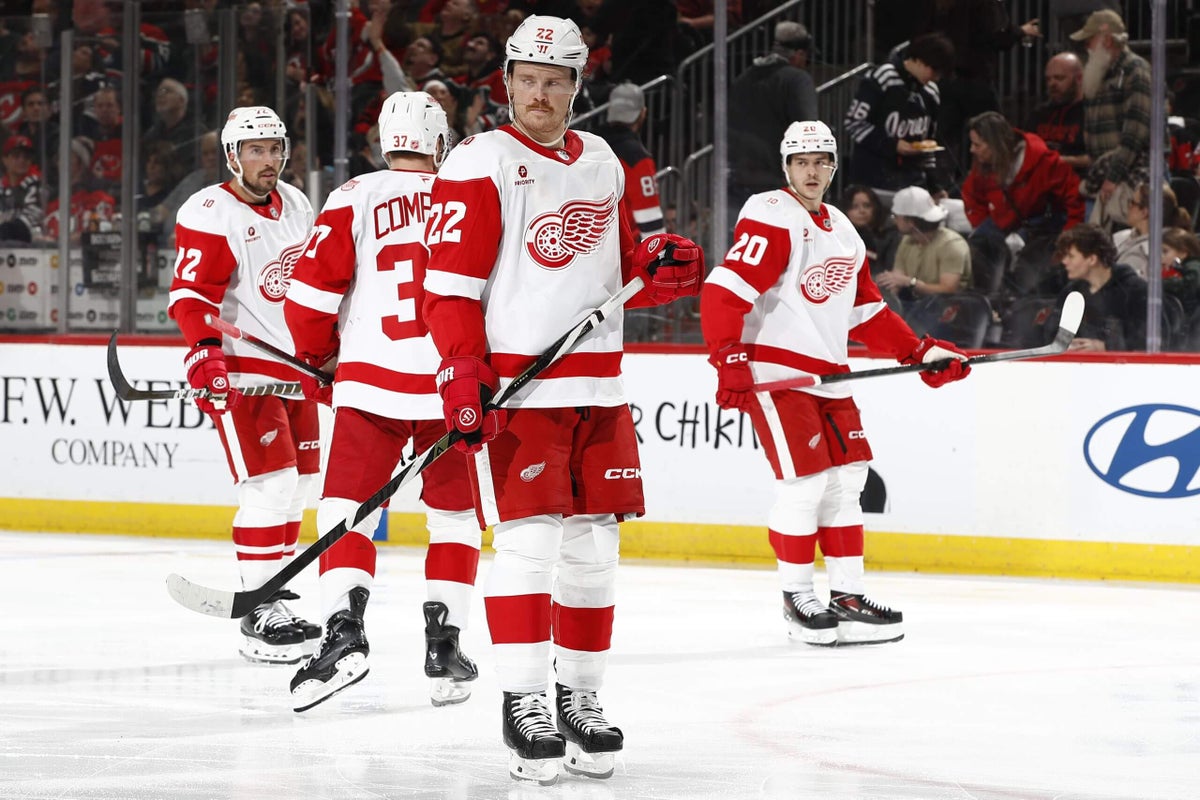
PITTSBURGH — It wasn’t deja vu. It wasn’t a rerun. It was just a familiar story, playing out again in a new fashion.
For the second straight critical game, the Detroit Red Wings dug themselves a 3-0 deficit. This was just days after they had called their flat showing in a home loss to the Philadelphia Flyers on Saturday “unacceptable” and “not good enough.” But when the puck dropped Tuesday against the Pittsburgh Penguins, for the first of just nine remaining games to try to chase down a playoff spot, the result was far too similar. The Penguins rode that hot start to a 5-1 win, and a frustrated Red Wings dressing room was left to try to find an answer.
“Disappointing that we come out and start like that,” Dylan Larkin said. “I really don’t have words for the start. The second two periods were better, and we played better, we just didn’t get the puck by (Stuart) Skinner, and that’s what it was.”
So ended another miserable month of March for the Red Wings — a narrative they entered the month wanting to change, only to see the same arc unfold with new details.
Every NHL season is different. Every team is different. But the trend here is impossible to ignore: In 2023, Detroit went 5-9-1 in the month. In 2024, 3-9-2. Last season, 4-10-0. And now, in 2026, 5-7-2. Different players. Different seasons. And in some ways, different problems. But far too similar an outcome.
There’s no doubt the Red Wings players and staff are sick of hearing about their March woes. And to that end, it was fair when coach Todd McLellan argued at the month’s outset that this group would write its own story. But now the month is over, and the same results are all there.
“We’ve written it,” he said Tuesday. “The book is closed on March now. We move to April. And we’ll have to review everything. If this is what happens all the time, then we seriously have to look at it. There’s teams that are elevating right now, and there’s teams that aren’t. And right now, we’re one of them that aren’t.”
What makes this year’s saga so frustrating for all involved is how good a spot the Red Wings seemed to be in after 60 games — that’s three-quarters of the season, and more than enough of a sample to be meaningful. Detroit ended February with the NHL’s ninth-best record by win percentage, at .617, playing a 101-point pace.
In reality, the seeds of this slide might have been sown before March began. On the morning of Jan. 26, the Red Wings were tied for the best record in the Eastern Conference. But Detroit limped into the Olympic break in early February by losing four of five after an injury to top-pair defenseman Simon Edvinsson that exposed the Red Wings’ shallow depth and slim margins on defense. In hindsight, maybe that was a harbinger.
Edvinsson returned after the break, though, and Detroit’s front office moved to address that issue at the trade deadline, trading its first-round pick to acquire veteran RHD Justin Faulk from the St. Louis Blues. At the time, that felt like a sign of progress: After years of hoarding picks and prospects, the Red Wings’ front office finally believed in its team enough to trade a premium asset for in-season reinforcements.
But the same night as that trade, another injury hit, this time to Larkin, the Red Wings’ captain and No. 1 center. Days later, Andrew Copp went down in Florida on a night the Red Wings blew a late lead to the Panthers and lost in regulation. At that point, the threat of another March spiral was clearly real. But as Detroit clung to a wild-card spot, there was at least room to see how it would face the adversity.
The injuries after the trade deadline are a real and unavoidable part of the story of this latest collapse. You can’t talk about the month without acknowledging them, or the very real strain of playing without two top-six centers plus more injuries to Michael Rasmussen and Nate Danielson, eroding the organization’s depth down the middle. It was a difficult circumstance to play through at the most important time of year.
That being said, the timing of those injuries masks another truth: Up until that point, Detroit had been the healthiest team in the league.
Star winger Lucas Raymond missed a couple of games early in the season and appeared to be playing hurt for a while even after he returned. Patrick Kane missed a couple of weeks on two occasions, and Mason Appleton missed a stretch in early December. Edvinsson’s injury before the break took a real toll. But by and large, the Red Wings built up a serious cushion through the end of January while being exceptionally healthy.
The issue is that when they weren’t — and even now, with Edvinsson, Larkin, Raymond and Copp all back in the lineup but not looking 100 percent — it revealed there wasn’t enough coming from elsewhere on the roster to make up for it.
There were individuals who stepped up (and some, such as Moritz Seider and Alex DeBrincat, whose impact never wavered), but there simply wasn’t enough scoring in totality, and other issues followed from there.
Faulk’s transition onto the Red Wings’ blue line started well with a 3-0 win in New Jersey in which he was quite noticeable. But his fit next to Ben Chiarot hasn’t meshed as quickly as Detroit would have surely hoped, and ultimately, needed. Meanwhile, Detroit’s special teams cratered, going from a top-10 power play (23.2 percent) and 18th on the penalty kill (79.1 percent) through the end of February to 25th on the man advantage (18.2 percent) and 29th on the kill in March (71.4 percent). And John Gibson, the goaltender who led Detroit through so much of the season, has shown recent signs of potential overwork, too.
The Red Wings have lost games every which way this month, though, whether they were about special teams or five-on-five, blown leads or slow starts they couldn’t recover from.
“It seems to be a different story every night, and that’s a tough one,” Larkin said. “I think when you come to the rink, you put your equipment on and it’s hockey, no matter what time of the year. It gets elevated this time of the year, but you have to make plays. You have to want the puck on your stick. The battles become even more important. And I think we’re just dipping our toe in a little bit too much.”
That has been most clear with Detroit’s starts, a constant talking point throughout the month. The Red Wings are last in the NHL with just 43 first-period goals this season, so this is far from a recent issue. It’s a consistent trend.
But in the kind of tight-checking, high-stakes games that late-season hockey brings out, having to constantly play from behind is especially hard to recover from without unwanted trade-offs.
“Sometimes I think we’re chasing goals because we haven’t scored a lot, so we’re paying the price for it defensively,” McLellan said. “And then when we focus defensively, we give up the offensive part. We’ve got to get both parts of our game going at the same time. And when we do find that, we’ll give ourselves at least an opportunity to win.”
There has also been a concerning inability to take advantage of teams coming in on a back-to-back, something the Red Wings excelled at for most of the season. Before March, they were 7-2 in such situations, according to independent analyst Prashanth Iyer. Tuesday sealed their March record against tired opponents at just 1-3-1.
In a tight playoff race, those points are crucial — the difference between making the playoffs and missing out.
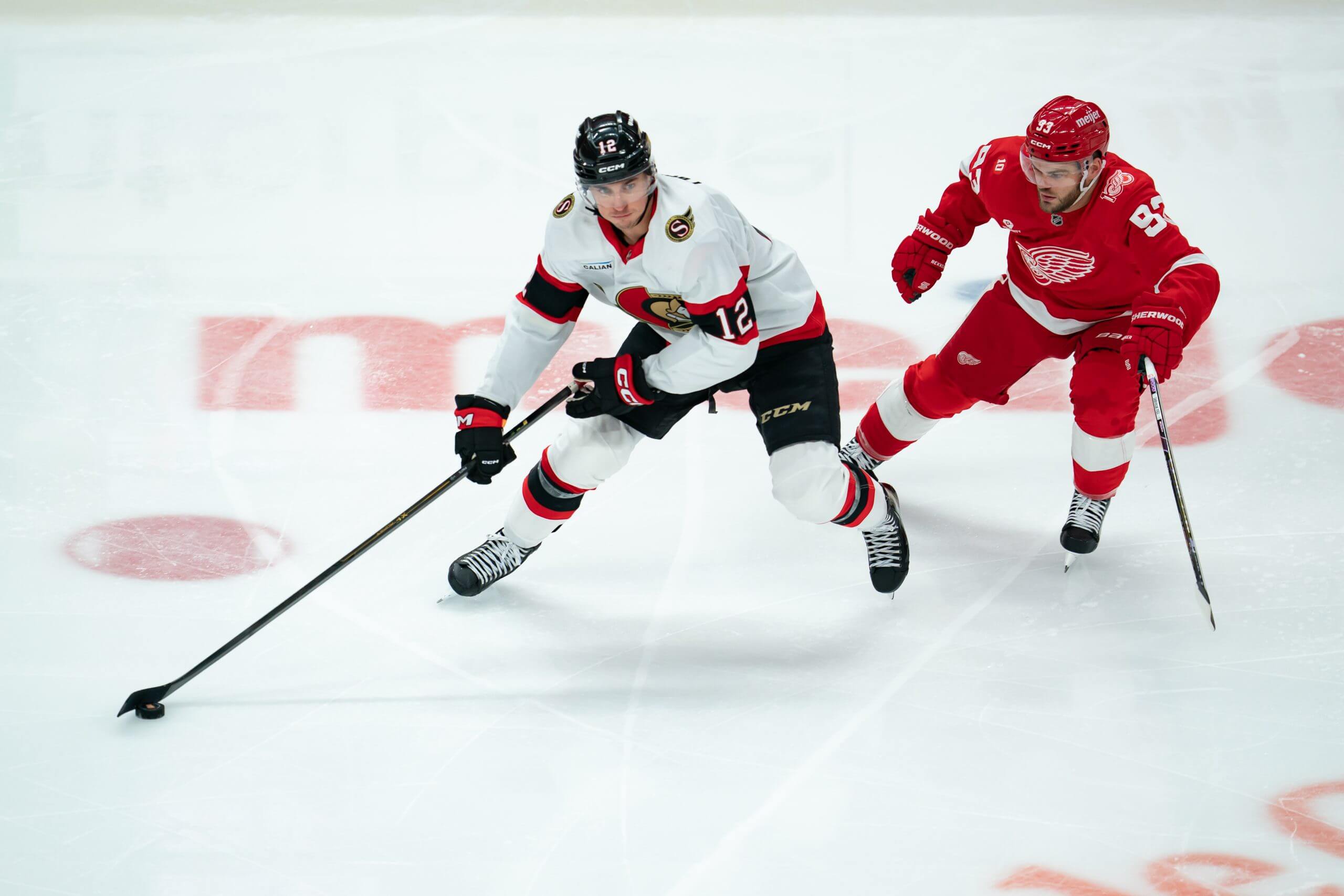
The Detroit Red Wings and Ottawa Senators are tied at 86 points through 74 games. (Jaime Crawford / Getty Images)
And that’s the other strange wrinkle in all of this. For most of the month, as Detroit slid down the standings, its Eastern Conference rivals surged. But now that they’re on the outside of the bubble, those other teams have started coming back to earth too, leaving a lane open if Detroit can figure out its own game.
On Tuesday, the Columbus Blue Jackets, Ottawa Senators, Philadelphia Flyers and New York Islanders lost in regulation, too. That means the Red Wings are still only 2 points back with eight games remaining, even after everything that’s gone wrong.
It doesn’t change what happened over the last 31 days. And make no mistake, those four weeks of malaise might very well doom them to a 10th straight season outside the playoffs. That’s the reality when missed opportunities pile up.
“It’s crunch time,” Copp said. “I think that (we) did such a good job throughout December, January, we only played a few games in February, but our game was in such a good place. And I think that mistakes get magnified this time of year, and there may be the same amount of mistakes, but they’re just being magnified. It’s adversity. We’ve got eight games left. And we’re sticking together. We’re absolutely not out of it. … We can’t linger and say, ‘Oh, us, March, blah, blah, blah, blah, blah.’ We’ve got a game Thursday night that’s going to be a huge game, and we’re doing nothing but preparing for that.”
“There’s a lot of noise,” Larkin added. “And that’s what I would call it, is noise. And we’ve got to do a better job, and we have done a good job, of keeping the outside noise outside. Every year’s different. Every team, every guy in this room is more mature, and we have new players. So it’s a different team than the last two or three years. It’s not fair to put this month, or what happened — it’s a different story every year.”
A different story, yes. But a similar result, and one it’s clear the Red Wings have to find a way to fix.