
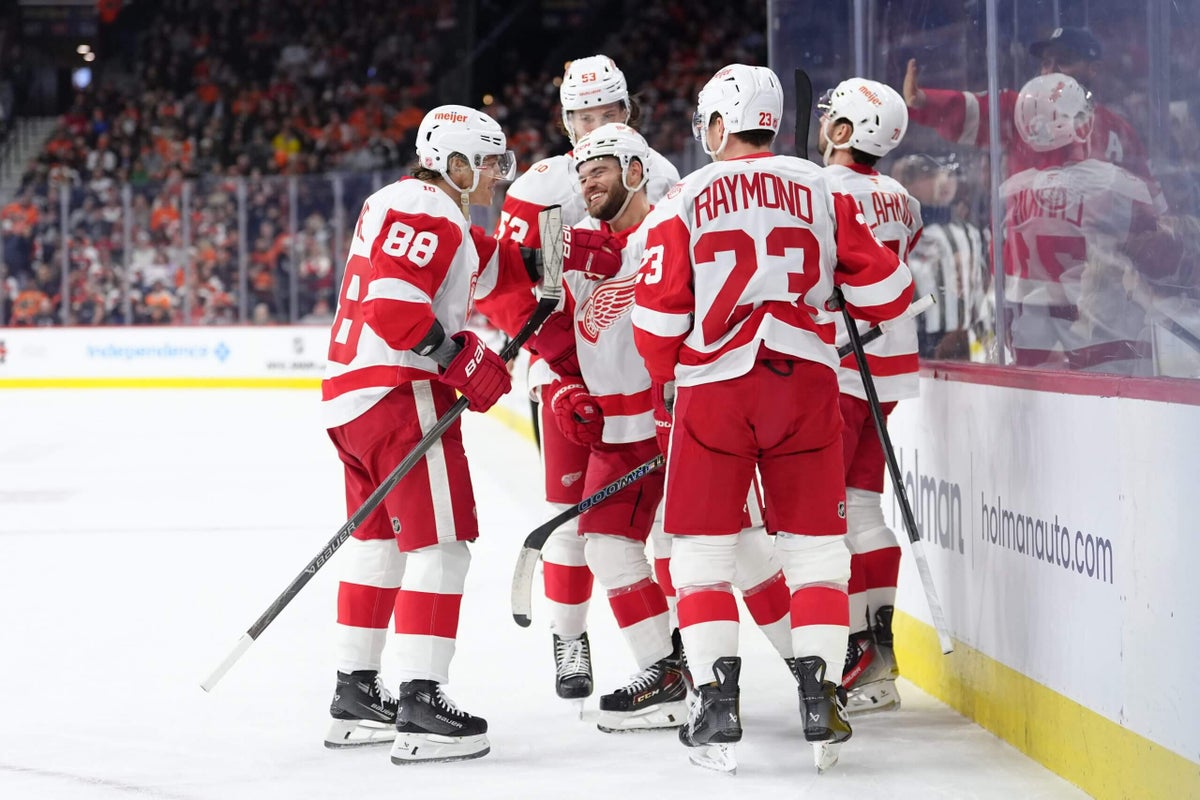
Just when it looked like the Detroit Red Wings might be running out of steam, after consecutive regulation losses fueled by flat starts, here they are: back tied for the Eastern Conference’s second and final wild-card spot.
That’s how much can change in two days at this time of year. And it’s a reminder of how much could change from here in the days to come. But for now, the Red Wings’ 4-2 win over the Philadelphia Flyers on Thursday looks like a shot of adrenaline for a group that needed one.
Here’s how they did it, and where it leaves them with seven games to play.
1. After the way slow starts have hurt the Red Wings in recent weeks — and really, all season — it felt paramount for Detroit to score first in this one.
The game took on a tight-checking character in both directions early on, which in itself was an improvement after the Red Wings had allowed a goal on the first shot they faced in each of their last two games. And though they couldn’t make much out of an early power-play opportunity, they got a second chance late in the first period, and Alex DeBrincat took advantage to give them the game’s first lead.
There’s a difference in playing with the lead or from behind for any team, but it’s especially important for the Red Wings right now. With multiple top players playing through injury, it’s going to be easier for them to grind clock and play opportunistically than it is for them to chase the game and try to make something happen. Certainly, making use of their power plays goes hand-in-hand with that.
But just as important as the first tally was the way they responded when things didn’t go their way, which is going to happen at points in any game.
The first instance of that came when the Flyers scored quickly in the second period and pushed hard in the immediate aftermath. The Red Wings weathered that storm, with a lot of credit going to netminder John Gibson, and stayed in the fight to respond with a Lucas Raymond tally just before the end of the second.
It was Raymond on that second goal, but the play was made by Simon Edvinsson, who spun out of a check along the offensive half wall, then slid down to the goal line to create a lane for a pass to J.T. Compher. And though the pass missed Compher’s stick and instead deflected off his skate, it went right to Raymond, who wired it home to regain the lead.
The Red Wings arguably faced more adversity in the third. After Detroit had stretched the lead to 3-1 on a Patrick Kane tally, the Flyers cut the deficit to 3-2 on a play that was initially ruled goalie interference but was overturned on a challenge. That overturn was the correct call, but seeing their goalie run into and their lead retroactively cut in half on the same play could have sent the Red Wings spiraling. That’s something they’ve struggled with lately, despite generally responding better to such situations for most of the year.
This time? DeBrincat struck back just 15 seconds later, giving Detroit back its cushion — which they rode all the way to the finish line.
The Red Wings had just four shots on goal in the third period compared with the Flyers’ 15, so clearly they were more protecting a lead than dictating. The Deserve-to-Win-o-Meter won’t be kind to them, and Samuel Ersson was not good in net for Philadelphia.
Detroit won’t care about any of that, though. At this time of year, the 2 points are all that matter.
2. It’s no coincidence Alex DeBrincat was responsible for perhaps the two most crucial goals of the Red Wings’ four Thursday.
All year, he and Moritz Seider have been their most consistent players. And DeBrincat has been one of the few Red Wings who has truly elevated down the stretch. He now has nine goals and 23 points in his last 16 games, and is just one goal away from his third career 40-goal season.
DeBrincat’s scoring is nothing new. He scored 39 goals last year and has been an excellent all-around forward for Detroit ever since he was acquired in summer 2023. He’s long been a good skater, has always been more feisty than his size would suggest — Thursday, the 5-foot-8 winger got into it after a whistle with 6-foot-3 Porter Martone — and probably doesn’t get enough credit for his vision because his shot is so good. And yet, it still feels like he’s elevated even further this season.
The goals Thursday came on partially broken plays, with a stick slowing down Kane’s set-up pass to him in the slot on the first tally and his third-period goal deflecting off a Flyers stick. But that’s what it takes at this time of year. Nothing will be easy. DeBrincat has simply found a way, and it’s made him Detroit’s go-to forward right now.
3. After the loss in Pittsburgh earlier this week, Dylan Larkin alluded to blocking out “outside noise.”
That’s a bit of a cliche in sports, but considering how tense and frustrated Detroit’s dressing room felt after that loss to the Penguins, the Red Wings might have achieved a measure of it to find the jump they did Thursday.
And when the Flyers started to dictate play in the second period, perhaps their most important player showed he could tune out the noise, too. Gibson stopped 32 of 34 shots one game after he had left the Penguins game one period in, leading to plenty of questions about his workload and ability to keep starting night after night. He looked right back to form in this one, though.
The best way to quiet down noise is to win, and you could already see the conversation turning more hopeful after the win in Philadelphia. Now, the Red Wings will have to do what they haven’t done nearly enough for the last two months and find a way to build on that success.
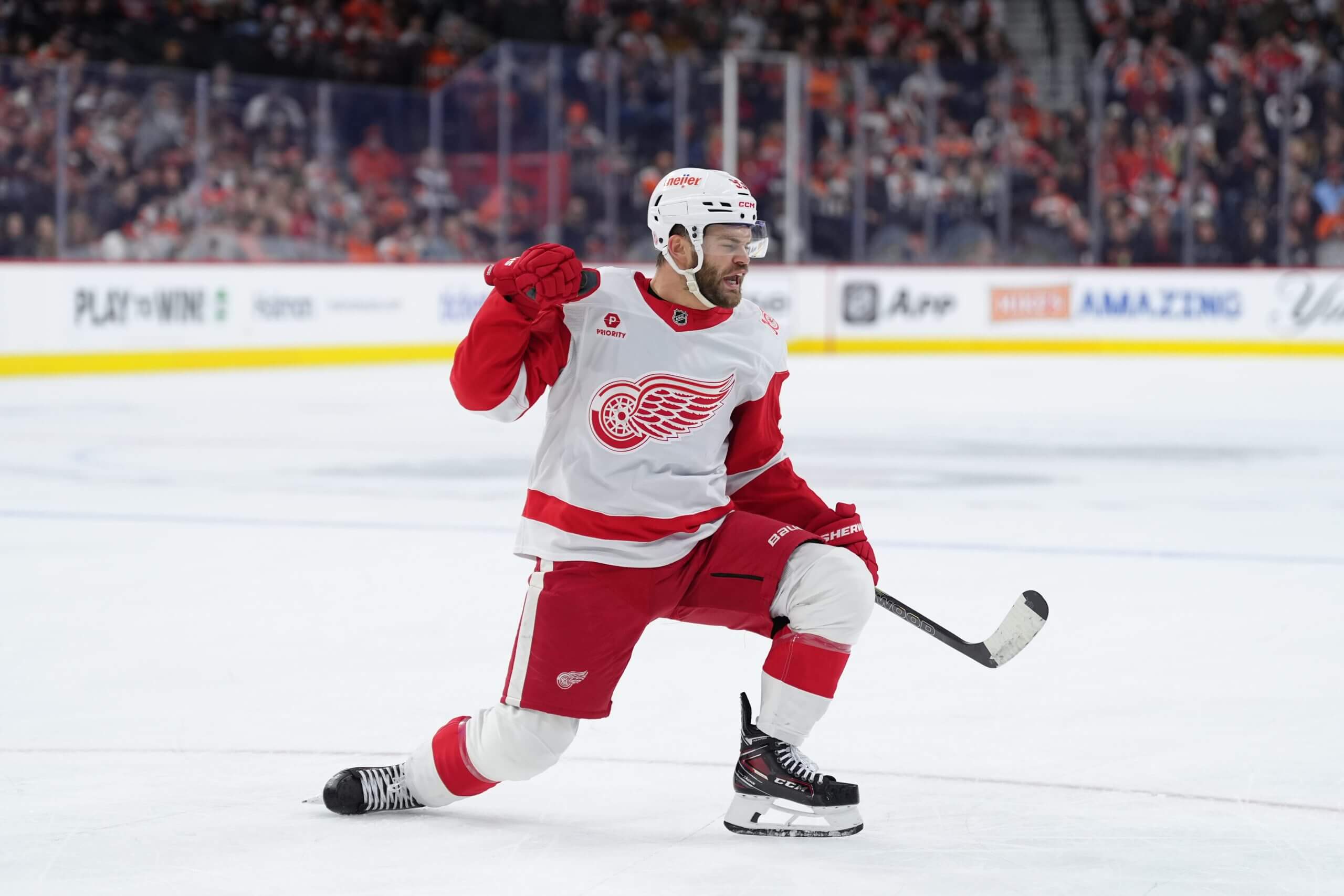
Alex DeBrincat has nine goals and 23 points in his last 16 games. (Kyle Ross / Imagn Images)
4. One of the changes Detroit made for the Philadelphia game was rearranging its blue line, moving up Albert Johansson to play with Seider, pairing Edvinsson with Justin Faulk, and Ben Chiarot with Jacob Bernard-Docker.
Faulk and Chiarot had been paired together ever since the Red Wings traded for Faulk in early March. But that pair had struggled recently, and so coach Todd McLellan went for a new look. That look only lasted two periods, though, because Faulk was injured in the second period.
Obviously, that’s bad news for the Red Wings, who traded for Faulk because they felt they needed his veteran presence and blend of physicality and puck-moving. McLellan told reporters after the game it was a lower-body injury and Faulk would be evaluated Friday.
5. As it stands, the Red Wings remain on the outside of the playoff bubble because of Ottawa’s edge in the regulation wins tiebreaker. But with seven games left, if Detroit has any edge on its competition for the wild card, it’s in the schedule.
The Red Wings’ next game is against the New York Rangers, one of the few teams already eliminated from playoff contention, and as of now, only two of their remaining opponents are in playoff spots (the Minnesota Wild and Tampa Bay Lightning). Meanwhile, the Ottawa Senators’ next three games are all against big-time opponents: those same Wild and Lightning, plus the Carolina Hurricanes. That makes this a big week for the Red Wings to try to make a move, with a Tuesday head-to-head with the Columbus Blue Jackets a massive one on the horizon.
Then again, as the last week has made clear, looking ahead at all right now is a fool’s errand. The picture is changing by the day. And though the Red Wings had some weight lifted off their shoulders Thursday, it’ll be right back if they slip against a beatable Rangers team this weekend.