
The Saturday uproar over the Pittsburgh Penguins win had nothing to do with Sidney Crosby or Evgeni Malkin missing scoring chances, another botched goaltender review, or phantom officiating.
No, goalie Arturs Silovs was the object of scorn and fierce criticism in the Penguins’ 9-4 win.
The Penguins’ rookie goalie allowed a soft goal in the first period and perhaps another in the third. His save percentage dipped from .891 to .888, but the reaction was overwhelming and perceptions cratered.
The emotions boiled to a frothy lather, all the while the Penguins moved ever closer to a playoff spot. The reactions and social media demands were three-fold, but uniform.
He’s not an NHL goalie!
He should never play in Pittsburgh again.
They have to call up Sergei Murashov immediately. He’s the future.
Of course, there were statistical arguments, too. Before Sunday, when he stopped 29 of 31 shots, Silovs’s save percentage over his previous eight games hovered around .860. And to add more fuel to the fire, the Penguins’ goalies rank toward the bottom of all goalies in the NHL.
Of the 50 goalies with 20 or more games played, Stuart Skinner ranks 45th with an .888 save percentage, and Silovs slots at 43rd with an .891 stopper rate.
So, how could the Penguins NOT turn to Murashov?
The answers to that question proved as unacceptable to the ardent as Silovs’s recent play, but the constructs built brushed aside a few stats and factors. First, to cite Silov’s last eight games is to ignore the nine games previous.
Silovs had a 22-save shutout over the Vegas Golden Knights on March 1. That proved to be a fulcrum of his slide. In fact, Silovs’s win on Sunday was the first since March 1 in which he stopped over 90% of the shots.
But before his struggles, including the March 1 shutout, Silovs posted a nine-game run with a +.900 save percentage in eight of those, totaling a .910 save percentage.
In fact, his stellar play in January through March is a reason the Penguins are about to clinch a playoff spot.
Silovs fit the planned motif of the 2025-26 Penguins; a team in transition that had ice time for players seeking to prove themselves at the NHL level. As Dubas likes to term it, the Penguins could give Silovs the runway he needed.
So, the charge that he isn’t an NHL goalie is a bit over the top. His ceiling is still murky as his game has holes, notably rebound control, but he’s had success and failures this season–like most rookies.
The Penguins goalies do not rank well statistically. Silovs is 43rd of 53 goalies who have played at least 1100 minutes, with a -7.63 goals saved above average, though he ranks ahead of luminaries Jordan Billington, Sergei Bobrovsky, and Frederick Andersen.
Skinner ranks 33rd.
Now, the problem with judging Silovs and Skinner against Murashov: It’s a one-sided argument. Murashov’s ability to perform better behind the Penguins’ sometimes very loose defense is assumed–or hoped–not known. After all, in five NHL games, Murashov’s save percentage was only .897.
And the term to remember is “loud.” When coach Dan Muse chides his team for high-volume scoring chances, he’s not only citing the number of chances, but how great the mistakes and the subsequent chances.
Would dunking another rookie into deep water at this point of the season be advantageous? Maybe. But there are also enormous risks to exposing young goalies.
Skinner suffered a fluke injury Saturday when he was hit in the face by an errant puck while he sat on the bench. So, pending his prognosis this week, the Penguins and fans might still get a look at Murashov in an NHL game.
Since March 1 in the AHL, Murashov has six starts and three of those were well below a .900 save percentage. Of course, three of them were well above, too.
One things fans forget, Penguins general manager Kyle Dubas wants to win as badly or more than everyone one of them. His fiery demeanor during games does nothing to hide his competitive nature.
The most important note that seemed lost in the fan flare up, is that Dubas has no reason or motivation to deny the team a better goalie.
If or when his team, including goalie guru Jon Elkin, decides Murashov is the better option, he can be recalled. There are no roster limits after the NHL trade deadline, so the team wouldn’t need to waive a goalie to make room.
Otherwise, the plan should remain to start Murashov’s NHL clock next season, in the low pressure games of October, when Murashov–like Silovs–can have the runway to adjust to the highest level. It’s what is best for him and the organization in the long-run and carries no risk.
2. Rickard Rakell
After 20 years at center, “Now, I love playing wing,” said Malkin Saturday.
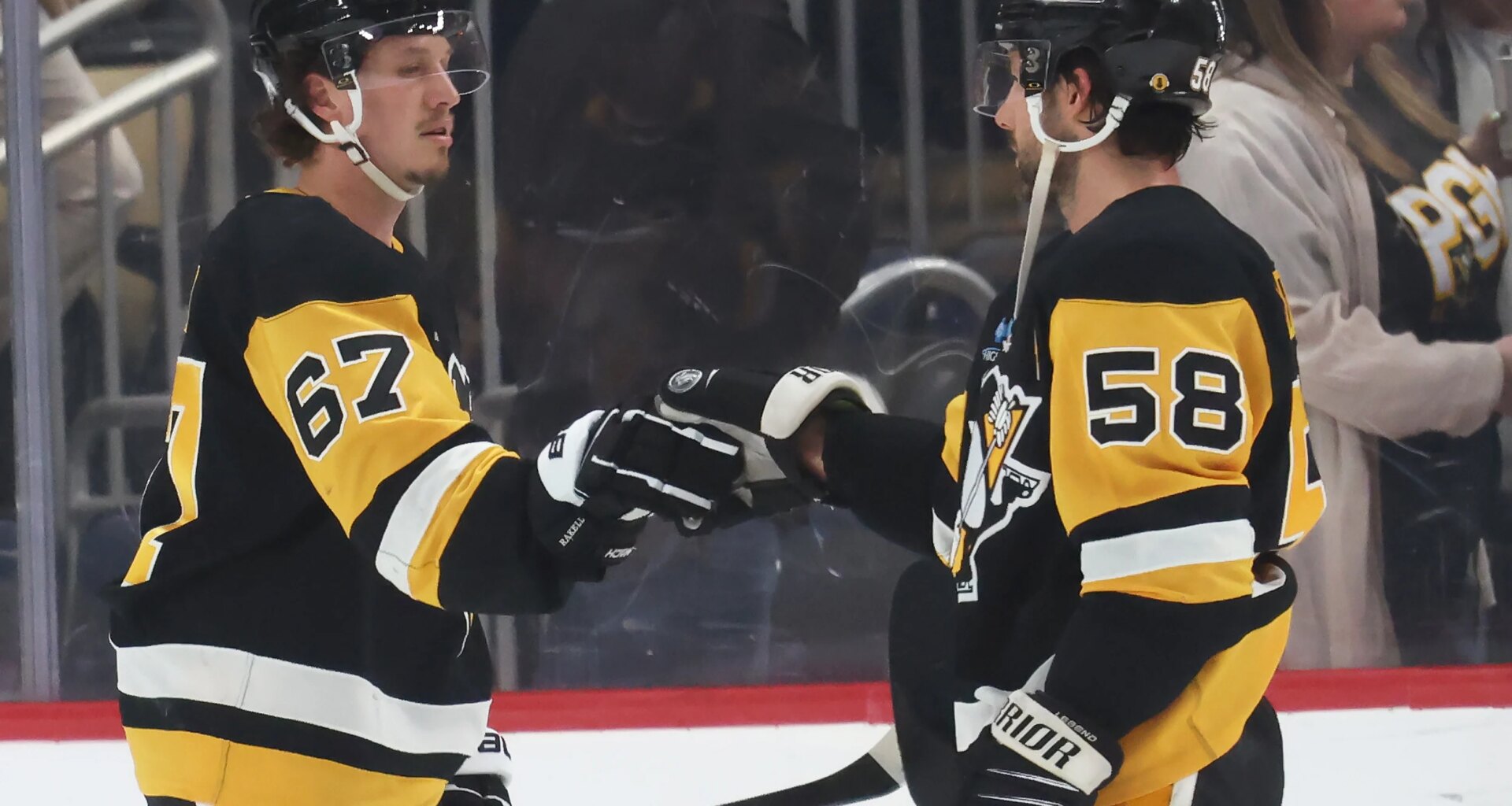
Coach Dan Muse has gotten the most out of his roster with a pair of position swaps in the top six. First, he moved Malkin to the wing, and more recently, Muse moved Rickard Rakell to the middle.
Over the last few weeks, Rakell has been on a tear. He was the NHL’s No. 1 star of the week for the previous week, with seven goals in five games. The improvement in the Penguins’ lineup because of Rakell in the middle has been enormous.
Tommy Novak had a good two-month stretch bookended by an awful two-month start and a post Olympic swoon. Muse has been Novak’s biggest advocate, but Rakell’s installation as 2C makes the top six more dynamic than it has been in several years–perhaps not since Evgeni Malkin before knee issues began plaguing his career several years ago.
The only downside to Rakell at center is his struggle on the faceoff dot. He’s only a 35% faceoff winner, which limits his usage in big situations and defensive zone draws.
Perhaps Nick Bonino can work some magic on Rakell’s faceoff skills.
3. Girard-Letang
The Penguins’ second defense pair has finally figured it out. After a brutal start together that was interrupted by Girard’s injury and Muse calling a timeout because things had gotten too bad to continue, the pair have been solid.
In fact, Girard has looked comfortable. He has begun to expand his game to include pinching deep into the offensive zone. Over his last five games, Girard has four assists and four shots on goal.
“I think we’re both smart enough to see–I mean, if he’s going, I’m going to have to stay back. If I’m going, he’s going to have to stay back. Sometimes we’re both going to go (forward),” Girard said in our first recent conversation in Tampa Bay. “That’s going to be a read that the forwards are going to have to make to take your spot and just read what we’re going to have to do. And I feel like we’ve been doing that the last four games, and we’ve been reading each other very well.”
By comparison, Girard had just four shots on goal in his last 11 games–his first 11 games–with the Penguins.
The rejuvenated second pair has only helped the Penguins create more goals than any Penguins team over a five-game stretch since 1995-96.
Rakell’s hot streak and the Penguins’ second pairing, perhaps not coincidentally, have seen considerable ice time together. While the Columbus Blue Jackets and New York Islanders have fallen off down the stretch, the Penguins look even more dangerous.
All three Penguins thoughts will play a big role in what comes next.
Tags: Pittsburgh Penguins
Categorized:PHN Blog