
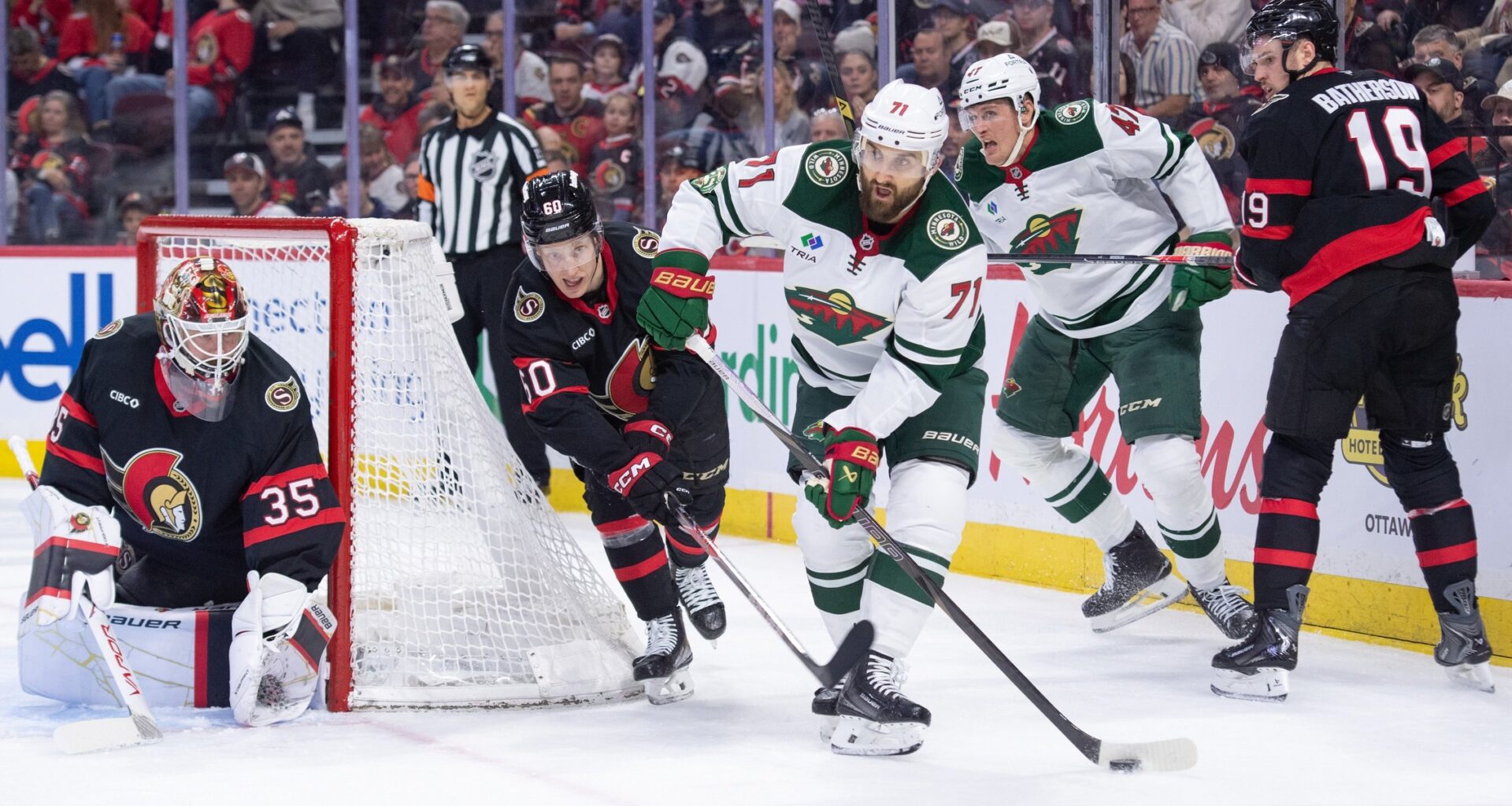
Minnesota Wild fans have been looking for good news about the Wild’s special teams for years. This year, fans got it with a Wild power play unit that’s top-five in the league statistically. However, the penalty kill is a different story. While it’s not as bad as it has been in the past, it still ranked in the bottom third of the NHL.
Bill Guerin tried to address the issue at the deadline. After adding Michael McCarron and Nick Foligno, the Wild were set to roll out fresh forwards on the penalty kill. So far, the results have been pretty good.
Since the trade deadline, the Wild’s penalty kill has been the third-best in the league behind the Nashville Predators and the Washington Capitals, allowing just 5.2 goals per 60 minutes. That translates to allowing a goal every 6 opposing power plays, for a 84% penalty kill percentage. Suppose Minnesota were to maintain that over the course of the season, it would be the best penalty kill in the league. As it stands now, they rank 17th in the NHL after a slow start to the season.
But this is a lie.
The phrase “putting lipstick on a pig” comes to mind when you peel back the layers of Minnesota’s penalty kill and take a look at what is really going on. The Wild are still bleeding chances at an incredibly high rate. They are allowing the 5th-most shots while having the 7th-highest expected goals against when shorthanded. On paper, that would make you think this team has a bad penalty kill. However, their saving grace is that no team has had better goaltending than the Wild over the same time period.
Jesper Wallstedt and Filip Gustavsson have a combined .911 save percentage, and they have been bailing out the Wild penalty killers. The Wild has had strong goaltending all year from either starter, but not on the penalty kill. Minnesota’s save percentage before the deadline when shorthanded was only at .864, good for tenth best in the league, but objectively bad.
Now, with new personnel, the Wild are still allowing the same amount of shots and chances, but their save percentage has increased. There’s a chance the new personnel is doing a better job of limiting high-danger chances, clearing lanes, and making things easier on their goalies. That allows them to boost their save percentage and play complementary hockey.
The new guys have also been getting plenty of penalty-kill time. Foligno and McCarron lead forwards in shorthanded time on ice since the deadline, just ahead of Matt Boldy and Yakov Trenin. Joel Eriksson Ek missed a few games, so his numbers don’t accurately reflect his impact. He could be the leader on the penalty kill if he were healthy. Either way, both Foligno and McCarron have been putting in the time.
The Wild acquired both of them for their impacts on the penalty kill. It seems to have paid off, even if the numbers suggest that the Wild’s goaltending has been doing the heavy lifting with a man down.
That leads us to the question of how the Wild deploy their lineup come playoff time. They have been burned in the past, especially by Dallas, when they take a penalty. So, given their recent penalty kill success, does that ensure Foligno draws in for Game 1 and beyond?
McCarron is a given, due to the high price tag paid to acquire him and his prowess in the faceoff dot; he’ll be in the lineup. Foligno is a different story. He’s been strong in his minutes but has also been a healthy scratch in a few games since coming to Minnesota. At this point, I’d bet Foligno gets into the lineup for his veteran presence and physical play on the fourth line. So, the Wild will go into the playoffs with a full lineup and all their penalty killers available.
While it’s hard to complain about the penalty kill numbers improving, there are only two teams better in the NHL than Minnesota on the power play, and the Stars are one of them.
The Wild are in a good position as they seem to have found some guys who have had better results, whether that is the effort of McCarron and Foligno or whether it’s the effort of Wallstedt and Gustavsson, I’m not sure. But I am sure they will all need to be on their A-game if the Wild are to avoid another special teams disaster this year.
All stats and data via Evolving Hockey and ESPN, unless otherwise noted.
Think you could write a story like this? Hockey Wilderness wants you to develop your voice, find an audience, and we’ll pay you to do it. Just fill out this form.