
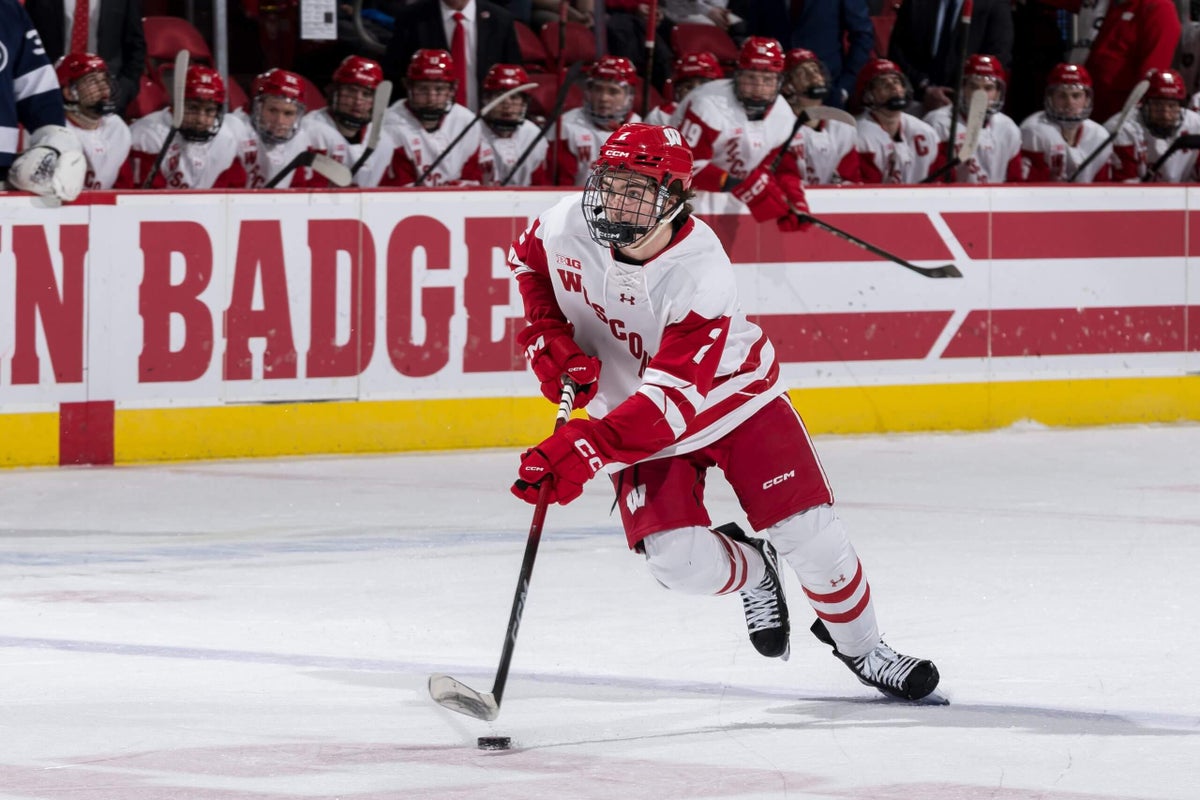
LAS VEGAS — Two years ago, Luke Osburn had to wait until the 108th selection to hear his name called in the 2024 NHL Draft. Last year, he won the USHL’s defenseman of the year award. And Thursday night, he’ll skate onto the ice at T-Mobile Arena with a chance to lead his Wisconsin Badgers, as a 19-year-old freshman, to a berth in the national championship game.
It has been quite a run for the 6-foot-1, 189-pound left-shot defenseman, who looks like quite a pick for the Buffalo Sabres.
Ryan Ward, who coached him in Youngstown, Ohio, when he was named the USHL’s top D, remembered him on a call in advance of the Frozen Four as his “cornerstone defenseman” and said, “he could do it all.”
Ryan Kosecki, one of the Phantoms’ co-general managers, said, “he was our everything.”
“He was our whole team last year, and we had a great team,” Kosecki told The Athletic.
Win or lose against North Dakota, he’ll likely play the 21:21 he has averaged this season — or more. The Badgers are underdogs, but they were underdogs in the Worcester Regional final against Michigan State when Osburn, his team trailing 3-1 late in the third period, scored to cut the lead to one as Wisconsin stormed back to win in overtime.
That goal was one of the first things Wisconsin assistant coach Nick Oliver mentioned in a phone call earlier this week when trying to describe the impact Osburn has had on the team as a teenager.
But before he got to the goal, he went to the one place everyone does when they talk about Osburn: the work he puts in and the leaps he has been able to make over the last couple of years.
“He’s just wired differently,” Oliver said. “From the time he wakes up until the time he goes to bed, he’s trying to find any possible way to get better. He’s one of the first ones into the rink most days, he’s one of the last ones to leave most days, and I think as the years have progressed, you’ve just seen his all-around game continue to round out because of it.”
Before he arrived on campus in Madison and long before he and the Badgers landed in Las Vegas, Osburn grew up in Plymouth, Mich., attending OHL games and later NTDP games. Those games took place at what’s now known as USA Hockey Arena, which was also his home minor hockey rink.
He’s an only child, but he’s from a hockey family. His dad, Tim, played at Michigan-Dearborn when it was still a Division I program and a couple of years of pro in Sweden. And though his mom, Cathy, grew up in Houston and fell into hockey, he has four cousins who still play (one, Zach, played at Michigan State, and another, Tyler, played at Lake Superior State) and an uncle who did, too. His cousin Katy played softball at Miami. (Ward joked that his family “has been to every single game he has ever played in.”)
Still, though Osburn always dreamed of playing hockey at a high level and says he was lucky two of his minor hockey coaches played in the NHL, it wasn’t until his first year in Youngstown that it began to feel real. Even then, he just felt like he was starting to get the hang of it and the confidence — and the award-winning 41 points in 55 games that came with it — didn’t come until Year 2.
That fall, he also led the World Junior A Challenge in points with 9 in five games en route to a rare gold at the event with Team USA.
When the Badgers recruited him, Oliver said they gravitated to Osburn and his family right away.
The player was small, and the first thing they noticed — and everyone does — was his feet. Ward describes his skating and escapability as “elite.”
“He’s as good if not better laterally as he is north-south,” Oliver said. “His ability to evade pressure, whether it’s at an offensive zone blue line or breaking pucks out, he’s got some dynamic to him that way with how he can use his legs and his feet.”
They were counting on his taking big steps in Youngstown, and Oliver and Wisconsin coach Mike Hastings were quick to credit the job the Phantoms staff did in helping him get there. But they give Osburn the credit first.
“He ended up turning into a heck of a player,” Oliver said.
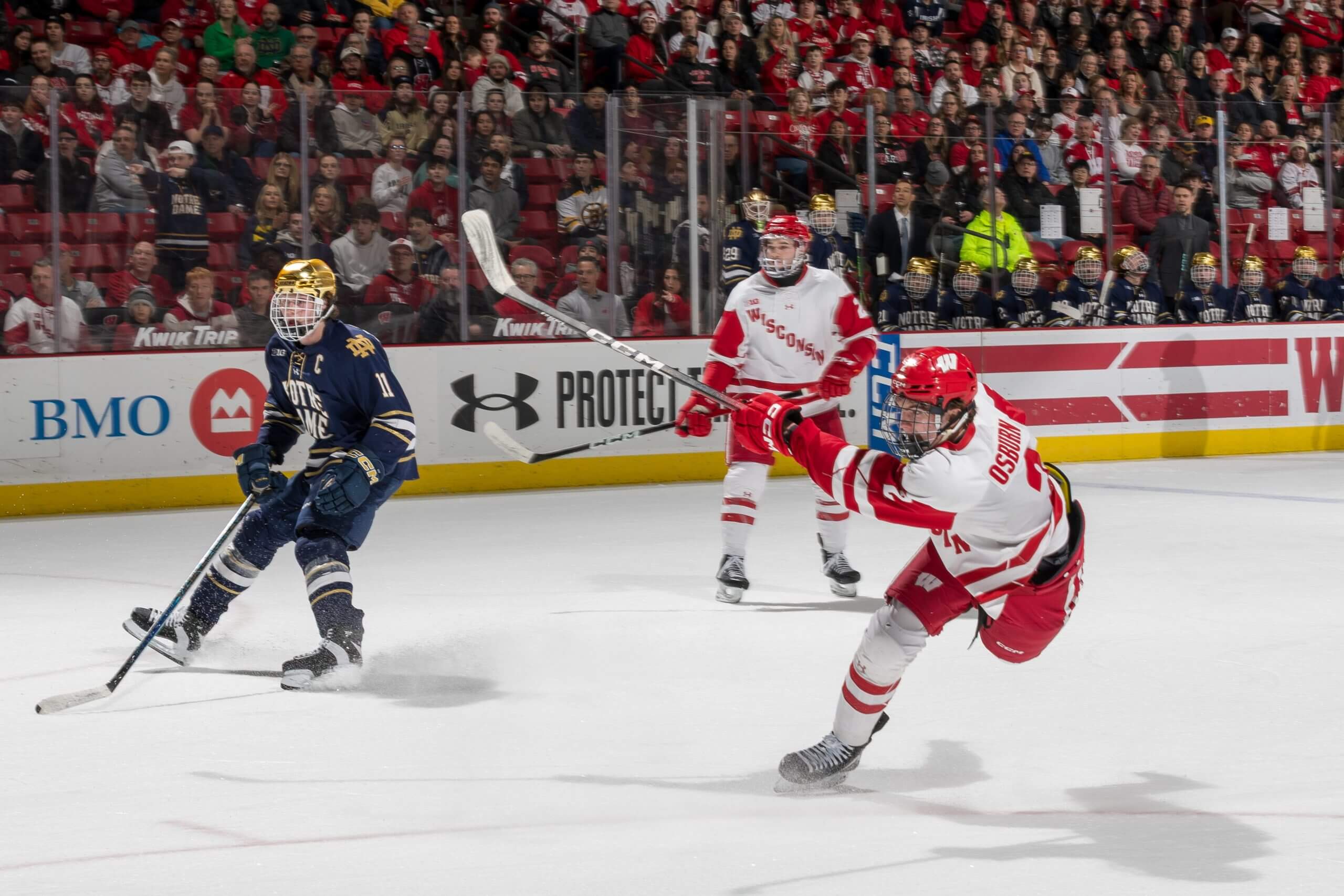
Luke Osburn snaps a shot toward the net in a game against Notre Dame. (Dan Sanger / UW Athletics)
In that second year with Youngstown, he was first over the boards in every situation — five-on-five, power play, penalty kill, first shifts of periods, last shifts of periods.
“He was someone that we relied on every day to push us forward, and he did,” Ward said. “His instincts with the puck are very, very good. Defending, he uses his feet to defend in a way that smothers opponents.”
When the Phantoms selected him in the fourth round of the USHL draft, Ward described him as light, slender and small, and he went back to play a year of U16 hockey before he joined them. Kosecki guessed he was 5 feet 8 and 150 pounds when they picked him.
“He worked so hard in the weight room, and now you see all of that hard work is paying off,” Kosecki said.
By the time he left, Ward described him as “chiseled out of granite.”
“That’s a testament to Luke, his work ethic, his buy-in and his willingness to push himself further than some of his peers. For me, it starts with every single rep in every single skill drill in practice,” Ward said. “Every shift he has, he goes 100 percent. That, to me, was the biggest reason that Luke has taken the steps that he has. Every single time he’s on the ice, he gets better, and after a year or two or three of that, you become a pretty good player.”
Even the skating, which has always been a strength, was a daily focus that he got better and better at, working on his feet, his gaps and his O-zone blue line work with an “intensity” that set the standard for his teammates.
Kosecki called him a “game changer” on and off the ice for their program because of that.
He was also, Kosecki said, someone who “makes the right play in every situation, and the game is really slow for him, and he doesn’t panic.”
“There’s times where you’re like ‘Oh, he’s got no options here,’ and somehow he either spins out of it or makes a pass that no one else sees. He has always had that sort of shimmy shake. Like really elusive,” Kosecki said.
Kosecki’s co-general manager, Jason Deskins, said the thing he’ll remember most about Osburn is “how steep of an incline he progressed at.”
He describes his game as “like Velcro.” They used to laugh when he’d go into a corner with three guys surrounding him because the crowd would think he was dead to rights and he’d come out of it with the puck on his stick “85-80 percent of the time.”
“It’s something that’s just innate for him. I don’t know if you can teach that,” Deskins said. “He’s pretty special in tight spaces in terms of working himself out of a phone booth. He’s got a lot of wiggle in his game and his ability retrieving pucks, and being deceptive, and creating space for himself, and beating F1 on the forecheck is pretty high-end.”
The player whom Hastings and Oliver will send out over the boards this week is more than they were even hoping Osburn would be as a freshman.
He made the Big Ten All-Rookie Team because of the role he played and the 21 points in 31 games he registered heading into the Frozen Four — with a pitstop in Minnesota with Team USA at the World Juniors, where he played 21:47 per game (second on the Americans).
Hastings made a point to say he was glad he got brought up in his news conference ahead of the Frozen Four.
Osburn is now one of his “minute eaters,” and he’s playing a role not dissimilar to the one he played in Youngstown already on both special teams.
“With some of our injuries that we’ve had, we’ve really needed him to step into that role,” Hastings said. “He’s not afraid of making a mistake. And in fact, he’s got an ability to flush that if that does happen and move on to the next. He has come in as a freshman but has not played like a freshman.”
When Osburn looks back on his not-yet-finished freshman year, he says it has definitely exceeded his expectations. The academic side has been a fresh challenge and one he called “tough,” but he has ambitions to get into Wisconsin’s competitive business school and has applied.
He also credits Hastings for helping him work through the defensive side of the college game while instilling trust in him throughout the year, describing himself as a two-way defenseman who can break pucks out and join the rush but also plays hard defensively and has a good stick.
He’s not fully satisfied yet, though. He’s still got two more games to win.
What would a natty mean? That’s hard to put into words.
“We’ve had a ton of ups and downs. We’ve had some valleys that we’ve had to get through. But just overall, the feeling being with this team and being able to be rewarded for all the hard work and the hardship we went through would be meaningful for me,” he said.