
Discussion Centers on Change, Growth, Player Pool, Money and More
by Avash Kalra/Senior Writer (@AvashKalra)

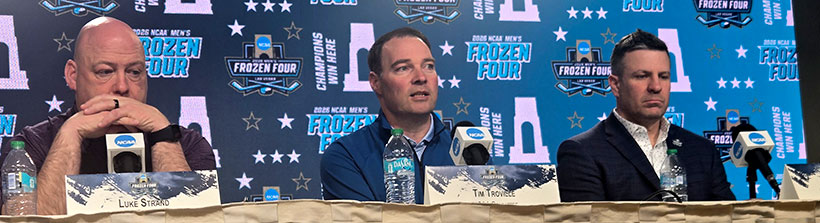
LAS VEGAS On a sunny, 83 degree afternoon in the middle of the driest desert in North America — hosting, as it were, the NCAA Frozen Four for the first time — eyes and ears of the college hockey world turned to the annual ‘State of the Game’ press conference.
But it doesn’t require showing up to this panel to know that the state of college hockey is one of massive transformation. And it felt appropriate to have this conversation at this year’s NCAA Frozen Four in particular, featuring a historic pedigree of teams — the four winningest programs in NCAA men’s hockey history, boasting a combined 33 national championships — in a modern setting that not long ago would have been a far-fetched idea to host this event, let alone be affiliated with the NCAA in any way.
College hockey’s market footprint is shifting, though, and rules regarding much of what Vegas offers — money, in particular — have relaxed over time. Want to gamble on the national championship game? Feel free. Denver is the betting favorite against Wisconsin.
Still, there was plenty to discuss, amidst a successful and entertaining on-ice and off-ice event in Las Vegas so far.
With the competition level in the NCAA rising rapidly — with many believing that college hockey is becoming the premier development pathway for players aspiring to play in the NHL — what does this mean for programs? For players?
“In the NHL, the more players that can come from NCAA hockey directly to the NHL is a good thing for them because the more you can tie their sport, especially in the U.S., to college fanbases, that’s an outstanding opportunity for the NHL to grow the game,” said Sean Hogan, Executive Director of College Hockey, Inc.
“The more teams we can create, the more fanbases we can create, the more players that come through our pipeline on the road to the NHL is a good thing for everybody. Might not be as the two paths as it used to be. You’re going to be 16, 17, 18 years old, play junior hockey wherever you want. When a college hockey team recruits you, they’re ready for you, you should be ready for college hockey because that’s going to be the next step on the development path to the NHL on the men’s side.”
There are currently 63 Division I men’s college hockey teams. The hope is for there to be more.
“It’s my own personal goal, I don’t know if I’ll ever get the chance to do it, but I’d love to see us grow up to maybe 75 programs,” said Tim Troville, Chair of the NCAA Men’s Ice Hockey Committee. “The player pool is growing.”
Maryville University in the suburbs of St. Louis recently announced that it is is launching a new Division I men’s hockey program. Unfortunately, soon after this announcement, Merychurst announced that it is dropping its hockey program starting next season as part of a “strategic restructuring.” This comes on the heels of American International, a recent powerhouse in Atlantic Hockey, transitioning from Division I hockey to Division II last year. That happened despite four regular season titles and three tournament titles for the Yellow Jackets since 2019.
So as much as programmatic growth is important in the NCAA landscape, so too — perhaps even more so — is retaining and supporting current programs.
“Where I think we’re going to see growth on the men’s or women’s side are Division I schools that do not have major college football,” Hogan said. ” The cost to compete at that level with revenue share and NIL money, third-party paying players, when I discuss our sport with others, you’re going to be really good in college basketball and you can have an outstanding NCAA Division I hockey program. Our sport is one of the few sports where the major blue bloods don’t always win the national championship. You can elevate your athletic department, your university, schedule some of the biggest blue bloods in college sports, they’ll be on your schedule, come to your building. That’s not something that happens in a lot of other sports.
“What can we do as a college hockey body to protect some of these programs, especially the independents? Do what we can to schedule them, seems like 10, 15 years ago we found a way to bring them all in conferences. I know that’s not always going to be possible. As much as we can, bring everybody in the group. Sounds like a pie in the sky type dream. We need to do that to protect our sport. We added one in Maryville. In the same week we lost one. So we’re still at 63. We want to get to 75, 85 programs. It’s doable. There’s places that have really strong ACHA Division I hockey programs. Went to a game this year out in the Midwest. They had 9,000 fans at a game. It’s doable. A lot of it’s going to have to be money donated by the university, or by third parties. New money.”
Canisius coach Trevor Large — formerly a coach at AIC and currently also chair of the NCAA rules committee — offered his insights, too.
“Maybe the competition that’s on the ice is parity, but it doesn’t exist in all other areas,” Large said.
No one wants to see the gap grow between the “blue bloods” of the sport, so to speak, and the smaller programs. This century, teams like Quinnipiac, Union and Yale have won national championships. Still, the conversation is somewhat ironic in a year with this year’s Frozen Four in particular — featuring Denver, Michigan, North Dakota and Wisconsin. Still, Denver and UND are not big schools in the traditional sense when it comes to collegiate athletics. Denver has fewer than 7,000 undergraduates — but that hasn’t stopped its hockey program from developing into the sport’s standard-bearer.
One potential new issue is an overhaul of NCAA eligibility rules. On the table is a change to age-based eligibility starting as early as fall 2026, shifting to a “5-for-5” model. This rule sets a 5-year, age-based clock that begins at age 19 or high school graduation (whichever comes first), potentially eliminating traditional redshirts and injury waivers.
“If it works backwards, it’s going to affect junior hockey,” said Minnesota State head coach Luke Strand. “A little bit adapt or die, gets younger players in there and things. At the same time these
players are becoming more elite at an earlier age, too. It’s not the end of the end for me. I think you’ve got to be equipped to change. Probably going to affect some programs, like ours, maybe a little bit more… I don’t think it was intended for hockey.”
“It’s going to have downstream effects,” Hogan added. “Again, we’ve only had about 36 hours to think about this. My initial thought was the eighth and ninth graders, you see this in college football, high school football, you have parents making decisions, I want my kid to repeat a year, so they get that 19-year-old graduation date, get another five years. I can see that happening. I don’t think that’s the intention of this. That’s how some people are going to be thinking. Not ideal.”
CHL Players and Transfer Portal
Denver and Wisconsin are playing for the national championship in 24 hours. “Blue bloods?” Sure. But there’s no high-end first-round NHL draft pick or recent CHL star on either team. Still, the influx of outstanding young players — Penn State’s Gavin McKenna, North Dakota’s Cole Reschny, just to name two examples — are part of the new college hockey landscape.
“We’re getting really good, I’ll say coaches, at the curveballs and change, having to figure them out,” Large said. “It’s all happening relatively quickly where maybe in the past there wouldn’t be change for many years. Now it seems like it’s almost monthly. I think it’s inevitable. The way I would explain it is: my job hasn’t changed. What has changed is the pool of players. It is a larger pool. Is it great for everybody? I don’t know how I could answer that.
“In terms of having a larger player pool that’s available to all colleges, I think there’s some real benefit there.”
Of course, teams now have the option to build key parts of their roster via the transfer portal. It opens right after the Frozen Four.
“The development internally, development of people, a little culture versus vulture type of thing,” Strand said. “Can you keep people around a little bit longer than they were out of the relationship part? Big picture is, like, you want guys who want to wear your jersey and represent your program. If they’ve got something else to do, I’m confident to say someone else will want to wear their jersey they left behind.”
Future Frozen Fours
“Just having additional opportunities to play college hockey is good,” Troville said. “I think where we choose to put the Frozen Four may weigh into that, too.”
Troville suggested that in about six months, sites for the 2029, 2030 and 2031 Frozen Fours will be announced. Washington D.C. and Chicago will host the event in 2027 and 2028, respectively.
The discussion about future Frozen Four sites is — right now — tied closely to the discussion regarding growing college hockey programs in other parts of the country.
“I was talking earlier about a program like UNLV, them being nearby,” Troville said. “We have several that are in the south, which you would consider ACC and SEC country. They’re playing high-level hockey. When we get to Tampa, Florida now has become an NHL juggernaut in hockey. Can we get some college hockey programs there? Even recently I’ve said in the past if you look at what like Arizona State has done, some of those places. We were just in St. Louis. Adding Lindenwood, some of those programs. I do think we could have some influence by bringing this tournament to some of those areas. Thinking about Pacific Northwest, what can we do up there to bring this tournament, those type of cities.”
“If I see a rink being built suitable for Division I by a university, there is one is Tuscon, I called the University of Arizona,” Hogan added. “It was a hard no. Doesn’t mean we didn’t try to do it. That’s one thing we’re out there doing, beating the bushes trying to create more teams. We’re doing it too for men’s and women’s.”