
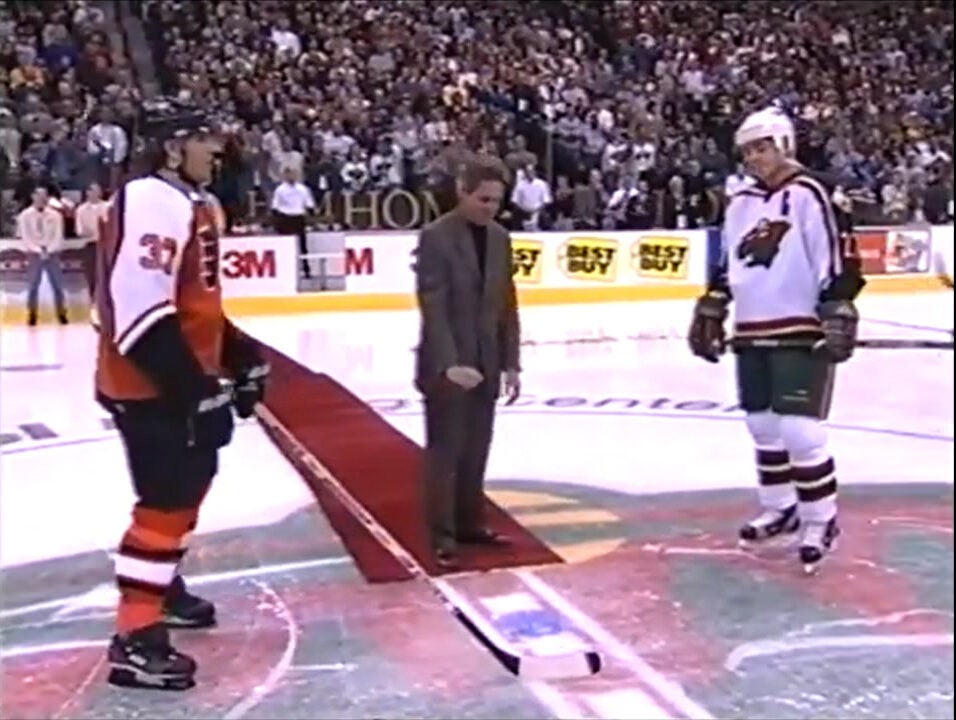
The Minnesota Wild marked their 25th season this winter, a milestone that underscores how far the franchise has come after curing the heartbreak the state’s hockey fans felt when Minnesota lost the NHL.
When the North Stars departed for Dallas in 1993, the wound cut deep. For the next seven years, the state was without a National Hockey League team.
“For all of us in Minnesota, that was something you watched growing up,” first-year Wild player and Richfield-native Darby Hendrickson said. “You watched Neil Broten or Dino Ciccarelli, and you wanted to be like them at the park. When they left, there was that void.”
That void disappeared when the NHL realized its mistake and awarded St. Paul an expansion franchise.
In 2000, the NHL returned and the Wild were born, restoring big-league hockey and establishing a new “State of Hockey” identity.
“When the Wild came back, there were players who became part of the fabric of a hungry town, a hungry state,” Hendrickson said. “Role models came back. Kids could relate to that. Kids started wanting to be a Minnesota Wild player.”
Built from Scratch
The Wild were assembled through an expansion draft — a roster pieced together from players other NHL teams felt they could afford to lose. Few of them knew each other well, and expectations externally were low.
“This was fresh for all of us,” first-year Wild player and the team’s current Senior Director of Player Development Brad Bombardir said. “None of us really knew what to expect.”
That group first came together at training camp in Bloomington, where competition was fierce and jobs were scarce.
“That training camp stands out more than any I can remember,” said Wes Walz, a member of that first team and current Wild TV analyst. “It was as competitive and as mean as it could be. Everyone was fighting for those 20 jobs.”
Many players arrived with something to prove.
“We wanted to prove people wrong,” Hendrickson said. “That we weren’t just castoffs or borderline players. We were hungry.”
The Coach Who Set the Standard
Perhaps the most important move the Wild made before playing a single regular-season game was hiring Jacques Lemaire as head coach. Lemaire brought instant credibility, having won 11 Stanley Cups as a player, coach or executive.
“Honestly, those early years, he was the most important person in that locker room,” Walz said. “He galvanized us as a team.”
Bombardir said Lemaire commanded respect without needing to say a word.
“He just had an aura about him,” Bombardir said. “An incredible hockey mind.”
Lemaire got the most out of a roster expected to struggle, especially given the Wild’s limited payroll compared with the league’s heavyweights.
“We didn’t want to get embarrassed,” Walz said. “We had a much smaller cap than teams we were playing against, but we competed every night.”
Hockey Comes Home
Anticipation peaked in September 2000, when the Wild christened the Xcel Energy Center in St. Paul with their first home game.
“You could sense the pride in the community and the state,” Bombardir said. “To have their game back.”
Walz remembers stepping onto the ice for warmups and seeing fans packed several rows deep around the glass.
“I will never forget that,” he said.
The hockey gods added poetry to the moment. Two native Minnesotans were on the roster, and in front of a roaring crowd, Hendrickson scored the first goal in Xcel Energy Center history.
“It means a lot that people were there and what they saw,” Hendrickson said, looking back 25 years later. “But I never thought of it as anything different. It was a goal. I didn’t score many in my career — but it was fun.”
From that first night on, the energy never waned.
“People were proud to have the NHL back,” Bombardir said. “The whole season felt that way.”
A Night to Remember
Another defining moment came three months later, when the Dallas Stars returned to St. Paul for the first time. In an unforgettable 6-0 Wild victory, rookie Marian Gaborik, the franchise’s first-ever draft pick, scored a goal on his way to becoming the team’s first true superstar.
“He was special, we all knew it,” Walz said. “We would all sit on the bench and and go, ‘That guy’s got more talent than anybody on this bench here or on that bench over there’. You could see it.
Bombardir agreed.
“He wasn’t like a normal 18- or 19-year-old,” he said. “His skating and shot were phenomenal, and he had a feel for the game.”
More Than the Record
The Wild won 25 games in their inaugural season, exceeding expectations. But wins and losses aren’t what anybody remembers.
“People just loved going to the rink,” Hendrickson said. “Every night it felt like a party in St. Paul, and then a hockey game broke out.”
Fans embraced the team’s work ethic and defensive style, even when the scores were low.
“Whether we won or lost, they appreciated how hard we played,” Walz said. “We were building something.”
Still Part of the Fabric
Twenty-five years later, many from that inaugural team remain connected to the organization. Hendrickson went on to spend 14 seasons as an assistant coach. He’s now an assistant coach for the Nashville Predators. Walz has long been part of Wild TV broadcasts as analyst. Bombardir still works in the Wild’s Player Development department.
Looking back, Hendrickson says the Wild’s beginning shaped his life.
“One of the most impactful things I was ever a part of,” he said. “And being from Minnesota? It was incredible.”
Walz admits choosing to put down roots in Minnesota after his playing days ended deepened the meaning of being part of that first team that brought hockey back.
“Some of the guys, the Minnesota boys, talked to us about how big this was for the fans, because they grew up here,” he said. “Now that I’ve lived here for 25 years? I really understand exactly what went on that first year.”
Bombardir also chose to stay in Minnesota when he retired from playing.
“If you love hockey, and hockey is a part of your life and it’s in you and in your blood. Minnesota is the place to be,” he said.
As much pride as they hold for their own roles in the past, Walz and Bombardir can’t wait to see what the current crop of Wild players might accomplish.
“I’m just so proud to see what this organization has has done, and where it’s grown and where it’s at,” Walza said.
“We want to win,” Bombardir said. “We want to win a Stanley Cup. And when it happens, it will be incredible.”
For Related Stories: Minnesota Wild