
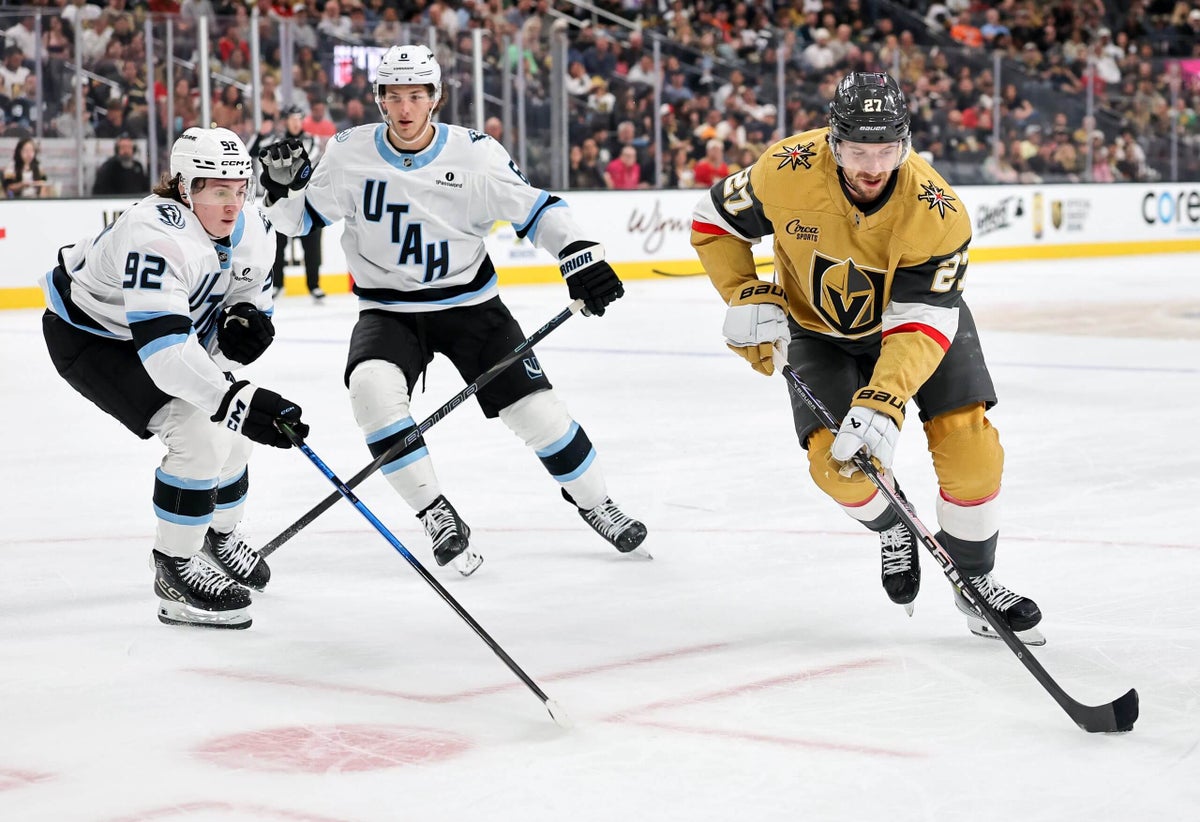
Something just feels right about a first-round series between these (non-divisional) teams. Las Vegas and Salt Lake City are a breezy six-hour drive away from each other. Don’t laugh; going from Pittsburgh to Philadelphia at the wrong time could take nearly that long.
The hockey should be interesting, too. In the Golden Knights, we get a star-studded team that got its act together at the right time. In the Mammoth, we get an up-and-coming, entertaining young team bringing playoff hockey to its city for the first time.
The odds

On one hand, the Mammoth won more games this year (43 to 39) and have a better goal differential (plus-30 to plus-15) than the Golden Knights. On the other hand, this is Utah’s first year as a playoff team and Vegas has been a perennial contender since practically its inception into the league.
Those facts color the odds in both directions.
Vegas is favored as one might expect; the Golden Knights have the resume, the pedigree and the roster strength to go deep despite their record. They look like a sleeping giant that’s finally waking up under John Tortorella, closing out the season on a 7-0-1 heater to win the division.
But the series isn’t nearly as lopsided as that pedigree might entail. The Mammoth are the real deal and are beginning to realize their potential at just the right time.
The numbers

Season-wide, the Golden Knights and Mammoth match up closely at five-on-five, with top-six marks in xG share.
Utah’s speed in transition and dangerous passing has quickly become a hallmark of its attack. But this team didn’t just create one-and-dones off the rush; they sustained pressure well, which helped them create a slightly higher rate of chances and goals this year. That’s going to be tested against Vegas’ defense, which tends to limit rush shots and overall allow fewer chances against. The difference is that this year’s Golden Knights have generally been leakier in net.
Since the Olympic break, the Golden Knights have been a much better five-on-five team, and since the coaching change, they have had more solid goaltending to match. The Mammoth’s defense trended down the stretch — and that extends to special teams situations. Utah’s penalty kill has been more porous as of late, and challenged its goalies. And it’ll be challenged by a Golden Knights power play that ranks top-three in xG and scoring this year — although it looks a lot less favorable as of late, with the team struggling to convert on its chances since the Olympics.
The Mammoth’s power play was pretty underwhelming all year, but it has kicked things up a notch lately. But Vegas could still earn the special teams’ edge if its penalty kill can keep up the momentum. The Golden Knights’ expected goal suppression ranked second in the league this year. It’s one area where the goaltending has actually performed well relative to its workload pretty consistently.
The big question
Can Mitch Marner shine in the playoffs away from Toronto’s bright lights?
If Marner was looking for a little less noise in the desert, that’s what he’s found thus far. He has spent the first season of the eight-year, $96 million deal he signed with Vegas last summer flying (relatively) under the radar despite shifting back to center and having one of the least productive offensive seasons of his career. Good luck getting away with that in Toronto.
That’s not necessarily meant as a knock on how Marner has played in 2025-26, either. Vegas’ plan to start him on a line with Jack Eichel might not have lasted long, but their results together have been fine; in about 175 minutes with them both on the ice at five-on-five, Vegas outscored opponents 11-6 and controlled more than 60 percent of the expected goal share.
The fit wasn’t perfect, though, and along with December injuries to Eichel, William Karlsson and Colton Sissons helped precipitate Marner moving to the middle for the first time in his NHL career. The move stuck, and it’s been more good than bad. Marner finished the regular season with 80 points (24G, 56A), which works out to 2.97 per 60 — impressive, but also his lowest output since his second NHL season. His Offensive Rating (11.1) still placed him in the 95th percentile, though. Ultra-elite? Not quite, but also not bad for a down year.
Where Marner has really added value, though, is on the other side of the puck. Long viewed as one of the best defensive forwards in the league despite playing on the wing, Marner put up a Defensive Rating of about 5.5, 10th among forwards overall and just a tick behind Eichel. With Marner on the ice against fairly tough competition, Vegas allowed about 2.0 goals per 60, the lowest number for any forward on the team outside of fourth-liners Nic Dowd and Cole Smith. Marner’s underlying numbers were fine, too, helping make his season a success — even if that success looked a bit different than anyone expected.
The irony at play: that’s closer to the sort of game — defensively strong, offensively fine — Marner brought to the playoffs with the Toronto Maple Leafs before the disasters of 2024 and 2025. He hasn’t had to be The Guy in Vegas, thanks to the presence of Eichel and Mark Stone, just like he didn’t have to be The Guy on the Canadian national team. Will Vegas need more to make a deep run? Time to find out.
The X-factor
Is Utah’s core peaking at the right time?
One of the major questions with the Mammoth entering the season was when their core would arrive as contending-caliber. The top group has started to check all the boxes necessary, but on paper, it’s not quite as emphatic as the guys on the other side.
Clayton Keller, Dylan Guenther, Nick Schmaltz and Logan Cooley are a terrific quartet up front. Mikhail Sergachev is a strong leader on the blue line. Whether that’s on the same level as Jack Eichel, Mark Stone, Mitch Marner, Pavel Dorofeyev and Shea Theodore is another story.
There are levels to this that often get exposed in the postseason, a lesson that Vegas has applied ruthlessly to its team-building philosophy since a lightning-in-a-bottle first-year run to the Cup final. On paper, Vegas’ group has Utah’s beat in each role. Total value: a projected Net Rating of plus-65 to Utah’s plus-39. That’s the main difference in this series.
When it comes to young players, though, things can change quickly — and that might be what we saw from Utah’s elite core down the stretch. Over their final 10 games, Keller put up 20 points, Cooley had 13, Guenther had 14, Mikhail Sergachev had 13 and Nick Schmaltz had 11. All above point-per-game. They all dominated at five-on-five, too, with xG rates approaching and eclipsing 60 percent.
Some of that stems from a power play that got red-hot, but that’s often the exact difference between a core that’s good enough and one that can put a team over the top. Utah’s group, over its last 10, looked like the latter.
With a tough defensive opponent in front of them, now we see just how high-end Utah’s core really is. Were the last 10 games just a hot streak or a sign of things to come?
The rosters

There are two reasons to believe Vegas’ top end is better: collective two-way ability and track record. It’s not just offense and they have a history of playing at this level.
Eichel, Stone and Marner are all cut from the same cloth in that way as two-way dynamos, each boasting a projected Defensive Rating of plus-2.5 or higher. That’s the team’s separating factor and something no other playoff team can boast. All three have been in the thick of Selke discussions throughout their career and that stinginess has kept up this season. Being able to consistently score at or above point-per-game rates on top of that only adds to what makes Vegas’ top end uniquely terrifying.
But it goes beyond that; their second layer of attack all offer similar ideals. Dorofeyev is not just a back-to-back 35-goal scorer; he’s also a defensively responsible winger who can support the two-way monsters above him on the depth chart. Tomas Hertl and Ivan Barbashev both scored right around 60 points this season while offering similar levels of responsibility. It leaves Vegas with arguably the deepest stable of difference-making 200-foot players. All six had an xG rate north of 55 percent this season.
Keller and Schmaltz are getting there this season and have taken massive strides in their two-way games. Schmaltz started popping up on the Selke list in our monthly Awards Watch pieces for his underrated defensive ability, while Keller’s growth in that regard over the last few months has been commendable. They both had an xG rate above 55 percent, too. There’s just not enough beyond them defensively with Guenther and Cooley still a work in progress in that regard, as expected for two U23 players.
Even offensively, Vegas has more. JJ Peterka was supposed to be the ace up Utah’s sleeve after scoring at a 70-point pace last season, but he regressed to 47 this season. Since Jan. 1, Peterka has just 19 points in 42 games. Not good enough, and his ability to drive possession is still in question. That Utah doesn’t have a sixth genuine top-six option after Peterka is another issue that puts the team behind what Vegas can throw out there.
Where the Mammoth make up some ground is in the bottom six. As strong as the Golden Knights’ top six is, their depth has become a real eyesore this season. Vegas has become a top-heavy team where nearly every depth player lost their minutes. Reilly Smith (1.51 points per 60) and Brett Howden (1.48 and in the top six to create some balance) are the only players here who can be trusted to chip in offensively. The other four all have a points-per-60 rate under 1.15.
The loss of William Karlsson is really felt here and the combined damage is a minus-41 Net Rating. That’s tied with the Oilers for the worst among playoff teams and bottom-five in the league. That’s a real flaw for Vegas, and while Utah’s group is better, it’s only marginally so.

Where the Mammoth shine is the depth of their defense corps. Sergachev has turned a lot of heads after a tepid start with some truly inspiring play since the Olympic break. The addition of MacKenzie Weegar has been a key part of that, adding stability to the top pair even if Weegar still has to clean some things up defensively. While John Marino and Nate Schmidt have slowed down a touch, they’ve been one of the best shutdown pairs this season, with 55 percent of expected goals, allowing just 2.38 xGA/60 and 2.03 GA/60.
That makes for an extremely capable top four. Add Sean Durzi’s puck-moving and Ian Cole’s sturdiness on the third pair and Utah has an enviable lineup from one to six. The problem, again, is that what Vegas has is just better.
As good as Utah’s shutdown pair has been, Vegas’ has them beat. Shea Theodore’s ascent to premier two-way defenseman this season has been notable and he’s been lights-out with Brayden McNabb, allowing just 2.05 xGA/60 and 1.86 GA/60 together this season. Given Vegas’ goaltending issues all year, that latter mark is impressive. Rasmus Andersson got off to a rocky start, but he’s been undeniably good over the last month, finally looking comfortable in Vegas as the puck-moving star he’s long been hyped to be. He’s worked extremely well with former teammate Noah Hanifin (57 percent xG), which gives Vegas one of the league’s strongest top fours.
That’s a lot of advantages for Vegas, but as is often the case, the great equalizer is usually goaltending.
Over the last two seasons, Karel Vejmelka has established himself as one of the game’s strongest starters with 23.1 goals saved above expected, the 10th-best mark in the league. The volume he plays to achieve those heights is under-appreciated and something the model does account for.
As good as Carter Hart has been over the last month, his play before that was still incredibly shaky, making him difficult to trust. Behind Vegas’ staunch defensive structure, Hart only has to be good enough, but Utah having a potential series stealer means he’ll have to bring his A-game.
The key matchup
Jack Eichel vs. Logan Cooley
If you’ve played Pokémon, think of this as Charizard vs Charmander. Eichel, in some ways, represents the mature, final-form version of Cooley.
The Mammoth center is a productive playmaker who always has the puck on his stick and scores goals, but probably doesn’t shoot the puck quite enough at five-on-five and racks up power-play points. Sounds like early-period Eichel, yes? At this point in his career, though, Eichel has found added production, more balance in his offensive toolkit and most crucially, high-end defensive play.
Cooley can’t compete with that on an individual level (yet), but Utah’s results with him on the ice (44 goals for, 31 against) are great, and his production (2.8 points per 60) is solid, too. He actually scores goals more frequently than Eichel despite taking about three fewer shots per 60. Eichel’s underlying numbers and defensive work (top 10 Defensive Rating among forwards) are more than enough to give him the edge, but the matchup is still worth watching now and down the line.
The bottom line
The Mammoth have the juice to knock off the Golden Knights and it wouldn’t shock many. But Vegas is battle-tested and is starting to realize its power as a defensive juggernaut under John Tortorella.
Utah won’t be an easy out, but it’s hard not to like what Vegas has more.
References
Understanding projection uncertainty
Resources
All Three Zones Tracking by Corey Sznajder