
PHN+ SUMMARY: “You never know when it’s your last series, so leave it all out there.”–Connor Clifton. From the perceptions and overall vibe of the players in the dressing room and several frank discussions between players and PHN on physicality and the role the Pittsburgh Penguins think it will play in their Round One series against the Philadelphia Flyers.
CRANERRY TWP., Pa. — There is not necessarily a groundswell of juvenile excitement, but a controlled eagerness in the Pittsburgh Penguins room. There are enough veterans in a room full of new faces that recognize Game 1 is not an accomplishment, only the start of the journey. But that doesn’t mean there isn’t a little something in the air.
Somewhat oddly, over the last couple of days, the players have been more readily available to chat with the media. Typically, the Stanley Cup Playoffs are a time to stay away from the keyboard jockeys and TV cameras. Yet, draped between the banal questions like “How happy are you to make the playoffs?” the players are discussing the underlying factors of the series, the heightened importance of parts of their game, and doing so with a surprising candor and a hint of vulnerability.
There’s a very human quality in the room this week, even as the mood might better be described as the hungry excitement in the moments before Thanksgiving dinner.
“I think within each player, they’ll bring it in different ways, and it looks a little bit different from person to person,” said coach Dan Muse. “But I think in regard to (physicality), all of it has to elevate.”
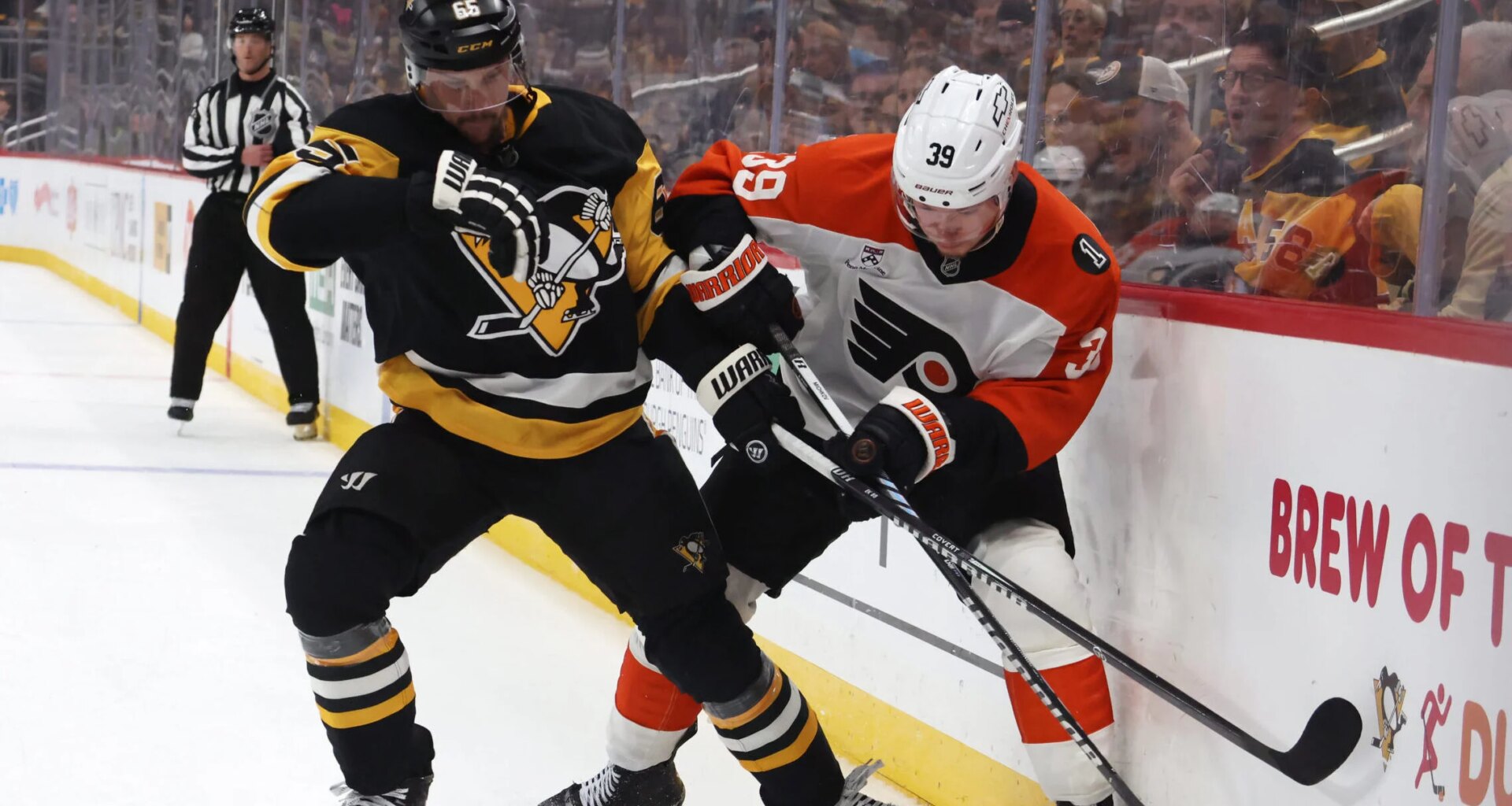
Make no mistake, the days of yore that featured the Flyers’ physicality against the Penguins’ finesse are gone. Neither team in the series is a heavy team that routinely inflicts punishment as a game plan, but that doesn’t mean it won’t be a physical series.
The physical conversation almost necessarily had to start with the Penguins’ most physical defenseman. We chatted for over two minutes specifically on that one topic and the effects that playing physically can have on the opponent.
“It depends how hard the hits are,” Clifton quipped.
Hits are a difficult stat line to compare as the scorers in some buildings award hits from a stern glance, and others need to see the boards wobble as the result of a concussive rumpus, but even so the relatively tame Flyers, at least compared to the snarling animals who have previously worn the black and orange, had 1882 hits this season, compared to 1444 Penguins hits.
There are plenty more factors in that stat, too. Most notably time with a lead and time with the puck, both of which the Penguins are among the best.
Yet is surely seems the Penguins are the stronger team, if not perhaps more physical, but in different ways.
“Everybody’s physical game or the way that they show their compete–I think it is a little bit different for each guy. And so I think all things become amplified right now. Some of our guys, the hits are a little bit louder, and they’re going to continue to elevate their games,” Muse said. “But then we also have some guys that I think are physical, in terms of just winning puck battles, getting to the inside, and that needs to continue to elevate. We have some guys that it might not necessarily be about those big checks, but they’re great in terms of making an impact with a great defensive stick. (And) that needs to elevate. And so all those things are important.”
Game 1 could be a different type of game that we’ve seen from the two teams this season. There almost assuredly will be heightened emotions that will spill beyond the often tidy constraints of the regular season.
So, really, how important is physicality early in the series, and does it have lingering effects later in the series?
Letang would certainly have the perspective of a defenseman who became the target rather than the beneficiary of a more physical team. Clifton might be the Penguins biggest pot stir, which is why his take on adding an element of brutality was more hypothetical about the benefits later.
“Every shift matters, every play matters. Backchecking, right? Might not work nine times, but the 10th time you break up a goal in a 1-0 game,” Clifton said. “Yeah, we’ve got to be loud and physical defensively too. We’ve got a lot of players that make plays and (score) goals, and that’s great. That’s part of it too, but I think we’ve got to dial in defensively and physically.”
Erik Karlsson
I’m starting to believe that Karlsson will be a very good front office exec when his playing days are done, if that’s a route he wants. He knows hockey and the players around the league at a granular level that rivals Kyle Dubas.
Karlsson is always a good chat. His mind begins racing, and he’s able to speak with such specificity and knowledge that it’s hard to get a word in. My original Norris Trophy ballot did not include Karlsson, but that was a mistake I rectified before sending in the ballot Friday morning.
I suppose I’m breaking some confidence for you here, but I told Karlsson I struggled with the Norris Trophy ballot and I almost didn’t include him.
“You’d better put me on it,” the three-time Norris winner laughed.
I told him that I almost didn’t include him, not because he didn’t deserve it, but because I didn’t think he’d give a sh*t about it. And to that he agreed, but with vintage Karlsson self awareness with a hint of self-effacement and a smile.
“You’re right. I know who I am.”
That guy is a peach. And I probably should have put him higher on my ballot, but I also felt terrible for omitting a couple of worthy defensemen. Balancing the homer aspect with the fact that I thought he was absolutely brilliant for at least half the season was a difficult struggle.
Ultimately, he agreed with my choice for No. 1, as he would have made the same. I didn’t seek validation, but from someone who so could intricately discuss the topic, it felt good nonetheless.
Tags: connor clifton erik karlsson phn+ Pittsburgh Penguins
Categorized:PHN+