
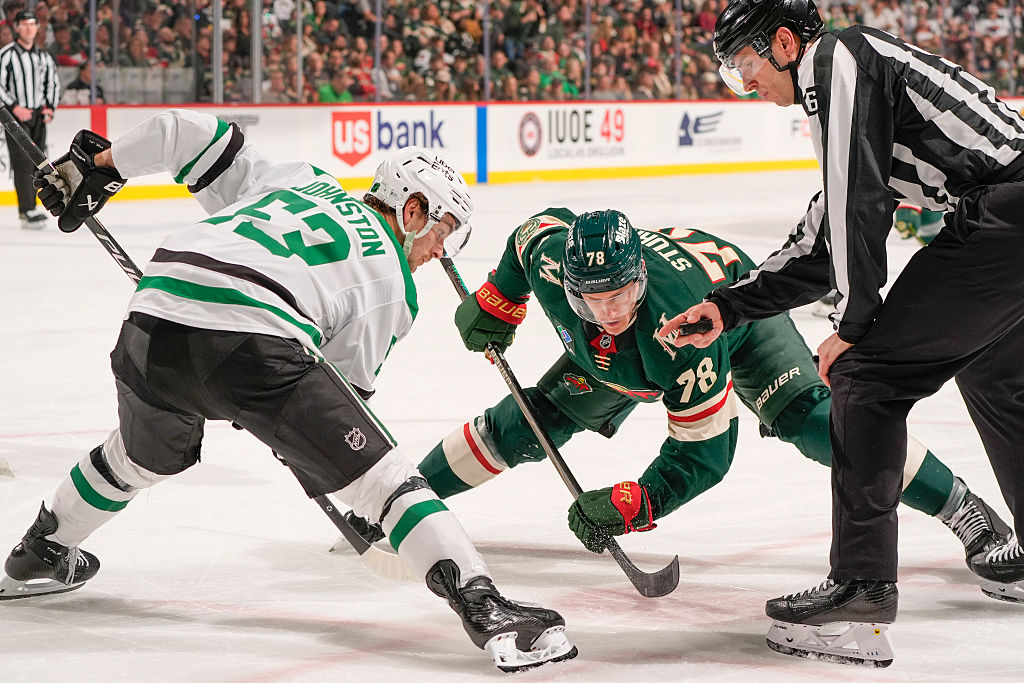
Keagan Smith provides a series preview, prediction and pick for Stars vs. Wild in the first round of the 2026 Stanley Cup Playoffs.
Start growing those playoff beards — the 2026 NHL Stanley Cup Playoffs have arrived at long last.
There have been plenty of discussions in recent days about whether the postseason format does a disservice to top teams by seeding the bracket based on division standings rather than conference point totals. Regardless of your own stance on the topic, it’s both a blessing and a curse that the Dallas Stars and Minnesota Wild now meet in the opening round. On one hand, this series should provide adrenaline-fueled hockey between elite sides; on the other, it’s a shame that one will see its season ended this early.
Here’s a detailed look at this Stars vs. Wild series, including a preview, betting odds, and a top pick on DraftKings Sportsbook.
Stars vs. Wild series preview
Dallas Stars
Over the last several seasons, the Stars have been on the verge of a potentially dynastic run but seem to come up just short every time. After making three consecutive trips to the Western Conference Final — falling to the Edmonton Oilers in back-to-back years and losing to the eventual champion Vegas Golden Knights in 2023 — there are certainly playoff demons to exorcise in Dallas. It’s tough to undersell just how successful the franchise has been though, becoming one of just seven teams to reach 50+ wins in three consecutive campaigns. All but one of the prior six to accomplish such a feat were rewarded with a Stanley Cup at some point in that span.
Could the Stars be the next to do join that list, reaching the Final for the first time since 2020 and hoisting their first Cup since 1999? The numbers suggest there’s certainly a chance. The first year of head coach Glen Gulutzan’s second stint with the team has gone swimmingly after a 112-point campaign, good for second in the Western Conference and third in the NHL. Dallas ranks ninth in scoring with 3.33 goals per game thanks to an offensive philosophy that prioritizes quality chances over quantity. While third-to-last in shots per game (25.3), the Stars are fifth in high-danger chances and are the NHL’s most efficient team with a 13.15% shooting percentage. Plus, they get in front of the net with the league lead in rebound goals. Their calling card is an elite power play that hits at a 28.6% clip, the second-best mark of any team.
One of the drivers of that man advantage is 22-year-old Wyatt Johnston, whose 27 power-play goals tie him for the sixth most in a single season ever. With 86 points (45G/41A), he’s second on the team in total scoring. He’s joined by Jason Robertson (96 P; 45G/51A), who paces the roster in points and ties for the team lead in goals. That’s not even mentioning Mikko Rantanen, who missed time due to injury with just 64 games played but has produced 77 points (22G/55A) when active. The high-end talent and depth are both excellent, and while first-line center Roope Hintz’s status remains uncertain, the return of Miro Heiskanen (63 P; 9G/54A) appears imminent. Getting the two-way defenseman back into the lineup is a massive boon for this group.
As impressive as the offensive numbers are, this team is just as effective on the other side of things. Dallas allows just 2.71 goals per game, second fewest in the NHL, also holding opponents to the seventh-fewest shots on goal (26.2). The Stars are 11th in high-danger attempts and third in medium-danger chances allowed, also ranking 10th in blocks per 60. The penalty kill is relatively average at 80.3%, but the overall results say plenty. While netminder Jake Oettinger has experienced a statistical down year with a career-worst SV% of .899, he still holds a respectable 2.59 GAA and has 35 wins under his belt. Plus, he’s been known to rise to the challenge come postseason time and may feel slightly fresher than in past seasons after being spelled by Casey DeSmith a little more often than last year.
Minnesota Wild
The challenger in this series doesn’t bring the same pedigree or postseason success as the Stars do, but the Wild are certainly contender thanks to their all-in blockbuster of a trade earlier this season. Yes, they’ve failed to make it out of the first round in seven tries since 2015, but this isn’t one of the rosters of old. Since acquiring Quinn Hughes, Minnesota went 27-14-7 and finished the regular season with 104 points, good for third in the conference. If there’s ever a year to break the dry spell and advance, it’s this one — though the tough draw to open the Stanley Cup Playoffs does lend itself to criticism of the format.
Minnesota’s goals per game mark of 3.27 may not be the most impressive, but bear in mind that does include the pre-Hughes era from the early season. In 48 games with him, the Wild average 3.58 goals and are obviously a significantly improved offense. For what it’s worth as well, they actually went the full season without suffering a single shutout. The Wild rank seventh in shots on goal with 29.3 per outing and are ninth in high-danger chances themselves, also generating the 10th-most attempts off rebounds. While they have an average shooting percentage at 11.19%, they’re still undoubtedly highly effective. The threat only multiplies on the power play, scoring at a 25.2% rate that’s good for third in the NHL. In games Hughes plays, that bumps up to 28.2%.
The star defenseman is, of course, one of the best quarterbacks of an offense from the blue line in the league with 53 points (5G/53A) in his 48 appearances with the franchise. On the full season, he sits at 76 points (7G/69A). The top scorer on this roster is Kirill Kaprizov, who remains a game-wrecking talent with 89 points (45G/44A) and particularly caught fire in the postseason last year. Matt Boldy is second on the Wild in scoring with 85 points (42G/43A). Mats Zuccarello (54P; 15G/39A), Joel Eriksson EK (51 P; 19G/32A) and Brock Faber (51P; 15G/36A) all broke the 50-point mark as well. However, there are whispers that suggest the team’s center depth isn’t sufficient for a Stanley Cup run.
Minnesota’s own defensive prowess shouldn’t be understated, either. The Wild are fourth in goals allowed per game at 2.87, but they tend to allow more chances at 24th in the stat (29.4). The good news is that they’ve conceded the third-fewest high-danger chances on the year and fifth-fewest medium-danger attempts, so perhaps they can take away some of those tries that Dallas excels at. While 16th in PK% at 79.8%, the Wild are fifth in blocks and 11th in hits, so physical play is another added bonus. Now, the decision in net does feel a bit surprising as the team announced Jesper Wallstedt will start game one despite playing the relief role behind Filip Gustavsson all season. The younger netminder’s numbers are better with a 2.61 GAA and .916 SV%, but he’s a rookie — Gustavsson is much more experienced and isn’t shabby whatsoever himself with a 2.69 GAA and .904 SV%.
Stars vs. Wild first-round series prediction, pick
DraftKings Sportsbook lists the Stars as -120 favorites in the series winner market to take this best-of-seven. The Wild are not far behind, coming in at +100 themselves to advance out of the first round.
Is it simultaneously thrilling and frustrating that these two awesome hockey teams are meeting in the opening round? Absolutely — it’s genuinely a shame that one of them will head home by the time the dust settles, especially since they’re each top-sixish squads in the NHL based on point total and raw talent on both rosters. Better teams should probably be rewarded with easier draws to begin the postseason, especially given the state of a poor Pacific Division in the same conference in which no team amassed even 100 points.
On the opposite hand, it is admittedly fun that the first round will have a matchup of this caliber (in addition to a similar situation between the 106-point Tampa Bay Lightning and Montreal Canadiens out in the Eastern Conference). Last time Dallas and Minnesota met, there were plenty of extracurriculars and punches were thrown between seemingly just about every player on the ice. There’s no question that this’ll be a physical, chippy series with plenty of bad blood between the two sides. Plus, there are plenty of narrative subplots between Jason Robertson playing in front of Wild GM Bill Guerin, who arguably snubbed him from Team USA, as well as the fact that the franchises are forever linked since the Stars originally played in Minnesota as the North Stars before relocating to Texas. Judging from social media, it seems there’s plenty of bad blood between fanbases.
With narratives addressed, let’s get into the actual hockey for a moment. These teams are both elite and are similar in a lot of ways. There’s a ton of star talent to go around. This could truly be anybody’s series and feels like about as much of a true toss-up as you can get in this league.
That being said, the Stars have a slight edge in a couple of ways.
The biggest key to the series is that the Stars are simply the deeper roster. There are plenty of superstars in this series, but the way Gulutzan has gotten the most out of his depth truly stands out. Tyler Seguin was declared out for the season early on and missed 55 regular-season games, Matt Duchene missed 25, Jamie Benn missed 22, Hintz missed 29, Rantanen missed 18… the list goes on and on. Despite all the injuries to key pieces at various points, Dallas managed its third-best finish in franchise history. Mavrik Bourque and Justin Hryckowian have emerged as integral pieces of the roster among others, plus Michael Bunting and Radek Faksa are both healthy and back in the lineup as well. Even if Hintz doesn’t return, the Stars have proven they can weather the storm and the bottom-six guys are a bit better than those of the Wild.
The other key that may give the Stars an edge is that they hold home-ice advantage after going 26-11-4 at American Airlines Center this season and 7-3 during the 2025 Stanley Cup Playoffs. However slight the margin is, the Dallas crowd is rowdy and the team has to be thankful it escaped the regular season with the right to play an extra game at their own barn in this series if it goes seven. Beyond that, the Stars have been one of the NHL’s best teams in one-goal games with a 60.9% winning percentage in such situations. After last year’s group found ways to escape in overtime during the postseason, that certainly matters this time around as well.
Can Minnesota win this series? Absolutely so, especially with the top-end talent and a physical style that grinds opponents down over the course of a game. In a seven-game series, that can prove crucial. Ultimately, the winning team will probably be the one that plays the cleanest hockey and isn’t lulled into taking bad penalties by their own frustration. Still, there’s just enough of an edge in Dallas’ direction to believe the Stars can make it through the first leg of what’ll be a gauntlet of Central Division foes, with the Presidents’ Trophy-winning Colorado Avalanche awaiting whichever franchise advances to round two.
Top Pick: DAL Stars vs. MIN Wild to go seven games (+210)
Puck drop for game one of this series is Saturday, April 18 at 5:30 p.m. ET.