
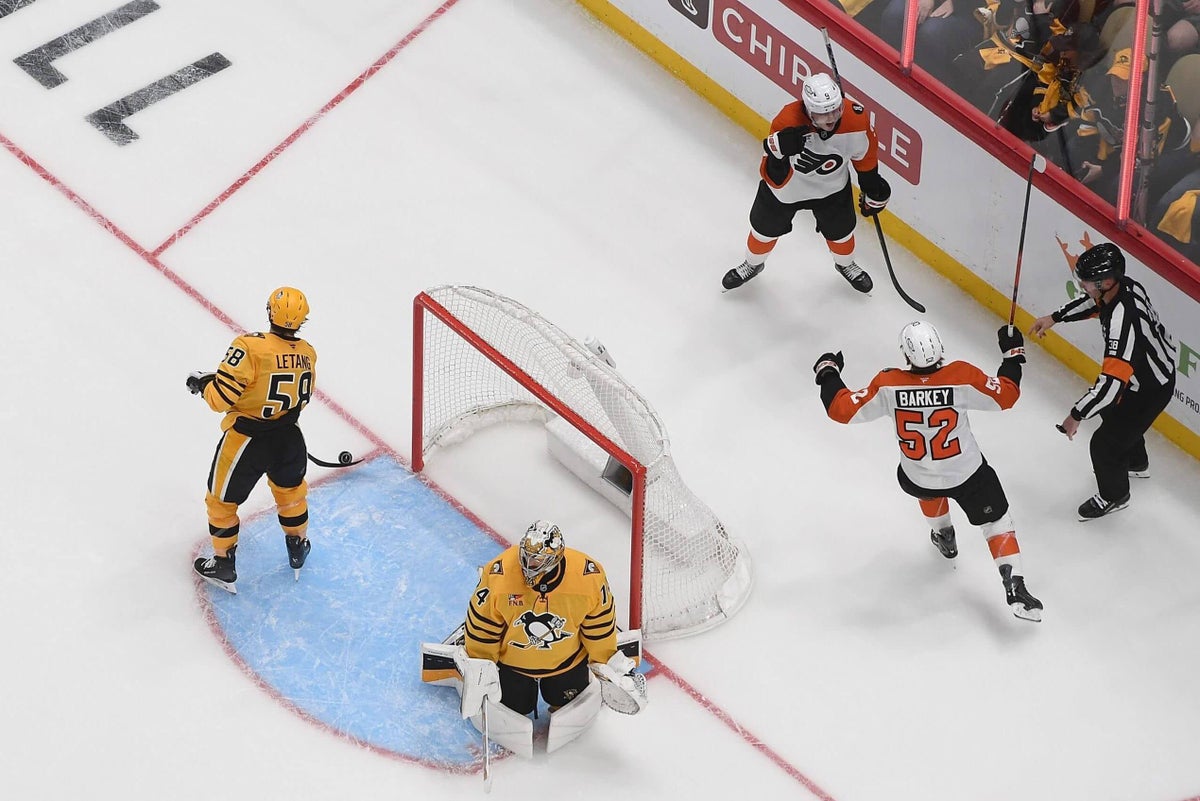
PITTSBURGH — Many of the players have changed over the years, but when the Pittsburgh Penguins lose in the playoffs, it almost always looks the same.
And so it did Saturday night in the Philadelphia Flyers’ convincing 3-2 victory at PPG Paints Arena.
The Penguins, because of their gallery of superstars over the past few decades, have always gone against the grain of conventional playoff hockey. Funny thing is, when they play the way you’re supposed to play in the playoffs — be disciplined, get pucks deep, keep things simple — they’re almost always successful.
They didn’t do any of those things in Game 1 of this highly anticipated series. They looked inexperienced. They looked immature. The Penguins looked tight in the opening period, careless in the second and all over the place in the third. This wasn’t a becoming performance from a team that has future Hall of Famers and Stanley Cup winners in every corner of the dressing room.
“I don’t know what it was,” Erik Karlsson said. “But it obviously was not anywhere near the way we know that we need to play.”
Karlsson’s candidness following losses is typically refreshing, and it was after this performance.
The defenseman explained that the Penguins didn’t play the way they had discussed playing. And it showed.
“We didn’t play the game we agreed upon,” Karlsson said, “and the way that we know we need to play.”
The Penguins, who managed only 17 shots on goal despite entering the game as the NHL’s third-highest-scoring team, could have had more. But they got away from playoff-style hockey, continually passing up shots in an effort to make the perfect play.
This maddening cuteness with the puck was a substantial part of the Flyers’ getting four breakaways. They didn’t score on any of them.
Several facets were at play, all of them indicating the Penguins were not mentally sound in this game.
• The Penguins were noticeably jumpy in the first period, which isn’t something you’d expect from a team with this kind of experience.
“I think we battled hard,” Karlsson said. “Everybody was trying really hard. But maybe we were trying a little too hard sometimes, overdoing things instead of just trusting one another to do your own job.”
They registered only five shots on goal in the first period while looking utterly out of sorts. There were spin-o-ramas in their own zone when a simple clear would have done, open looks that were passed up for the sake of making the pretty pass, and enough breakdowns at Philadelphia’s blue line to keep Dan Muse watching video with his team for the next 48 hours.
“They settled down before we did,” Karlsson said, acknowledging that the Penguins were far too amped up for this game. “It was one of those games. The first game in the first round is always like this, a lot of emotions. We just didn’t play well, didn’t handle it well. We never got any traction today.”
• There wasn’t enough simplicity in the Penguins’ game. In fact, there was none at all.
A lack of discipline was also a problem. The Penguins looked like they wanted to turn the game into a track meet, and when they couldn’t, they doubled down and tried even harder. It didn’t work out for them, as Bryan Rust explained.
“I think the type of game they play, it was going to be a low-event game,” Rust said. “We were not comfortable enough playing in a low-event game.”
Given their experience, the Penguins should be comfortable playing in any style of game. But Rust was right.
“You’ve got to be aware of your opponent, how they play, how the game’s going,” he continued. “We didn’t adjust to the game early on.”
They never adjusted, never settled for the simple play.
“We wanted things to happen when there wasn’t anything there instead of just waiting for it to come to us,” Karlsson said. “The will inside of us was a little bit too strong. We didn’t execute the game plan that we set out for today’s game. We battled really hard, maybe too hard. We just didn’t make the plays that were there. And when they were there, we still tried to make them.”
• There were some flashes of the legendary 2012 series in this game. The Flyers were tough and physical, and for whatever reason, the Penguins sometimes can’t control themselves when Philadelphia is the opposition.
Evgeni Malkin went out of his way to take runs at players all game. Sidney Crosby took two penalties, his second one late in the third period when he slashed Travis Sanheim enough times to the point of essentially daring the officials to make a call. They did.
“We know it’s Philly, we know it’s the playoffs, we know it’s coming,” Malkin said. “I like to play physical; I like to play a hard game. But just after a whistle, we need to just, like, go away and play smart. It’s the only way, because they allow it. This game, cross-check, you know? But again, we know it’s coming. But then we just — everybody should be a little bit smarter. That’s it.”
That would go a long way toward getting the Penguins in this series. They lost the mental game in every conceivable way in Game 1.
“We were off in a lot of aspects,” Karlsson said. “We played with our emotions more than our heads.”
Ten quick postgame thoughts
• Muse needs to put Crosby back on a line with Rickard Rakell and Rust, which would also mean reuniting Malkin with Egor Chinakhov and Tommy Novak. We know those lines work. The trio of Crosby, Rust and Chinakhov was not good, and I don’t see any visible chemistry between Crosby and Chinakhov. You don’t want to overreact to one playoff loss, but it seems like a clear decision to make.
• Crosby was oddly quiet, especially given his postseason history and penchant for destroying the Flyers. I have a theory.
In fact, I’ve written about it this season.
Dating back a handful of seasons, Crosby has now scored only four goals in the past 30 games in which he’s played when there has been a three-day or longer layoff. In this case, Crosby hadn’t played in six days, since the Penguins played in Washington last Sunday afternoon.
Long layoffs do not produce his best hockey.
• Stuart Skinner was outstanding. This should have been a Philadelphia rout, but it wasn’t because Skinner kept the Penguins in the game.
• Give Dan Vladar credit, too. He entered the postseason running hot, and he stayed that way. He didn’t face much in the way of work, of course, but when he was challenged, he was good.
• The only real positive for the Penguins, other than Skinner, was the performance of the fourth line. Blake Lizotte, playing for the first time in more than a month, may have been the Penguins’ best player.
• The Samuel Girard-Kris Letang pairing took a big step backward Saturday. After a bumpy start following Girard’s trade from the Colorado Avalanche, he and Letang played quite well in the last few weeks of the regular season. Then came Game 1 of the postseason. They were cavalier with the puck, responsible for several odd-man rushes against and refused to shoot the puck. It was a poor showing for them.
• The Penguins, to a man, said Philadelphia’s physicality didn’t bother them. I wonder if that’s the case with Chinakhov. He was lit up by two early hits in the first period and was barely noticeable for the remainder of the game.
• The Penguins were guilty of three offensive-zone penalties, two by Crosby and one by Anthony Mantha. That’s not a good road map for winning playoff games.
• The Penguins’ power play has been abysmal for a couple of weeks now, and it’s a big problem. They had nothing going with the man advantage in Game 1. It wasn’t crisp; they weren’t able to set up in the attacking zone, and they simply looked out of sync to the extreme.
At least the penalty-killing unit was much better, thanks largely to the presence of Lizotte.
• Malkin had 2 points, which is great. But he didn’t have a strong game. He turned the puck over consistently, got away with a couple of penalties that weren’t called and played far too high-risk all night. He and Crosby need to be considerably better.