
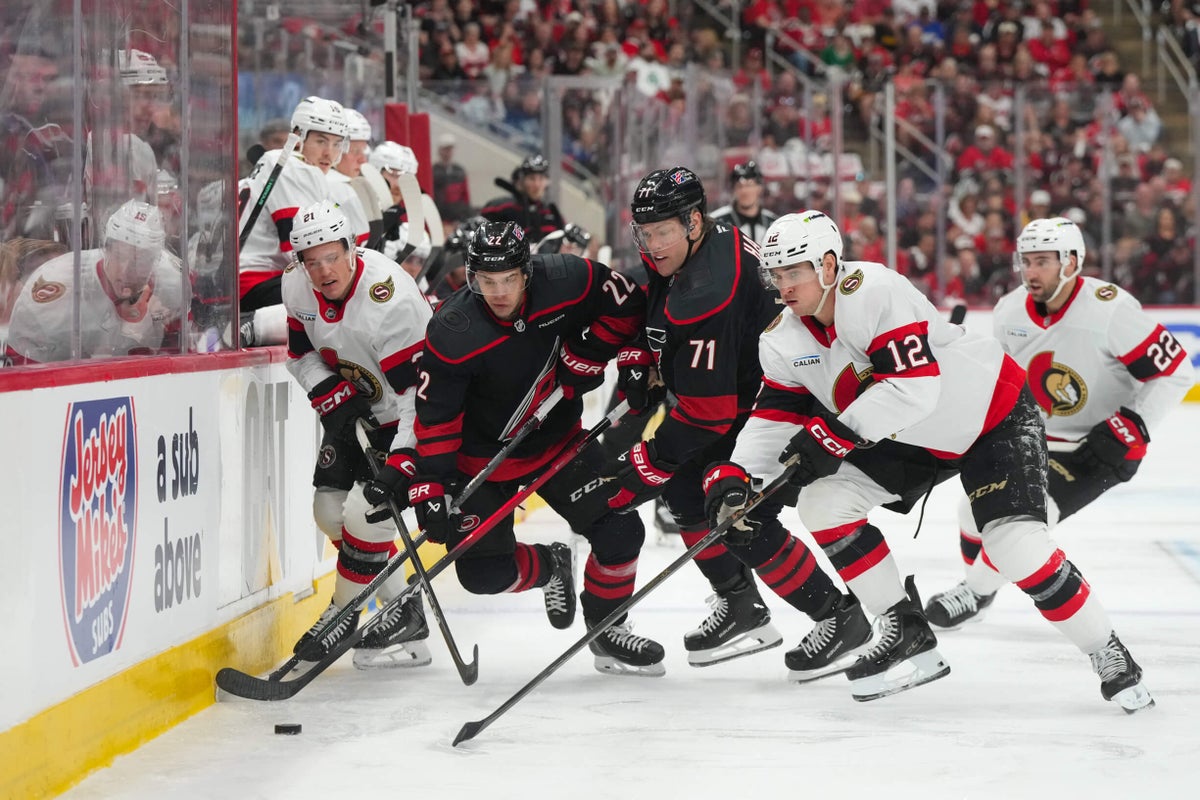
RALEIGH, N.C. — To get a sense of how little ground the Carolina Hurricanes and the Ottawa Senators gave each other in their first-ever Stanley Cup playoff encounter, chew on this: The first registered shot on goal Saturday afternoon came more than six minutes into the first period.
Yes, there were blocked and missed shot attempts before Ottawa forward Dylan Cozens finally put a puck on net. But it was very clear that each team was taking away the middle of the ice and limiting chances for the other. And if this regular season is any indication, the Hurricanes’ 2-0 victory in Game 1 won’t be a one-off.
“Not a lot of space for both teams, I think, all game,” Senators defenseman Jake Sanderson said. “I think it’s going to be like that all series. Tight checking, both of us pride our games on.”
That defensive brand of hockey was projected to be the calling card for both teams entering the postseason, and neither side disappointed. However, the Senators’ prowess wasn’t the same quality as that of the Hurricanes, who out-chanced and outhit Ottawa throughout.
As much as the Senators have drawn rave reviews for their commitment to playing defense under coach Travis Green, the Canes showed why they’ve been among the best teams in the league during coach Rod Brind’Amour’s tenure.
“I think both teams have a lot to be proud of tonight with that effort,” Hurricanes forward Taylor Hall said. “First game of playoffs is always fast and physical, and there’s not a lot of time out there, and that was the case tonight.”
Green said he hadn’t seen the advanced numbers when he addressed the media in the bowels of the Lenovo Center, minutes after the loss. The eye test more than sufficed, as he also noted the lack of space given by either team.
“They probably deserve to win analytically, and they did,” Green said.
The Senators hoped to take advantage of a game-opening scrap between captain Brady Tkachuk and Hurricanes counterpart Jordan Staal. The Senators “loved” the energy. But the Canes did, too. The physicality ramped up and so did the Canes’ desperation. When the Senators had a first-period power play, the Canes were relentless defensively, even diving to make clearances. And with every defensive play and hit, the Canes flexed their home-ice advantage with a raucous, towel-waving crowd.
“They’re just always on top of you,” Tkachuk said. “They’re always in the right spots. And you can see that they blocked a lot of shots there, especially at the end. But all game, they’re sacrificing their body so they don’t give you much.
“They frustrate the whole league with the way they play.”
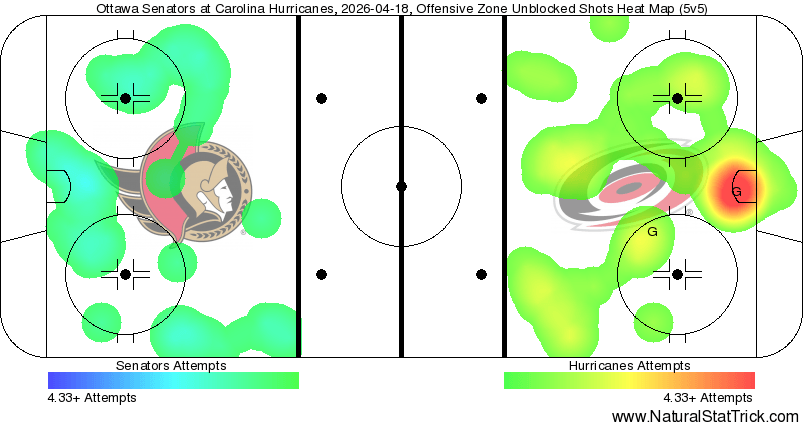
According to Natural Stat Trick, Carolina overpowered Ottawa in shot attempt rate (71.05 percent versus Ottawa’s 28.95 percent), scoring chances (14-7), and high-danger chances (6-4) at five-on-five in the opening 20 minutes.
And still, the Senators emerged from it tied 0-0.
“I thought we weathered the storm great in the first period,” Sanderson said. “It’s a really hard barn to play in, never mind playoffs.”
When the dust settled, the teams had combined for 96 hits and 51 shots, with 27 of the latter coming in the third period. But goaltending, solid for both sides throughout the game, made the difference. The two shots that beat Ottawa’s Linus Ullmark needed to be crafty. Canes forward Logan Stankoven redirected a puck past the netminder after the Canes’ cycled around in the offensive zone. And their second one came after a goalmouth scramble, just after Ullmark made an initial save.
“I see the first (shot) and felt like I got such a good piece of it that it was going to end up in front of me,” Ullmark said. “And when it didn’t, all of a sudden you feel like people hit you from behind. You’re thinking, ‘Oh, it’s, you know, it’s there. ‘So you’re looking, unfortunately, the other way. And that’s when they capitalized and got a greedy one.”
Ullmark made 27 saves on 29 shots in the loss. He wasn’t the biggest problem, but he remains an essential ingredient for the Senators to withstand the Hurricanes’ pressure. He will need to be better than Frederik Andersen, who was perfect in the Canes’ victory.
But the list of what needs to be done goes beyond Ottawa’s goaltending. It starts with working hard down low to generate more high-danger chances. On Saturday, the Senators lost the battle 11-5 at five-on-five.
“I thought we had some good looks like that,” Tkachuk said. “But the more you can do that, the better chance we have.”
Continuing with the five-on-five theme, here’s a startling statistic to swallow for the Senators’ offense: Their checking line of Nick Cousins, Shane Pinto and Michael Amadio registered a 0 percent shot attempt rate and expected goals percentage, according to Natural Stat Trick and Moneypuck. Pinto, who ended the season with a faceoff rate above 50 percent in the regular season, only won two of his six draws against the Hurricanes. That will obviously need to change in a hurry for Game 2.
The spotlight will also shine on the Senators’ defense on Monday night in Raleigh. Not just for the unit’s efforts, but for who might have to potentially step up if Artem Zub can’t play after a throttling hit on Hurricanes forward Seth Jarvis that backfired and knocked Zub out for the rest of the game. The Senators are already waiting on Tyler Kleven’s return and using Dennis Gilbert, often used as an extra, as a third-pairing defender alongside Nikolas Matinpalo. It might mean using another depth option for Game 2, like Lassi Thomson, if they can’t get their regular top-pairing rearguard back.
“It’s tough,” Sanderson said after the game. “He plays big minutes. Obviously, (he’s) my partner, I rely on him a lot, so haven’t seen him yet, but I hope it’s OK.”
All of these factors could result in Ottawa needing to double down on its defensive structure, stick work and aggressive nature in their own zone. If Zub can’t go, the defense could be subjected to more changes, or the Sens might have to limit exposing their third pair. Gilbert, who played on that third pair, was on the ice for just 8:26 in the loss.
At least playing defensively isn’t foreign to these Senators. Maybe to previous iterations, but not the 2025-26 version that ended the season tied for second league-wide for fewest shots against. And they know what they’re up against when they meet Carolina again soon.
“It’s just going to be like this all series,” Tkachuk said. “It’s going to be a long series and a good battle.”