
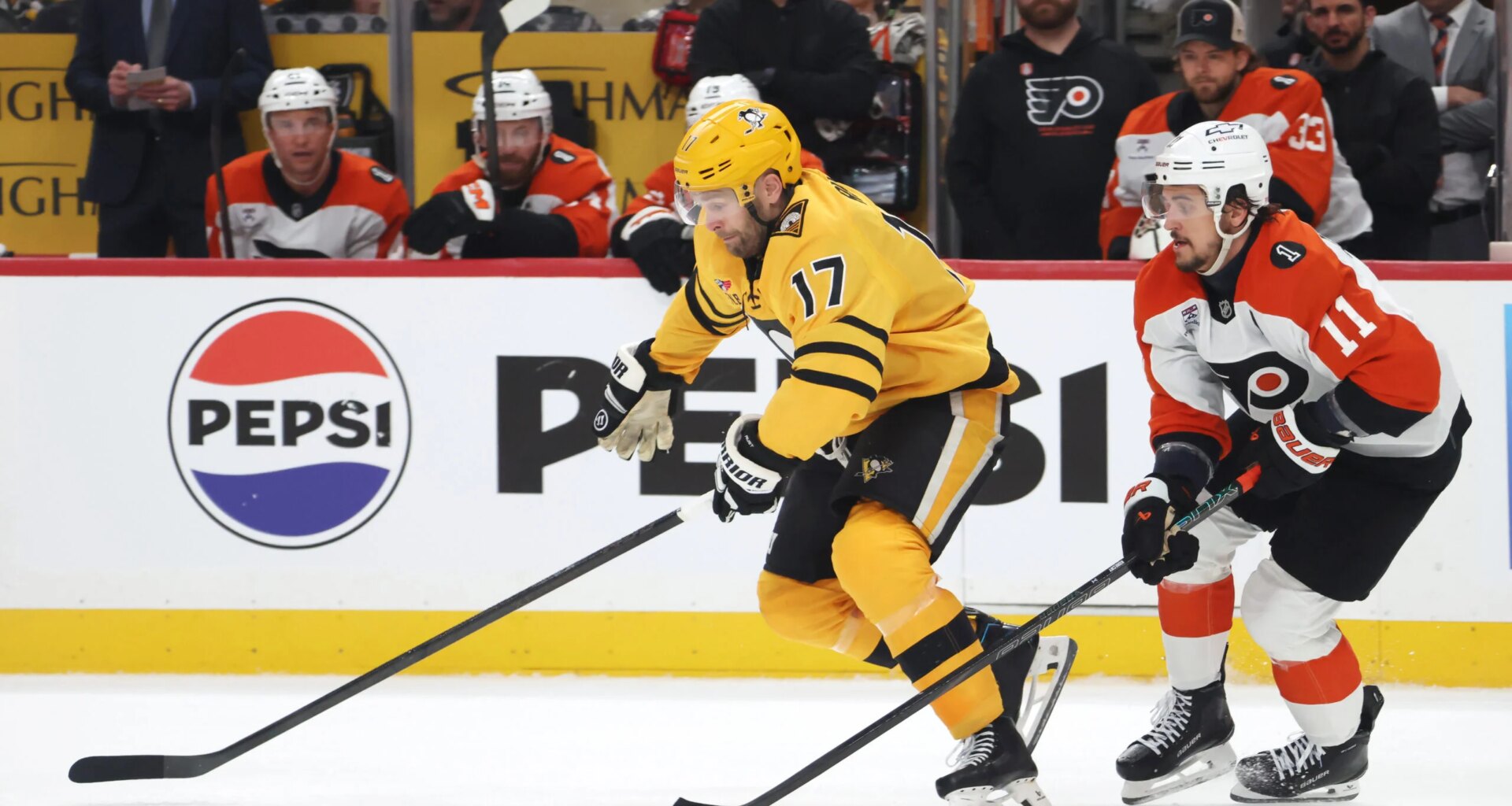
The late start pushed the Pittsburgh Penguins vs. Philadelphia Flyers Game 1 start back to nearly 8:30 p.m. for the sake of the television broadcast, and while the Pittsburgh fans brought their best, the Penguins showed up for their big return to center stage unprepared for what was to follow.
That is not a slight on Penguins coach Dan Muse, but a direct knock on the Penguins team that dealt with their stymied rush game by trying more … and more of the same in a 3-2 loss to the Flyers at PPG Paints Arena, and a 1-0 series deficit.
The Penguins’ veteran players admitted they were stubborn. It must work. Try again. The same vets also admitted the Penguins did not adjust their thinking despite knowing what the Flyers would do. And Erik Karlsson and Evgeni Malkin used different words but admitted the Penguins were the team that took longer to settle down and deal with the emotion and pressure of Game 1.
In short, if it could go wrong for the Penguins in Game 1, it did. Even Sidney Crosby who has earned a large parcel of mental space rent free within the Flyers’ universe after 21 years of domination, was largely held in check by the Flyers’ suffocating neutral zone structure.
Yet the Penguins kept trying to skate through the congealed mass of Flyers defenders, who took away space and the runway to race ahead on a rush game. Oh, but the Penguins tried and tried again, absolutely to the Flyers’ benefit.
When PHN asked defensemen Kris Letang and Karlsson, neither they nor others in the dressing room argued.
“You know, we didn’t really set out to do what we really needed to do on our game plan,” Karlsson said. “We turned too many pucks over in the wrong spot and we made it hard on ourselves. It was a hard game for us out there, and we only have ourselves to blame.”
“I think we have to simplify a little bit, with our speed and with our forecheck game, that’s going to help us,” Letang said. “I think we tried to go through the neutral zone with control, trying to get through the line with control. Especially in the second period, we kind of got away from our game of putting it deep, trying to grind them down low.”
“We should play our game. We lost a little control in the second period, and we started fighting. This is what they want,” said Malkin. “We know it’s a tight, physical game, but we need to play better. Our blue line, we should control the puck (more), play deeper, and focus more behind the net. We gave them so many chances.”
No, the great surprises of Game 1 did not include Sidney Crosby’s meager stat line, three shots, three hits, and one giveaway with a minus-1 rating but rating how it came to be.
In fact, the great surprise of Game 1 was how most of the Penguins’ came to produce rather weak statistical lines. Few of the Penguins’ best players delivered best performances, but instead were literary and figuratively ensnared in a hockey trap, assuming they would eventually overcome the obstacle.
Rickard Rakell was the exception to the rule, as was the Penguins’ fourth line with the returning Blake Lizotte and Connor Dewar.
The Flyers were at their best in Game 1, and the Penguins were at their worst. Perhaps that is why the Penguins’ room was anything but dejected. No, many of the players took a positive tone despite how they played the game and the result.
The fixes are quite easy. Sometimes, it does not take a chalkboard rewrite or team reinvention, but merely doing the very things the team knew they should have done the first time.
“We’re already excited for Game 2,” said Karlsson with some air of believability.
2. Reverts
After Letang and Sam Girard jelled as a defense pairing over the final weeks of the regular season, they were astonishingly bad in Game 1. The mistakes landed on Girard’s doorstep as he tried to whirl around forecheckers and thread passes through crowds of Flyers.
Connor Clifton stepped forward and left position to make a few hits, but exposed his goaltender in the process by not making the defensive stop. Parker Wotherspoon also let Flyers forwards behind him with speed.
“They flip a lot of pucks, and they have really fast forwards. So they try to create turnovers on the forecheck like that, when a D has his back turned to the play,” Letang said. “I think it’s us and (us being) able to sustain a forecheck and the attack down low.”
It was a game in which the Penguins’ unheralded defensemen, who have been steady and reliable rearguards, embodied the worst fears of their game.
3. Stuart Skinner
Not all surprises were bad. Penguins goalie Stuart Skinner was well above board. He kept the Penguins in the game despite their proclivity to yield odd-man rushes and their turnovers springing the Flyers on breakaways.
It is not much of a surprise that Skinner elevated his game, but a healthy sign nonetheless.
Skinner earned a solid A in the PHN postgame report card, but for the persistent criticism and wonderment if the Penguins goalies could perform to an adequate level, Skinner’s playoff performance was a good sign for the Penguins that if the skaters can figure out their game and the Flyers defensive posture, they will have a capable goalie.
Tags: erik karlsson Penguins Analysis Philadelphia flyers Pittsburgh Penguins stuart skinner
Categorized:PHN Blog