
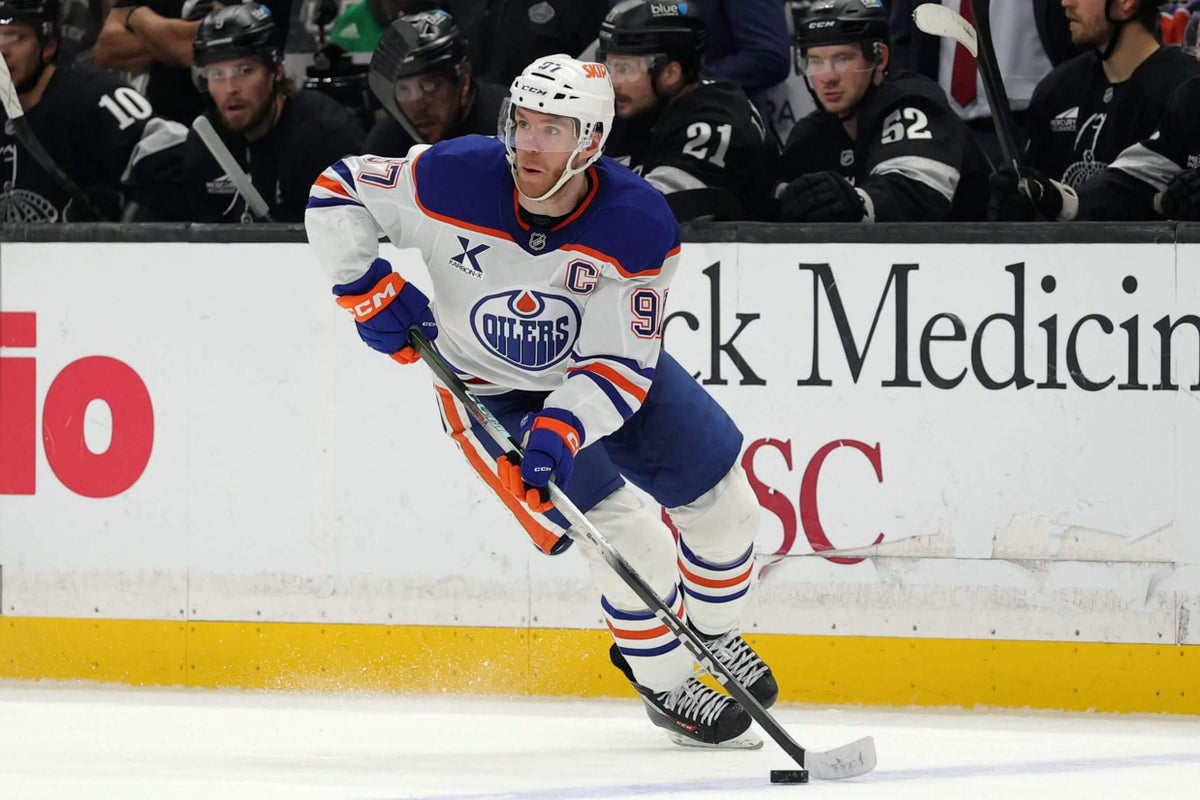
EDMONTON — Connor McDavid meant it as a compliment.
The best hockey player on earth, speaking the day before his team was scheduled to start what it hopes to be a third consecutive two-month odyssey to the bitter end of the Stanley Cup playoffs, was asked how the 2025-26 iteration of the Edmonton Oilers compares with the past few.
“I’ve felt good about each and every group we go in with, honestly,” McDavid said, “and this group is no different.”
It was the savvy answer. It was the diplomatic answer. It might have even been the correct answer.
And that last bit is the one that should terrify Edmonton Oilers fans. All parties involved need to hope that something has changed, even after six months of largely uninspired hockey that screamed otherwise. The Oilers finished in second place in the drab Pacific Division, good enough for home ice in the first round against the Anaheim Ducks. McDavid on Sunday called his team’s regular season “monotonous,” and boy, was he right.
Despite that, he is, as ever, a singularly unparalleled force in modern hockey, one who finished the season on a post-Olympic, 1.8 point-per-game scoring bender that propelled his team out of danger, nearly propelled him to another Art Ross Trophy and should propel him to a fourth Hart Trophy.
He’s also the same guy who, in October, signed a two-year, $25 million, dual-purpose contract extension. Was it a ludicrously team-friendly move by the player, designed to give general manager Stan Bowman more space to operate? Yes. Was it McDavid telling Bowman, in effect, that he was on the clock? Also, yes.
That’s what the Oilers’ still-in-the-gates 2026 postseason is about, and why there’s a certain sense of dread hanging over the proceedings. They can either close the deal after two straight years of agonizing failure, or they can somehow fall short in a way that doesn’t suggest a team stuck on a treadmill as the stopwatch ticks. The degree of difficulty on both might be equally high.
It shouldn’t be. For more than a decade, across multiple front offices, the Oilers have relied on a pair of all-time greats to an irresponsible, unfair, unnecessary degree. McDavid and Leon Draisaitl dragged them to the doorstep of the Cup in 2024 against the Florida Panthers, then came nearly as close in last spring’s rematch.
The summer, in turn, brought nothing of consequence, as Bowman leaned even further into a forward group whose value was dangerously concentrated at the top. McDavid and Draisaitl are elite. Zach Hyman and Ryan Nugent-Hopkins are quality support. Beyond them, best case was a group of question marks and lottery tickets. Even with Nugent-Hopkins, Edmonton’s middle-six forwards entered 2025-26 with a combined Net Rating of minus-12. The rest of The Athletic’s top five teams in projected points all averaged a plus-5.
Wholly unaddressed were the team’s goaltending problems. Stuart Skinner had followed a below-average regular season by getting pulled in Game 5 of the Cup Final last year, and Calvin Pickard was a career backup.
By March 13, Andrew Mangiapane, Bowman’s best attempt at adding a depth forward, had played his way onto the waiver wire, and Tristan Jarry — acquired from Pittsburgh in December for Skinner, a second-round pick and defenseman Brett Kulak — had taken the goaltending from bad to terrifying.
“They’ve been to the Cup (Final) twice because of three or four guys. If you had given them any kind of depth on the forwards or if their goalie wasn’t Stuart Skinner, they’re probably two-time Stanley Cup champions. So what do they do? They go out and get a goalie who might not be as good as Skinner,” an executive told The Athletic before the playoffs, in a contender-ranking exercise that put Edmonton between the Buffalo Sabres and Montreal Canadiens. “It’s astounding to me that they haven’t fixed any of the holes.”
Edmonton had started to buckle under that weight, losing four straight going into the Olympic break and five of nine coming out of it. From there, things seemed to devolve. Draisaitl’s regular season ended in a March 15 win over the Nashville Predators. After a 5-2 loss to the Tampa Bay Lightning on March 22, McDavid correctly noted that poor play across the Pacific Division was the main thing keeping the Oilers afloat.
“We’re fortunate to play in this division,” McDavid said. “A lot of teams are fortunate to play in this division. It’s a bit of a pillow fight right now.”
Post-“pillow fight,” McDavid averaged two points per game (10 goals, 12 assists), and the Oilers went 7-2-2. In five of those wins, he had goals. In another, he had four assists. Relatively improved goaltending and defensive play count for something; McDavid counts for a whole lot more.
“Five or six weeks ago, it was a little bit dire, obviously, with some health questions and fighting for a playoff spot,” McDavid said on Sunday. “We’ve earned the opportunity to be in this position. Pacific Division or not, we’re here.”
Indeed they are — and their situation, given how things looked a month ago, couldn’t realistically be much better.
Draisaitl’s return from a lower-body injury is imminent, as is that of Jason Dickinson, a defensively impactful third-line center added at the deadline by Bowman to play behind his two Hall of Famers. Matt Savoie, a skillsy winger drafted at No. 9 by Buffalo in 2022, has popped on McDavid’s line, and Hyman seems ready to roll as well. The defensive group, led by 95-point stud Evan Bouchard, goes three pairs deep. Connor Ingram took control of the goaltending job by default and has acquitted himself well, playing in 22 of Edmonton’s last 27 games and, after the Olympic break, putting up a .901 save percentage.
If the Oilers find themselves in a better spot in June (and that, of course, would only mean one thing), you can imagine the path they’d take. There’s secondary scoring, if you squint hard enough, and a forward group that, overall, looks better than the one the Oilers took into the 2025 first round against the Los Angeles Kings.
“About five minutes before I got out here, we were actually looking at our Game 1 lineup (from 2025),” coach Kris Knoblauch said on Sunday. “We were (saying), “Wow. What was going on? What were we thinking?’” He views the current group as one with more proven commodities, and it’s tough to disagree. It’s also tough not to grade on a curve.
Just as clear, too, is a second, uglier route, one that ends with a Cup-less McDavid entering a de facto walk year on a roster weak in predictable spots and doomed for the same, stale reasons. On March 9, The Athletic’s Pierre LeBrun wrote that while “the feeling is (McDavid) will give the Oilers one more season next year in this contention window,” he also couldn’t discount how McDavid would feel about a postseason flame-out.
Edmonton’s first step toward avoiding its nightmare scenario can come on Monday against the Ducks. The road to real change, and a happy ending, is a whole lot longer.