
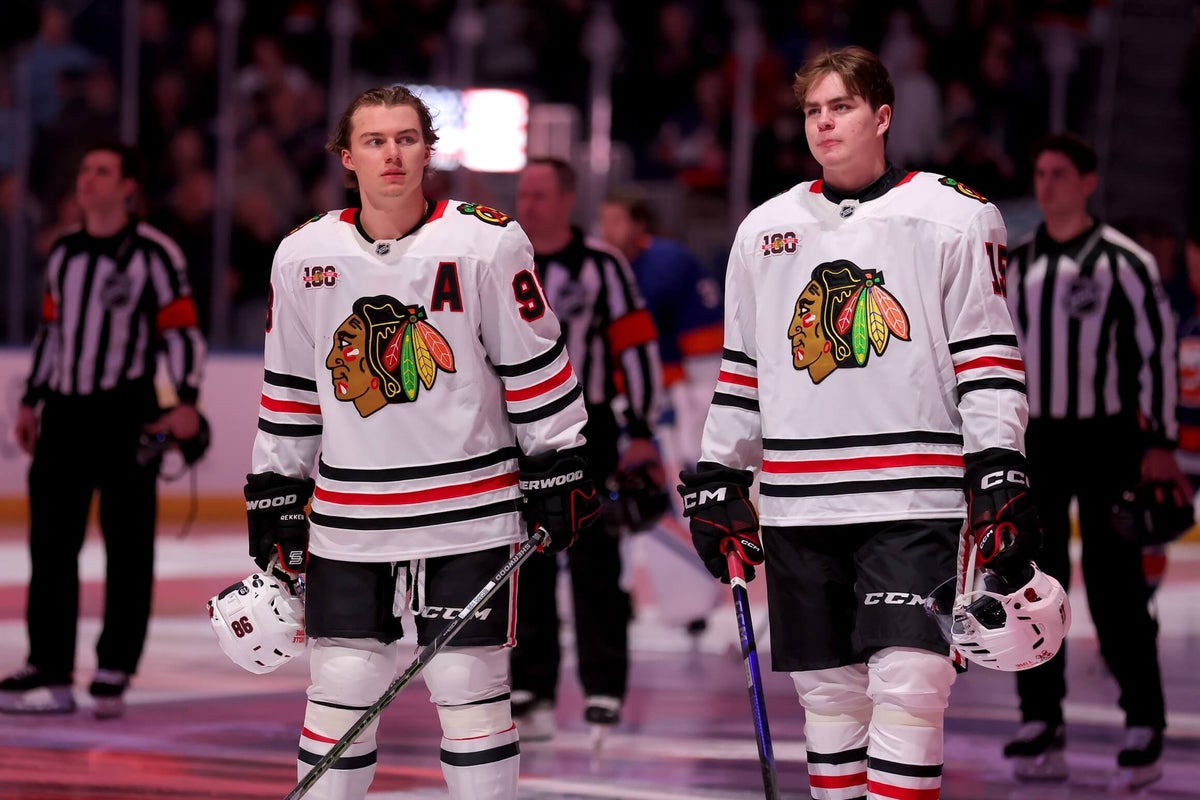
If all goes according to Kyle Davidson’s plan — a big if, of course, in the perilous world of the long-term rebuild — the 2025-26 season will be remembered as the one in which the next generation of Chicago Blackhawks got the keys to the bus. Out went Jason Dickinson and Nick Foligno. In came Ryan Greene, Oliver Moore, Nick Lardis, and eventually Anton Frondell and Sacha Boisvert.
There’s undeniable talent among the Blackhawks forward group, but there’s still a long way to go to realize it all. It’s still mostly potential, not production. Chicago was the second-lowest-scoring team in the league, behind only the Calgary Flames. And barring a dramatic move by Davidson this summer, it’ll fall on those teens and 20-somethings (and perhaps whoever the Blackhawks draft in June with a top-four pick) to provide the bulk of the scoring.
Who stepped up this season, and who’ll step up next season? Let’s take a look at how the forwards fared.
Connor Bedard: Never mind another top-four pick, never mind Anton Frondell’s impressive start, never mind Louis Crevier’s emergence as an NHL defenseman. The single most important development of the 2025-26 Blackhawks season, by a country mile, is Connor Bedard’s leap into megastardom. A shoulder injury robbed him of a chance at the kind of season Macklin Celebrini had, but at the time of his injury, Bedard and Celebrini had nearly identical stats and were tied at 44 points through 31 games, trailing only the NHL’s Big Three of Nathan MacKinnon, Connor McDavid and Nikita Kucherov.
Bedard also showed a newfound aggression at both ends of the ice, creating his own space and his own shot with an uptick in footspeed, and engaging much more seriously on the defensive end. Even with a dip in production at the end of the season, he still finished with 30 goals and 75 points in 68 games. That he had such a remarkable campaign while playing predominantly with rookie Ryan Greene and journeyman André Burakovsky (who flatlined the entire second half of the season) is a testament to just how good Bedard is, and just how good he can be.
The question now: will Kyle Davidson go out and get Bedard a winger worthy of him?
Grade: A
Tyler Bertuzzi: His finishing ability around the net has never been in question. His consistency has. But this season, possibly the best of his career, Bertuzzi brought it almost every night. The nights off and halfhearted efforts that marked his first season in Chicago were few and far between. Bertuzzi was fully engaged on the forecheck and a menace around the net, posting a career-high 32 goals and 58 points. Jeff Blashill is a big Bertuzzi guy, dating to his Detroit days, and the veteran validated his coach’s belief in him. While it’s fair to question the future of several other Blackhawks veterans, Bertuzzi — now an alternate captain — could be a fixture in the top six for the foreseeable future, so long as his streakiness doesn’t creep back into his game.
Grade: A-minus
Sacha Boisvert: Came to Chicago with much less hype than Frondell and much more skepticism. Things ended poorly for Boisvert at Boston College, and at just 20, he clearly needed some time in Rockford to get him NHL-ready. But he acquitted himself fairly well in a mostly fourth-line role, posting a goal and an assist in seven games. There’s skill there, for sure, but the 2024 first-rounder is still pretty raw, and is unlikely to break camp with the Blackhawks in the fall.
Grade: Incomplete
André Burakovsky: His arrival in Chicago as a ready-made winger for Bedard was met with skepticism, but the veteran quickly made Davidson look awfully smart. Through Jan. 7, Burakovsky had a very healthy 10 goals and 19 assists through 38 games, and helped Bedard take that leap into stardom. Then the bottom fell out. Over the last 37 games of the season, Burakovsky had just one goal and three assists. Even though he played with Bedard for most of that time, Blashill stubbornly refused to demote him until well into March. Four points in 37 games: that’s fewer than defensive defenseman Connor Murphy had in 17 games before being traded.
It was a nightmarish second half for Burakovsky, and raises the possibility of the Blackhawks buying out the last year of his contract, or simply burying him in Rockford next season. It’s one thing to block a young player’s path for someone productive and useful, such as Bertuzzi or Ryan Donato. Quite another for a veteran who was producing at such a spectacularly poor level for such a prolonged stretch.
Grade: D
Ryan Donato: It was always a long shot that Donato could replicate the 31-goal season that earned him a four-year, $16 million contract with the Blackhawks. But it became all but impossible once it became clear that Blashill didn’t see him on Bedard’s wing, or in the top six at all. Donato spent nearly the entire season in the bottom six, and did what he could with the limited role. Fifteen goals and 15 assists for a bottom-sixer is solid production, even if it’s not quite a $4 million value. Donato’s leadership and tenacity — he’s one of the Blackhawks’ more frequent skirmishers — add to his value, too. He’s a fine depth player, and a good voice in the room.
Grade: C-plus
Anton Frondell: The Blackhawks didn’t have the same uplifting finish to the season as a year ago, but that didn’t matter as much because Frondell was everything they hoped he’d be in his first NHL action. He played 12 games after finishing his season in Sweden and produced nine points, including three goals. Although he was close to scoring several times on the power play, all of his production came at five-on-five. He also switched from wing to center after not playing much center this season and held his own. He made some mistakes, some that cost him in his goal, but his attention to defensive detail and strength give the Blackhawks hope for the future at that position.
Grade: B-plus
Ryan Greene: Considering Greene wasn’t going to make the team out of camp and was headed to Rockford before a teammate’s injury altered his trajectory, he had an unexpected NHL season. He played in 81 of 82 games, scored 12 goals, produced 29 points and spent a lot of time this season on the top line with Bedard. He was third among the team’s forwards in shorthanded ice time and took the second-most faceoffs.
He’s another player where it’s unclear whether the Blackhawks want him at center or wing. His versatility and IQ are two of his strengths, and he showed this season he can play in key situations and make plays. His finishing ability will be something he looks to improve on. He was fifth on the team in individual scoring chances and high-danger chances. His five-on-five defensive metrics need improvement too, but that was largely the case across the board for the team this season.
Grade: B
Sam Lafferty: He was probably hopeful he’d have a large role on this season’s team after being acquired again by the Blackhawks, but he mostly became their 13th forward and appeared in 29 games. One of those came as a defenseman. Despite Lafferty’s limited opportunity, Blashill and Lafferty’s teammates raved about him and how well he accepted his role.
Grade: C
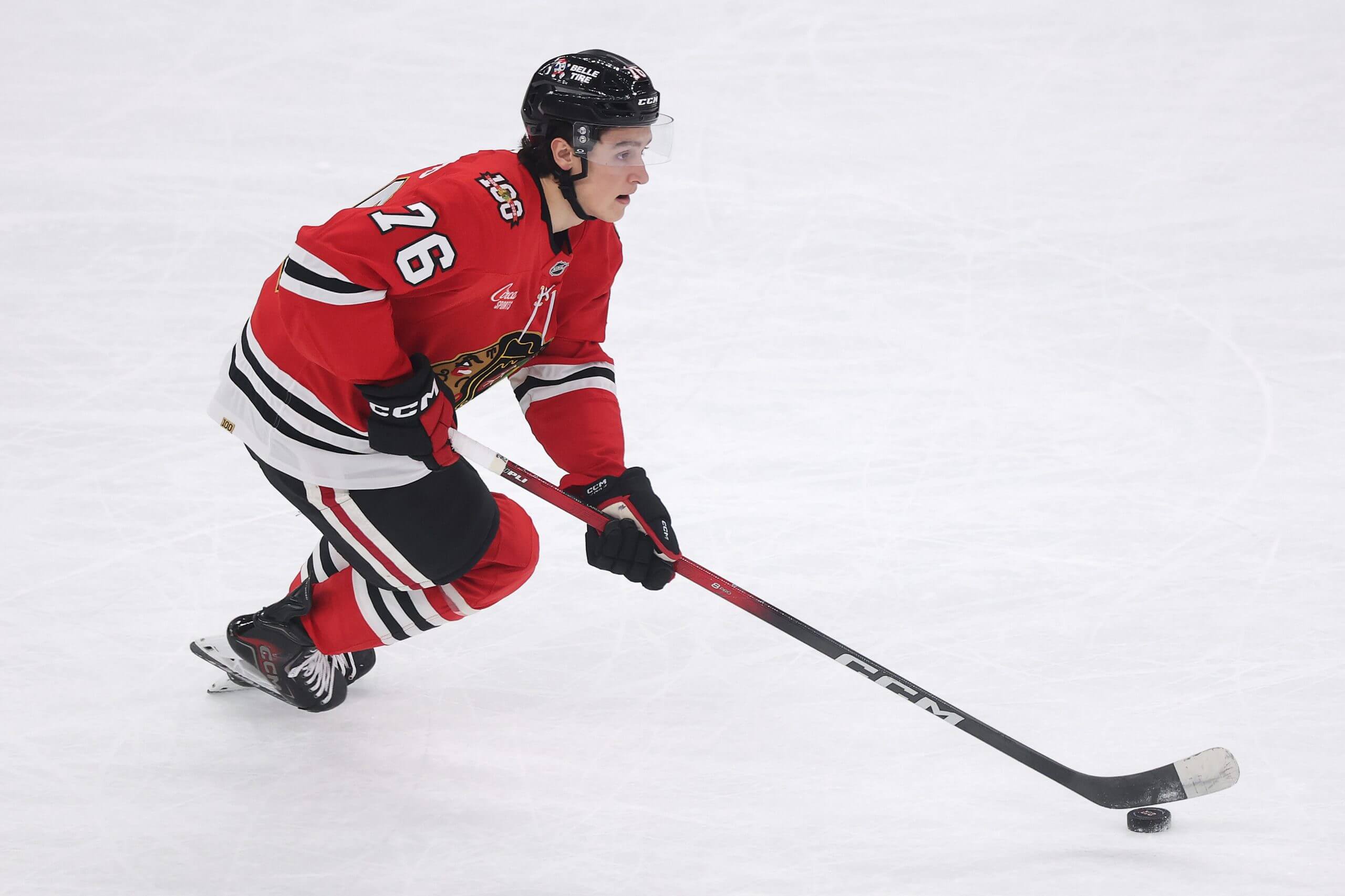
Nick Lardis scored 10 goals in the NHL this season. (Michael Reaves / Getty Images)
Nick Lardis: Lardis scored 28 goals in his first pro season, 18 in the AHL and 10 in the NHL. Obviously, those numbers aren’t often combined, but his production in both places is part of his development and proof that what he did in junior can translate to a higher level. He was on a 20-goal pace in the NHL as a 20-year-old. Also important to his season was proving to Blashill he could earn his keep elsewhere in the lineup and deserved to be in a top-six role. His analytics were slightly better with Nazar than Bedard, but neither sample size was massive. He and Oliver Moore developed chemistry starting in Rockford.
Grade: B
Andrew Mangiapane: The Blackhawks were hoping to learn more about Mangiapane’s game after acquiring him at the trade deadline, but an injury limited him to 10 games. He was fine in those games: not great, not terrible. He played mostly in a bottom-six role and had a goal and an assist. He was on the ice for four goals for and six against. It’s unclear where he fits next season, if he’s still in the organization. He could make the team next season, could be bought out or placed on waivers to potentially be assigned to Rockford.
Grade: C
Ilya Mikheyev: Last season, Mikheyev was the Blackhawks’ most all-around player. He didn’t reach those heights this season, but he was still useful. He’s one of the league’s best penalty killers. He bounced around the lineup in various roles. Late in the season, he played on Frondell’s wing and they showed promise together. Seven of Mikheyev’s 18 goals also came after the trade deadline, after scoring just six in his first 35 games. He is scheduled to be an unrestricted free agent come July. The Blackhawks would still like to re-sign him. We’ll see what happens.
Grade: B
Oliver Moore: He graduated from Rockford early in the season and took steps throughout the year. Where exactly he fits among the rest of the forwards is still up in the air, but he showed he can play at the NHL level, especially with his speed. His game did fare better while playing center, but the Blackhawks are crowded there. If he can unlock more offense, like he did early in Rockford, he might be able to play on anyone’s wing. If not, his speed and forechecking could be ideal to center the fourth line. He finished with five goals and 14 assists in 51 NHL games this season. His defensive metrics were impressive this season. In Evolving Hockey’s model, he was second to only Murphy in even-strength defense on the Blackhawks.
Grade: B
Frank Nazar: He had stretches early and late in the season where he was the Blackhawks’ top offensive player. Nazar came out of the gate faster than Bedard, but a lower-body injury in November followed by a broken jaw in December derailed his season. He did get back on track around the trade deadline and produced a team-best eight goals over the final 21 games.
If the Blackhawks can get him playing consistently like that, he should be close to 30 goals and 60-plus points. With Frondell moving to center, Nazar was also bumped to the third line, but it didn’t affect his ice time or opportunity. His new contract will take effect next season, and the Blackhawks will be hopeful he takes that next step as a key player for them.
Grade: B
Landon Slaggert: Used mostly in a bottom-six role this season. Defensively, he holds his own, but his offensive production hasn’t been much in the NHL so far. He had four goals and three assists in 53 games this season. If that doesn’t change, he’ll have to be really good defensively to earn a spot in the lineup. He was mostly able to do that this season: the Blackhawks were only outscored 15-13 with him on the ice despite having a 40.44 offensive zone faceoff starting percentage. Bertuzzi and Mikheyev were the only players to have a higher goals for percentage. He was also given more penalty kill minutes after the trade deadline.
Grade: C
Teuvo Teräväinen: This was arguably Teräväinen’s worst NHL season ever. He produced 35 points, which was the same amount of points he had as a rookie. He had just 21 assists after having 43 last season. His 40.88 expected goals percentage and 35.29 goals for percentage were the lowest of his career. The Blackhawks were outscored 44-24 with him on the ice at five-on-five. He was on the fourth line by the end of the season. The Blackhawks have to wonder if it’s a sign of things to come or if he was just worn down by the Olympics and the condensed schedule.
Grade: D-plus